
Adunay daghang klase sa pisikal nga sistema, namely aduna kami:
Mechanical systems
Electrical systems
Electronic systems
Thermal systems
Hydraulic systems
Chemical systems
Unang matod, kita kailangan maabot ang pagkamahimo niining mga sistema, asa man nindot? Ang mathematical modeling sa control system mao ang proseso sa pagbuhat og block diagrams alang niining klase sa mga sistema aron mahatagan sila og performance ug transfer functions.
Karon, huna-hunaan nato ang mechanical ug electrical type sa mga sistema sa detalye. Hatagan nato og analogies ang mechanical ug electrical system lang nga importante sa pagkat-on sa theory sa control system.
Adunay duha ka tipo sa mechanical systems. Ang mechanical system mahimong linear mechanical system o mahimong rotational mechanical type sa sistema.
Sa linear mechanical type sa mga sistema, adunay tulo ka variables:
Force, representado ngadto sa ‘F’
Velocity, representado ngadto sa ‘V’
Linear displacement, representado ngadto sa ‘X’
Ug usab adunay tulo ka parameters:
Mass, representado ngadto sa ‘M’
The coefficient of viscous friction, representado ngadto sa ‘B’
The spring constant, representado ngadto sa ‘K’
Sa rotational mechanical type sa mga sistema adunay tulo ka variables:
Torque, representado ngadto sa ‘T’
Angular velocity, representado ngadto sa ‘ω’
Angular displacement, representado ngadto sa ‘θ’
Ug usab adunay duha ka parameters :
Moment of inertia, representado ngadto sa ‘J’
The coefficient of viscous friction, representado ngadto sa ‘B’
Karon, hatagan nato ang linear displacement mechanical system nga isipensya sa ubos-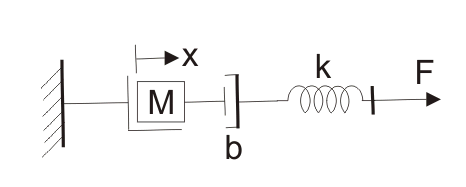
Gisulat na nato ang iba't ibang variables sa diagram mismo. Adunay x nga displacement sama sa gihatag sa diagram. Gikan sa Newton’s second law of motion, makapagbutang mi og force ingani-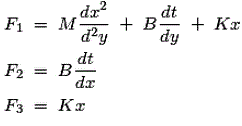
Gikan sa diagram sa ubos makita nato nga:
Pagsubstitute sa mga values sa F1, F2 ug F3 sa equation ug pagkuha sa Laplace transform, adunay transfer function ingani,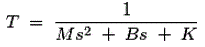
Ingani ang equation mathematical modelling sa mechanical control system.
Sa electrical type sa sistema adunay tulo ka variables –
Voltage nga representado ngadto sa ‘V’.
Current nga representado ngadto sa ‘I’.
Charge nga representado ngadto sa ‘Q’.
Ug usab adunay tulo ka parameters nga active ug passive components:
Resistance nga representado ngadto sa ‘R’.
Capacitance nga representado ngadto sa ‘C’.
Inductance nga representado ngadto sa ‘L’.
Karon, handa nami sa pagkuha sa analogy sa electrical ug mechanical types sa mga sistema. Adunay duha ka klase sa analogies ug sila mao ang gisulat sa ubos:
Force Voltage Analogy : Aron masabtan kini nga tipo sa analogy, hatagan nato og circuit nga adunay series combination sa resistor, inductor ug capacitor.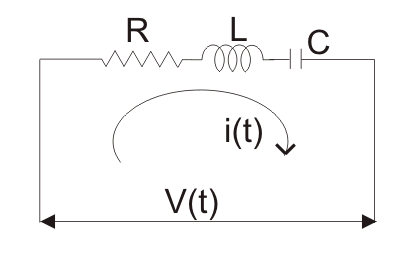
Adunay voltage V nga gigamit sa series sa mga elements sama sa gihatag sa circuit diagram. Karon, gikan sa circuit diagram ug sa tabang sa KVL equation, makapagbutang mi og expression sa voltage ingani sa terms sa charge, resistance, capacitor ug inductor,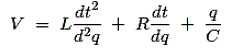
Karon, pagcompare nato ang uban sa natukod para sa mechanical system, makita nato nga-
Mass (M) analogous sa inductance (L).
Force analogous sa voltage V.
Displacement (x) analogous sa charge (Q).
Coefficient of friction (B) analogous sa resistance R ug
Spring constant analogous sa inverse sa capacitor (C).
Ingani ang analogy nga gitawag og force voltage analogy.
Force Current Analogy : Aron masabtan kini nga tipo sa analogy, hatagan nato og circuit nga adunay parallel combination sa resistor, inductor ug capacitor.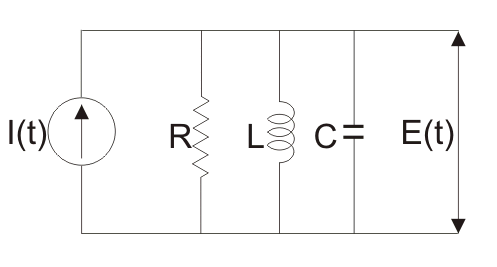
Adunay voltage E nga gigamit sa parallel sa mga elements sama sa gihatag sa circuit diagram. Karon, gikan sa circuit diagram ug sa tabang sa KCL equation, makapagbutang mi og expression sa current ingani sa terms sa flux, resistance, capacitor ug inductor,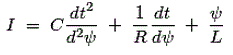
Karon, pagcompare nato ang uban sa natukod para sa mechanical system, makita nato nga,