• Product
  • Suppliers
  • Manufacturers
  • Solutions
  • Free tools
  • Knowledges
  • Experts
  • Communities
Search


Theory of Wind Turbine and Betz Coefficient

Electrical4u
Electrical4u
Field: Basic Electrical
0
China

WechatIMG1820.jpeg

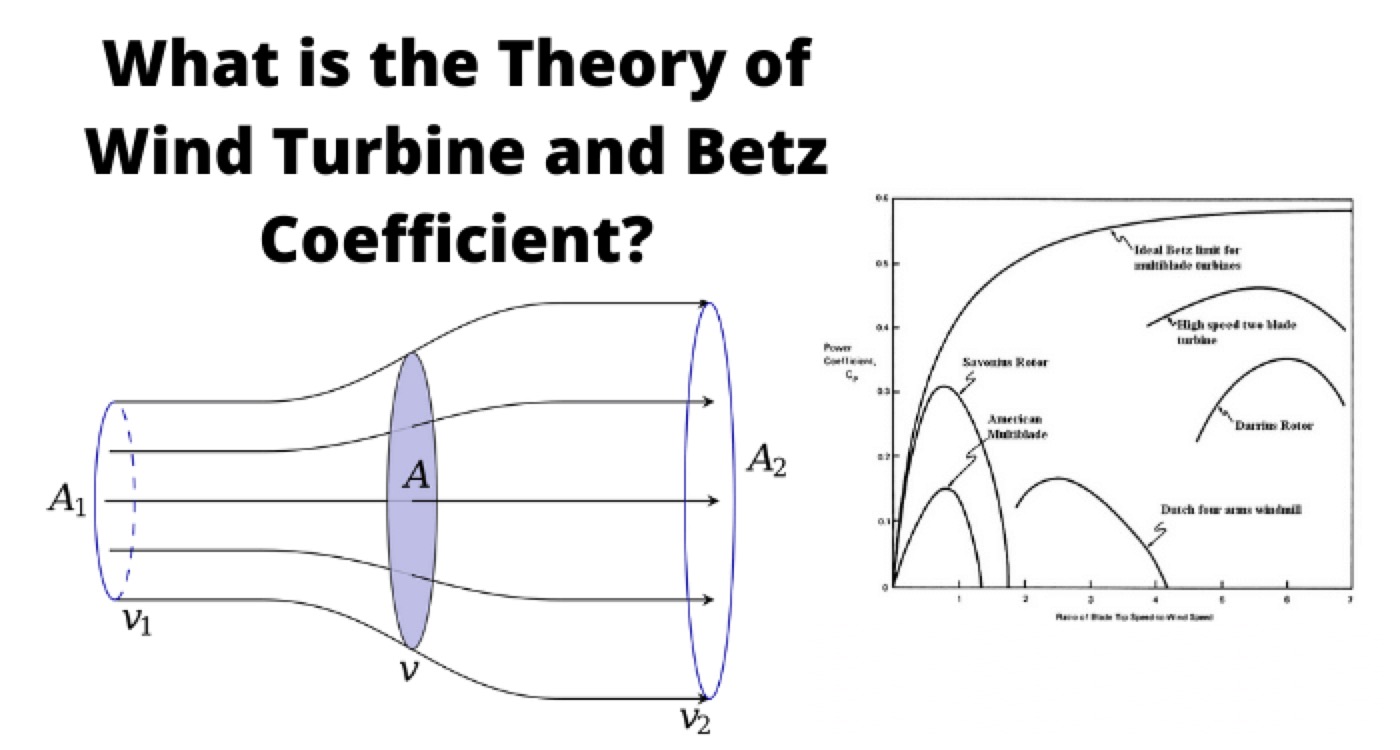
For determining power extracted from wind by wind turbine we have to assume an air duct as shown in the figure. It is also assumed that the velocity of the wind at the inlet of the duct is V1 and velocity of air at the outlet of the duct is V2. Say, mass m of the air is passed through this imaginary duct per second.
Now due to this mass the kinetic energy of wind at the inlet of the duct is,

Similarly, due to this mass the kinetic energy of wind at the outlet of the duct is,

wind energy theory
Hence, the kinetic energy of wind changed, during the flow of this quantity of air from the inlet to the outlet of the imaginary duct is,

As we already said that, mass m of the air is passed through this imaginary duct in one second. Hence the power extracted from the wind is the same as the kinetic energy changed during the flow of mass m of the air from the inlet to the outlet of the duct.

We define power as the change of energy per second. Hence, this extracted power can be written as,

As mass m of the air passes in one second, we refer the quantity m as the mass flow rate of the wind. If we think of that carefully, we can easily understand that mass flow rate will be the same at the inlet, at the outlet and as well as at every cross-section of the air duct. Since, whatever quantity of air is entering the duct, the same is coming out from the outlet.
If Va, A and ρ are the velocity of the air, the cross-sectional area of the duct and density of air at the turbine blades respectively, then the mass flow rate of the wind can be represented as

Now, replacing m by ρVaA in equation (1), we get,

Now, as the turbine is assumed to be placed at the middle of the duct, the wind velocity at turbine blades can be considered as average velocity of inlet and outlet velocities.

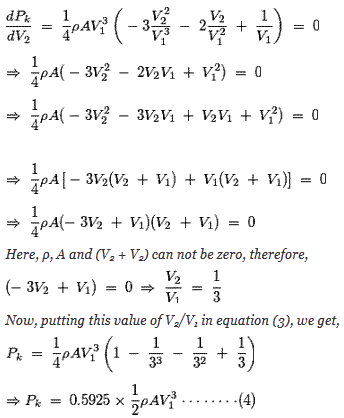
To obtain maximum power from wind, we have to differentiate equation (3) in respect of V2 and equate it to zero. That is,
Betz Coefficient

From, the above equation it is found that the theoretical maximum power extracted from the wind is in the fraction of 0.5925 of its total kinetic power. This fraction is known as the Betz Coefficient. This calculated power is according to theory of wind turbine but actual mechanical power received by the generator is lesser than that and it is due to losses for friction rotor bearing and inefficiencies of aerodynamic design of the turbine.

From equation (4) it is clear that the extracted power is

  1. Directly proportional to air density ρ. As air density increases, the power of the turbine increases.

  2. Directly proportional to the swept area of the turbine blades. If the length of the blade increases, the radius of the swept area increases accordingly, so turbine power increases.

  3. Turbine power also varies with velocity3 of the wind. That indicates if the velocity of wind doubles and the turbine power will increase to eight folds.

wind power generation

Statement: Respect the original, good articles worth sharing, if there is infringement please contact delete.
Give a tip and encourage the author!
Recommended
Three-Phase SPD: Types, Wiring & Maintenance Guide
1. What Is a Three-Phase Power Surge Protective Device (SPD)?A three-phase power surge protective device (SPD), also known as a three-phase lightning arrester, is specifically designed for three-phase AC power systems. Its primary function is to limit transient overvoltages caused by lightning strikes or switching operations in the power grid, thereby protecting downstream electrical equipment from damage. The SPD operates based on energy absorption and dissipation: when an overvoltage event occ
James
12/02/2025
Railway 10kV Power Through Lines: Design & Operation Requirements
The Daquan Line has a large power load, with numerous and scattered load points along the section. Each load point has a small capacity, with an average of one load point every 2-3 km, so two 10 kV power through lines should be adopted for power supply. High-speed railways use two lines for power supply: primary through line and comprehensive through line. The power sources of the two through lines are taken from the dedicated bus sections fed by the voltage regulators installed in each power di
Edwiin
11/26/2025
Analysis of Causes of Power Line Loss and Loss Reduction Methods
In power grid construction, we should focus on actual conditions and establish a grid layout suitable for our own needs. We need to minimize power loss in the grid, save social resource investment, and comprehensively improve China's economic benefits. Relevant power supply and electricity departments should also set work goals centered on effectively reducing power loss, respond to energy conservation calls, and build green social and economic benefits for China.1.Current Status of China's Powe
Echo
11/26/2025
Neutral Grounding Methods for Conventional-Speed Railway Power Systems
Railway power systems primarily consist of automatic block signaling lines, through-feeder power lines, railway substations and distribution stations, and incoming power supply lines. They provide electricity to critical railway operations—including signaling, communications, rolling stock systems, station passenger handling, and maintenance facilities. As an integral part of the national power grid, railway power systems exhibit distinct characteristics of both electrical power engineering and
Echo
11/26/2025
Send inquiry
Download
Get the IEE Business Application
Use the IEE-Business app to find equipment, obtain solutions, connect with experts, and participate in industry collaboration anytime, anywhere—fully supporting the development of your power projects and business.