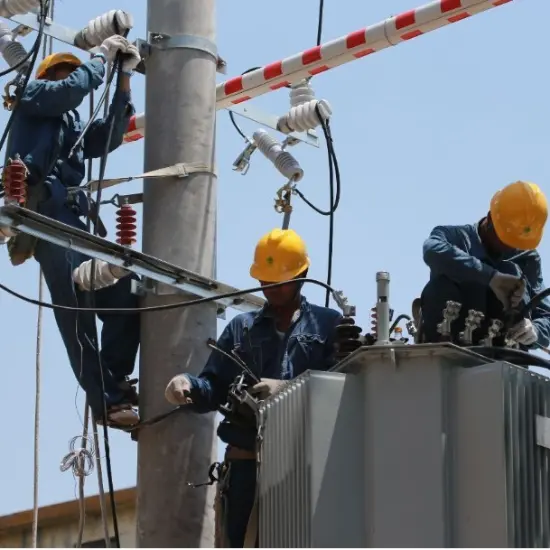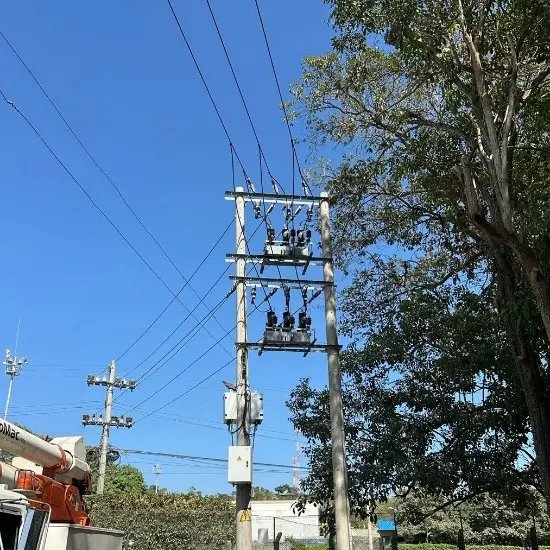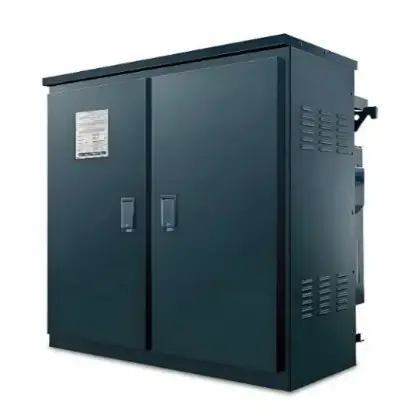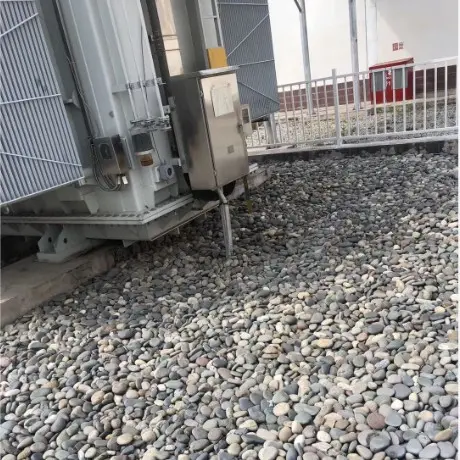
In power grid construction, we should focus on actual conditions and establish a grid layout suitable for our own needs. We need to minimize power loss in the grid, save social resource investment, and comprehensively improve China's economic benefits. Relevant power supply and electricity departments should also set work goals centered on effectively reducing power loss, respond to energy conservation calls, and build green social and economic benefits for China.
1.Current Status of China's Power Development
Nowadays, people's daily lives are inseparable from electricity supply. Electricity is the power source for modern facilities and the foundation of people's lives and production. However, at present, China has a high rate of electricity waste. For example, the dense wires above buildings, air conditioners running year-round in enterprises of all sizes, and high-power electrical appliances in factories all lead to excessive electricity consumption. Moreover, most of China's circuits operate under overload for long periods, which also causes excessive energy consumption. Therefore, power loss has become one of the urgent problems to be solved in China.
2.Causes of Power Loss
2.1 Power Loss Caused by Technical Reasons
2.1.1 Circuit Load Loss
In power equipment (including wires, distribution lines, voltage regulators, transformers, synchronous condensers, transmission lines, etc.), copper loss, circuit overload energy consumption changes, and losses in the current coil of watt-hour meters will all cause energy loss.
2.1.2 Mismatched Power Grid Equipment
Increased losses of grid equipment, uncoordinated compensation between peak and valley periods, and unreasonable compensation for low-voltage reactive power will lead to excessive energy consumption in the distribution network, three-phase overload in low-voltage grids, increased neutral current, and higher grid loss rates.
2.1.3 Excessive Loss of Power Equipment
During the overall operation of many power devices, live-line operations will cause power loss such as iron loss in transformers/voltage regulators and losses in insulators.
2.1.4 Transmission Line Loss
In many areas, problems such as line aging, non-standard conductor cross-sections, long-term load operation of lines, irregular transmission grid layouts, unreasonable line distribution, and circuitous power supply will cause excessive loss of operating lines and hinder economic benefit growth.
2.1.5 Power Loss from Electromagnetic Field Conversion
When power equipment connected to the grid operates, the voltage remains constant, and the power loss during operation is also fixed. A certain amount of electricity is consumed during magnetic field exchange, so electromagnetic conversion in electromagnetic fields will also lead to power loss.
2.2 Power Loss Caused by Management Reasons
2.2.1 Unreasonable Archive Management
Problems such as non-standard management of basic data, inconsistencies between drawing data and actual conditions, failure to update drawing data in a timely manner, and loss of archives will make it difficult to solve and manage problems after they occur.
2.2.2 Measurement Errors in Power Grids
In work, phenomena such as missed meter reading, missed recording, incorrect recording, and estimated recording by staff are serious, and supervision over meter reading, verification, and payment collection is inadequate. In addition, measurement errors caused by non-standard current transformers, or excessive voltage drop in power lines due to too small cross-sections of secondary lines, will all cause power loss.
2.2.3 Lack of Power Loss Calculation Methods
The absence of power loss calculation methods will lead to excessively high loss rates. After loss occurs, there is no effective way to analyze and identify the causes, and no correct improvements or management measures are taken after the causes are identified, which will also increase the loss rate of the distribution network.
3. Measures to Reduce Power Loss
3.1 Countermeasures for Technical Reasons
3.1.1 Reasonably Improve Transmission Efficiency of the Grid
Based on actual conditions, focus on grid configuration and distribution, determine a reasonable transformer operation combination, arrange appropriate operation modes and optimal load rates. In terms of grid safety, select safe, reliable, and economical grids based on the grid loss rate. For the operating voltage of the grid, pay attention to the impact of rated load, no-load, and overload operation on grid components, and maximize the balance between safety and reliability to achieve the optimal combination.
3.1.2 Minimize Transformer Power Loss
According to the operating conditions of substations, appropriately adjust the number of operating transformers or parallel transformers, change the system operation mode to maximize the reliability of power supply, or adjust the number of transformers according to the load to reduce transformer loss.
3.1.3 Reasonably Adjust Power Load According to User Electricity Usage Patterns
Adopt dual-circuit power supply, appropriately adjust the load of the transmission grid. Inconsistent current (or voltage) amplitudes in the power system, or amplitude differences exceeding the specified range, can easily increase excessive loss in phase and neutral lines while affecting the safe operation of user electricity. Planned arrangement of electricity usage time can improve the grid load rate and reduce power loss.
3.1.4 Reasonably Adjust Grid Layout
Based on Actual ConditionsIn practice, appropriately adjust grid operating parameters and load rates according to electricity demand, make grid distribution close to economic distribution, reduce excessive economic loss, and add reasonable configurations. This can effectively reduce active power and voltage loss, and greatly improve the transmission capacity of power lines.
3.2 Countermeasures for Management Reasons
3.2.1 Strengthen Theoretical Calculation of Power Loss
Through practical analysis of power loss theory, we can understand the composition of power loss and fluctuations in loss rates. Power loss theory is also the most basic theoretical material for power loss management, the theoretical basis for formulating measures to effectively reduce loss rates, and a measure of the quality of power loss management. Formulating management measures to reduce power loss technically can help promptly identify management problems and unreasonable grid layouts, and promote the development of power loss management work.
3.2.2 Strengthen Management by the Leadership
Due to various problems in the actual work of staff, a leadership responsibility system should be established. Leaders of various departments should personally oversee power loss management in business, dispatching, and measurement departments, strictly prevent and correct electricity quantity issues in a timely manner, strengthen analysis work in power loss management, and investigate illegal electricity use and theft. Strengthen personnel management at measurement points to prevent "favoritism-based electricity supply" and other situations, quickly and accurately feed back information to relevant departments to implement loss reduction measures promptly, and establish a fast and efficient management system.
3.2.3 Reasonably Construct and Transform Grid Layout
Based on current density, reasonably increase conductor cross-sections, transform circuitous lines to reduce excessive energy consumption caused by them, renovate old power lines, reasonably transform grid pressure, simplify power wiring, voltage levels, and substation levels, reduce substation capacity, and avoid repeated waste. This not only improves grid capacity but also achieves good loss reduction results.
4.Conclusion
Nowadays, society and daily life are inseparable from electricity. The electricity costs of various electricity-consuming units in China reduce their profits. To maximize the benefits of these units, excessive power consumption should be avoided as much as possible. This article discusses the causes and prevention measures of power loss, helping electricity-consuming units recognize the importance of these measures. Large-scale electricity is transmitted to various units through lines to ensure their normal operation. For these units, there is excessive consumption and waste in electricity use. The quality of the circuit itself is related to grid power consumption. Reducing power loss, minimizing the loss rate, using electricity reasonably, and avoiding waste can greatly increase the profits of China's electricity-consuming units.