Why Do Substations Use Stones, Gravel, Pebbles, and Crushed Rock?
In substations, equipment such as power and distribution transformers, transmission lines, voltage transformers, current transformers, and disconnect switches all require grounding. Beyond grounding, we will now explore in depth why gravel and crushed stone are commonly used in substations. Though they appear ordinary, these stones play a critical safety and functional role.
In substation grounding design—especially when multiple grounding methods are employed—crushed rock or gravel is laid across the yard for several key reasons.
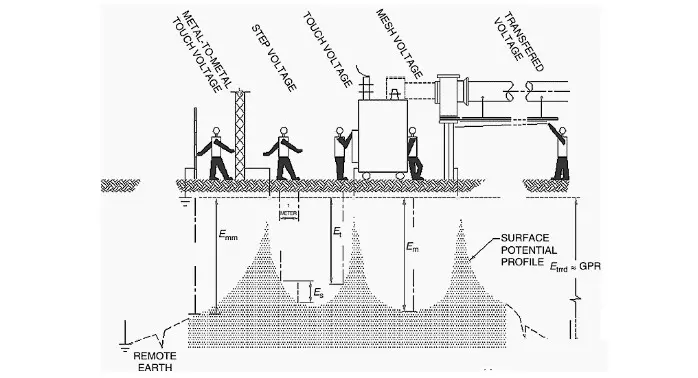
The primary purpose of spreading gravel in a substation yard is to reduce Ground Potential Rise (GPR), also known as step voltage and touch voltage, defined as follows:
Ground Potential Rise (GPR): The maximum electrical potential that a substation grounding grid may reach relative to a remote earth reference point assumed to be at true zero potential. GPR equals the product of the maximum fault current entering the grid and the grid’s resistance.
Step Voltage (Eₛ): The maximum potential difference that can exist between two feet (typically spaced 1 meter apart) when fault current flows into the grounding system. A special case is transferred voltage (Etransfer), where voltage appears between a grounded structure inside the substation and a remote point outside—often evaluated over a 1-meter distance from metal structures to ground surface points.
Touch Voltage (Eₜ): The maximum potential difference between a grounded metallic structure (e.g., equipment casing) and a point on the ground surface when a person touches it during a fault current flow.
During short-circuit events, both step and touch voltages increase significantly. Compared to common materials like soil, grass, or concrete, gravel and crushed stone have relatively high resistivity. This high surface resistivity limits current flow through the human body, thereby reducing the risk of electric shock during maintenance or operation near energized equipment.
Thus, gravel and crushed stone are intentionally used in substations to increase surface layer resistance, effectively mitigating hazardous step and touch voltages and enhancing personnel safety during ground faults.
The table below shows the resistivity of various materials such as stone, sand, etc.
| Materia | Resistivity (Ω·m) |
| Clay and saturated mud | <100 |
| Sandy clay and wet silt | 100–250 |
| Clayey sand and saturated sand | 250–500 |
| Sand | 500–1500 |
| Weathered rock | 1000–2000 |
| Crushed stone | 1500–5000 |
| Gravel | 1500–10000 |
Reasons for Using Stone in Substations and Electrical Switchyards
Below are the specific reasons and factors for using stone instead of other materials:
Grass and other weeds or small vegetation can indeed cause problems. During rain or humid conditions, plant growth can make the ground slippery, posing potential safety risks to personnel and equipment. Moreover, dry grass may ignite during switching operations or cause short circuits, adversely affecting equipment and grid reliability. Therefore, substations typically implement measures to control vegetation growth to ensure safe and stable operation.
Using stone around switchyards helps prevent wildlife—such as snakes, lizards, rodents, and other small animals—from entering the substation area.
A gravel surface prevents puddles and water accumulation in the switchyard, which is undesirable for high-voltage equipment.
Pebbles and crushed stone are more impact-resistant than grass or sand, helping to dampen vibrations from transformers (caused by core magnetostriction) and mitigate movement during seismic events.
The use of stone and gravel increases the surface layer’s resistivity, thereby reducing touch and step voltage hazards. Additionally, it suppresses the growth of small plants and weeds—which, if present, could lower surface resistivity and increase the risk of electric shock during routine maintenance and operations.
Overall, the stone material used in switchyards improves working conditions, supports stable operation, and enhances the effectiveness of the existing grounding system in protecting against electric shock.