Isipagkakatiwala sa pagkontrol nga presisyon sa mga proseso industriyal adunay dugang pagtaas, ang tradisyonal nga Teknolohiya sa Pulse-Width Modulation (PWM) dili na makapugos sa mga pangutana alang sa mataas nga dinamiko nga performance ug kaayo nga harmonics. Sa kabalaka, ang teknolohiya sa high-frequency PWM nagsuporta sa kalidad sa output waveform ug nagbawas sa harmonics sa sistema pinaagi sa pagtangtang sa carrier frequency, bisan pa nag-optimize sa performance sa mga inverter. Kasagaran, ang pagbalanse sa efisiensiya ug reliabilidad sa sistema samtang gisulay ang teknolohiya sa high-frequency PWM nahimong usa ka mahalagong aspeto sa pagpalambo sa teknolohiya sa inverter.
1. Basic Theory and Technical Characteristics of High-Frequency PWM
Ang teknolohiya sa PWM mao ang sentral nga teknik nga gigamit sa electrical control systems sa mga inverter aron magregulate sa voltage ug frequency. Gitumong niini ang pulse sequences pinaagi sa pagkumpara sa reference signals ug carrier signals ug gigamit kini nga pulse sequences aron kontrolon ang switching states sa mga power devices, tungod kay maabot ang presisyon nga kontrol sa power supply sa load. Sa pagkontrol sa inverter, ang duty cycle D sa PWM mahimo ipahayag pinaagi sa relasyon sa reference wave amplitude Vref ug ang carrier wave amplitude Vtri sama sa sumusunod:

Ang modulation ratio m gitakda isip ang rason sa reference wave amplitude sa carrier wave amplitude. Nagsugyot kini ngadto sa effective value ug harmonic characteristics sa output voltage. Ang expression para niini mao:

Ang carrier frequency fc nagrefer sa frequency sa triangular wave nga gigamit aron matumong ang PWM signal. Ang iyang balore direktang makaapekto sa dynamic response speed ug distribution sa output harmonics sa sistema. Ang frequency ratio N gitakda isip ang rason sa carrier frequency sa reference wave frequency, ipahayag isip:

nga diin mao ang reference wave frequency. Ang teknolohiya sa high-frequency PWM kasagaran nagrefer sa mga PWM control techniques uban ang carrier frequency nga sobra sa 10 kHz. Sa modern nga mga inverter, samtang nagdugay ang mga pag-improve sa performance sa mga power device, ang carrier frequencies nagsugyot ngadto sa 20 kHz o mas taas pa. Pinaagi sa pagtangtang sa carrier frequency, ang output harmonic components nagsugyot ngadto sa mas taas nga frequency ranges, nagpadali sa subsequent filtering ug nagbawas sa motor noise ug vibration.
Ang mga eksperimento nagsugyot nga ang pagtangtang sa carrier frequency gikan sa 5 kHz hangtod sa 20 kHz mahimo mobawasan ang motor noise sa 12–15 dB ug mobawasan ang temperature rise sa 5–8 °C. Sa pagtangtang sa carrier frequency, ang PWM output waveform mas mapapadami ang ideal sine wave, ug ang Total Harmonic Distortion (THD) mobawasan sigurado. Sa carrier frequency nga 20 kHz, ang THD sa output voltage sa inverter mobaba ngadto sa humoltor 5%, nga mas maayo kaysa sa 8%–12% nga typical sa low-frequency PWM techniques. Mas daghan pa, ang high-frequency PWM nagsugyot sa benefits sama sa mas rapido nga dynamic response ug mas taas nga kontrol accuracy.
2. Key Challenges in Implementing High-Frequency PWM and Their Solutions
2.1 High Switching Losses and Mitigation Methods
Ang pinaka prominent nga isyu sa teknolohiya sa high-frequency PWM mao ang sharp nga pagtangtang sa switching losses. Tungod kay ang switching losses sa mga power devices proportional sa switching frequency, ang high-frequency operation mobawasan ang efisiensiya sa sistema ug nagdugay sa thermal management. Ang switching loss Psw sa single Insulated-Gate Bipolar Transistor (IGBT) module mahimo imodelo isip sumusunod:

diin ug mga turn-on ug turn-off energy losses, respectively; Err mao ang reverse recovery energy; Vdc mao ang actual DC bus voltage; mao ang reference voltage; mao ang actual current; ug Iref mao ang reference current.
Arong pagbawasan ang switching losses, ang sumusunod nga mga pamaagi mahimo gamiton:
Una, gamiton ang advanced power devices sama sa Silicon Carbide Metal-Oxide-Semiconductor Field-Effect Transistors (SiC MOSFETs), nga may superior nga switching characteristics kon ikomparar sa conventional IGBTs;
Pangulo, optimiza ang gate driver circuit design pinaagi sa paggamit sa dual-slope drive techniques aron dynamic adjust ang gate resistance samtang ang switching transitions, tungod kay mauban ang switching speed ug electromagnetic interference (EMI);
Huling, implementa ang soft-switching techniques, sama sa zero-voltage switching (ZVS) o zero-current switching (ZCS) topologies, aron mobawasan sigurado ang switching losses.
2.2 Dead-Time Effect and Compensation Techniques
Sa operasyon sa high-frequency PWM, bagama't ang absolute dead-time wala moganti, ang iyang proporsyon relative sa switching period nagsugyot ngadto sa mas taas, naghimo kini mas prominent ang dead-time effect. Kini mahimo mobawasan ang output voltage distortion, degraded low-speed performance, ug increased torque ripple. Aron epektibo mobawasan kini nga mga isyu, ang dead-time compensation algorithms gigamit, ipahayag isip:
3 FPGA-Based Implementation Scheme for High-Frequency PWM Technology
3.1 System Architecture Design
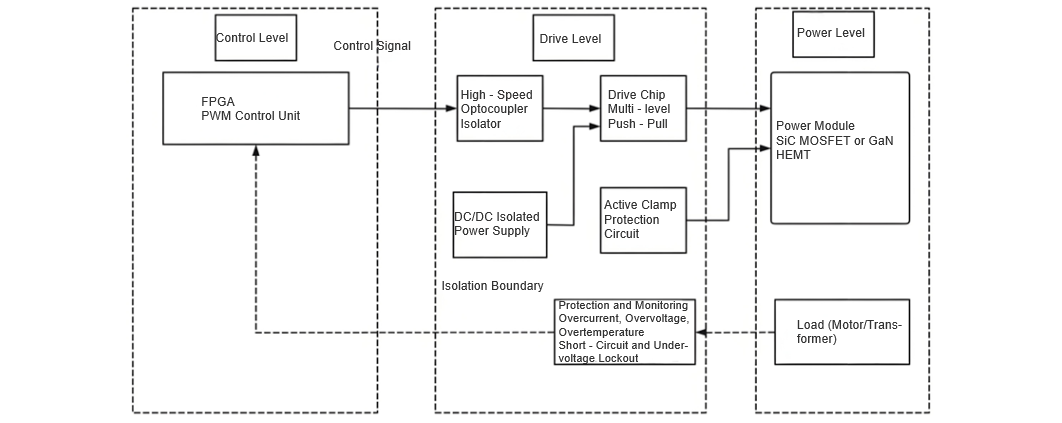
Ang high-frequency PWM control nagdugay sa mas taas nga demands sa real-time performance ug kontrol precision sa computing platforms. Ang traditional Digital Signal Processors (DSPs) kasagaran molabay sa limitations sama sa insufficient computational power ug significant interrupt latency samtang gisulay ang high-frequency PWM. Sa kabalaka, ang Field-Programmable Gate Arrays (FPGAs) mas suited sa mga aplikasyon niini tungod sa ilang parallel processing capabilities ug hardware-level implementation flexibility.
Ang overall architecture sa FPGA-based high-frequency PWM control system gisulay sa apat ka core modules: ang main control unit, ang PWM generation unit, ang feedback signal processing unit, ug ang protection unit. Partikular:
Main Control Unit: Executing closed-loop control algorithms such as speed, current, and position loops;
PWM Generation Unit: Responsible for generating high-precision PWM waveforms and managing dead-time control;
Feedback Signal Processing Unit: Handling the acquisition and preprocessing of signals such as current, voltage, and position;
Protection Unit: Detecting and responding to faults such as overcurrent, overvoltage, and overtemperature to ensure system safety.
Ang sistema nag-adopt sa modular design, uban ang functional modules interconnected pinaagi sa standardized interfaces. Internally, ang FPGA employing a dual-clock-domain architecture: control algorithms operating in a lower-frequency clock domain to reduce resource consumption, while the PWM generation module runs in a high-frequency clock domain to ensure precise timing and high resolution.
3.2 Optimization and Implementation of PWM Control Algorithm
To achieve high-performance high-frequency PWM control, the conventional Space Vector Pulse Width Modulation (SVPWM) algorithm is optimized by introducing an improved PWM control algorithm, expressed as:

where Ta is the conduction time of the upper leg of Phase A; vα and vβ are the components of the reference voltage in the α-β coordinate system. This algorithm is implemented in the FPGA using a pipelined architecture, transforming complex trigonometric computations into simple linear operations. This significantly reduces computational latency and enables single-cycle execution. To optimize dead-time control, an adaptive dead-time compensation strategy is adopted.
3.3 System Performance Testing and Analysis
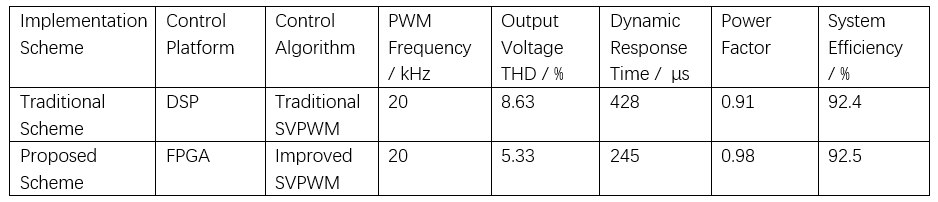
To evaluate the superiority of the proposed high-frequency PWM implementation scheme (hereinafter referred to as the "proposed scheme"), it is compared with a conventional DSP-based implementation (hereinafter referred to as the "conventional scheme"). The test platform is built on a Xilinx Artix-7 FPGA and a TMS320F28379D DSP, using identical power-level circuit topologies and power modules (1200 V/50 A SiC MOSFET). Performance metrics include output voltage Total Harmonic Distortion (THD), dynamic response time, power factor, and system efficiency. Each test is repeated three times, with results averaged to ensure reliability.
As shown in Table 1, the proposed scheme demonstrates significant advantages over the conventional scheme across most metrics: output voltage THD is reduced from 8.63% to 5.33%, a 38.2% improvement; dynamic response time decreases from 428 μs to 245 μs, a 42.5% reduction; and power factor increases from 0.91 to 0.98. Although the system efficiency improves by only 0.1%, this marginal gain is still meaningful given the already high baseline efficiency exceeding 92%.
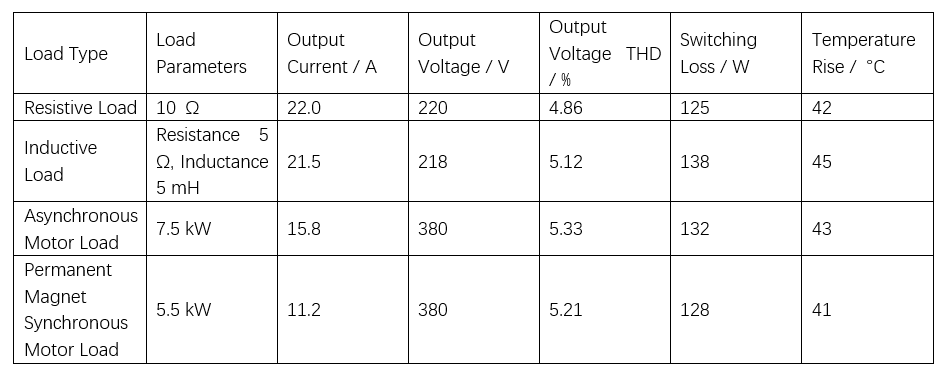
The feasibility of the proposed scheme under varying load conditions is further tested, with results presented in Table 2. The tests cover resistive, inductive, and motor loads. The results show that the proposed scheme maintains stable performance across all load types: the variation in output voltage THD is only 0.47%, demonstrating excellent robustness of the control algorithm; switching losses are maintained between 125 W and 138 W, with a fluctuation of just 10.4%, indicating effective power management; and temperature rise is kept within 41–45 °C, confirming superior thermal stability.
4 Conclusion
High-frequency PWM technology is a key enabler for enhancing inverter performance, yet its implementation in electrical control systems faces multiple technical challenges. This paper addresses critical issues such as high-frequency switching losses, dead-time effects, and driver circuit design by proposing systematic solutions and presenting an FPGA-based implementation framework.
The proposed scheme offers high precision, low latency, and strong real-time performance, effectively improving both dynamic response and steady-state accuracy. The research provides solid technical support for high-performance inverter control and holds broad application potential in fields such as industrial automation, renewable energy generation, and electric vehicles.