Kasamtangan sa Pagdiskubre sa Single-Phase Grounding Fault
Ang mababang akurasiya sa pagdiskubre sa single-phase grounding fault sa mga sistema nga dili efektibong gipundok sa ground mahimong ipasabot sa daghang mga paktor: ang nagbabagyo nga struktura sa mga distribution network (tulad sa looped ug open-loop configurations), ang iba't ibang mga modo sa system grounding (kasama ang ungrounded, arc-suppression coil grounded, ug low-resistance grounded systems), ang kasinatian nga taasan sa annual ratio sa cable-based o hybrid overhead-cable wiring, ug ang komplikado nga mga tipo sa fault (tulad sa lightning strikes, tree flashovers, wire breakages, ug personal electric shocks).
Klasipikasyon sa Mga Grounding Fault

Ang mga fault sa power grid mahimong maglakip sa metallic grounding, lightning discharge grounding, tree branch grounding, resistance grounding, ug poor insulation grounding. Kini usab makapahimulos sa iba't ibang mga scenario sa arc grounding, sama sa short-gap discharge arcs, long-gap discharge arcs, ug intermittent arcs. Ang mga katangian sa signal sa fault nga gitumong sa iba't ibang kondisyon sa grounding nagkalain-lain sa porma ug magnitudo.
Mga Teknolohiya sa Pag-atiman sa Grounding Fault
Dugay sa Mga Grounding Fault
Komplikado sa Mga Katangian sa Grounding Fault
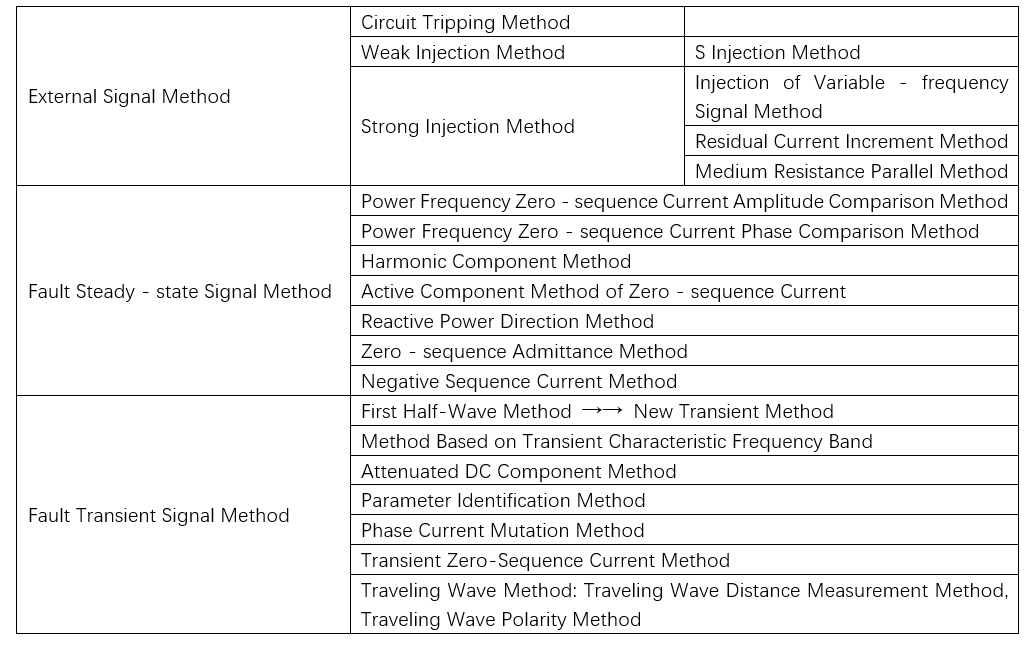
Mga Pamaagi sa Pag-localize sa Single-Phase Grounding Faults
Karon adunay tulo ka kategoriya, total nga 20 basic methods, alang sa pag-localize sa single-phase grounding faults:
Ang artificial intelligence (AI) usa ka cutting-edge teknolohiya sa pag-abli sa moderno nga teknolohiya. Igi-establish niining mga teyoretikal nga modelo pinaagi sa pag-simulate sa mga katangian sa tawo, hayop, o tanom, ug gi-solve ang mga problema pinaagi sa "human-like" thinking. Partikular sa mga power grids, nga inherent nga highly nonlinear nga sistema, sila nahimong bahin sa aplikasyon sa AI. Gihapon, ang paggamit sa computer computing nag-enhance sa operational speed, na enable ang solusyon sa komplikado nga sistema sama sa power grids.
Expert Database: Establish a database that integrates relevant knowledge and experience.
Artificial Neural Network: Simulates the operation of human neurons to solve problems, functioning as a highly nonlinear system.
Ant Colony Optimization: An algorithm that simulates the biological behavior of ants searching for food to solve the traveling salesman problem.
Genetic Algorithm: Simulates the biological evolution process to obtain global optimal or suboptimal solutions.
Petri Net: Models interrelated components in a system, describing phenomena where related components change in chronological order.
Rough Set Theory: Uses more information than the system requires as input to ensure a comprehensive description of the system's operational status.
Ang kadaghanan sa mga intelligent algorithms adunay sulod pa sa teoretikal nga yuta, nganong pipila ra ang gisulti nga praktikal nga gisulti. Pero, ang AI algorithms nagpakita sa ilang superioridad sa bag-ong era.