The inability to manually operate the local mechanical trip of a 10kV vacuum circuit breaker is a relatively common fault type in power system maintenance work. Based on years of field experience, such issues typically stem from five core areas, each requiring troubleshooting based on specific symptoms.
Operating mechanism jamming is the most common cause. The tripping process of a circuit breaker relies on mechanical energy released from spring energy storage; if rust, deformation, or foreign objects exist inside the mechanism, energy transmission is directly hindered. When handling a fault at a chemical plant last year, disassembly revealed an oxide layer formed on the surface of the trip half-shaft due to moisture, increasing the friction coefficient by over 40%. A more hidden issue is deterioration of dashpot oil. A case from a substation showed that hydraulic oil solidified in low temperatures reduced tripping speed to 60% of the standard value—this condition is easily misdiagnosed as an electrical fault. Regularly applying lubricant grease conforming to IEC 60255 standards and replacing dashpot oil every two years can effectively prevent such problems.
Deformation or fracture of transmission components requires focused inspection. The insulating rod, as a key power transmission component, consumes tripping kinetic energy even with minor bending. During a 2021 maintenance at a wind farm, it was found that foundation settlement caused a misalignment deviation of 2.3mm among the three-phase rods, increasing mechanical load by 25%. Fatigue fracture of metal linkages is more sudden. Records from a steel plant showed that after more than 3,000 consecutive operations, the yield strength of the linkage decreased by approximately 15%. It is recommended to perform magnetic particle testing (Magnetic Particle Testing) on equipment operating for over five years.
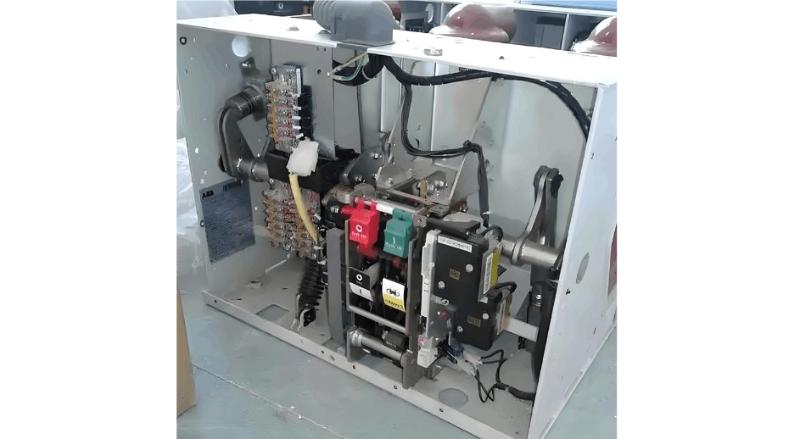
Abnormalities in the arc extinguishing chamber directly affect contact movement. When vacuum drops to above 10⁻² Pa, changes in pressure differential across the bellows increase resistance to contact motion. A fault report from a power supply station indicated that a leaking arc extinguishing chamber increased the required operating force by about 30N. A more special case is contact welding. Even after successful interruption, microscopic welding may occur when short-circuit current exceeds 20kA. In an incident at a data center last year, a short-circuit current of 22.3kA caused an alloy layer to form on the contact surfaces of the fixed and moving contacts, requiring special tools for separation.
Defects in secondary components are often overlooked. Inter-turn short circuits in the trip coil reduce electromagnetic pull force; in actual cases, a resistance deviation exceeding 10% may lead to failure to operate. In a tunnel power supply project, oxidation of coil terminals increased contact resistance to 5Ω, resulting in coil terminal voltage falling below 65% of the rated value. Misalignment in auxiliary switches is even more hidden; when the switching angle deviates from the design value by more than 3°, it may prematurely cut off the control circuit. It is recommended to use an oscilloscope to monitor the current waveform of the trip circuit, as abnormal pulse width often appears earlier than mechanical failure.
Installation foundation issues have cumulative effects. If the breaker body tilts more than 2°, the operating rod bears lateral force. At a hydropower station, concrete base cracking caused a 3.5° tilt, resulting in pin wear four times greater than under standard conditions within two years. Environmental factors cannot be ignored either. At a coastal substation, salt fog deposition caused the spring stiffness coefficient in the mechanism box to decay at an annual rate of 7%.
Handling such faults must follow the principle of dynamic testing. In addition to conventional mechanical characteristic testers measuring tripping time and speed, a low-voltage operation test is recommended: reduce the operating voltage to 30% of the rated value for tripping; if the operation cannot be completed, the mechanism resistance has severely exceeded limits. For frequently operated breakers (over 200 operations per year), the maintenance cycle should be shortened to 18 months. Practical experience shows that approximately 70% of faults can be avoided through early cleaning and lubrication of the mechanism, while the remaining 30% require lifespan prediction of components based on condition monitoring data. Of course, some compound faults still require disassembly analysis for accurate diagnosis—this is precisely the challenge of maintenance work.