The windings and core of a transformer are the primary components responsible for transmitting and transforming electromagnetic energy. Ensuring their reliable operation is a major concern. Statistical data shows that core-related issues account for the third-highest cause of transformer failures. Manufacturers have paid increasing attention to core defects and have implemented technical improvements regarding reliable core grounding, core ground monitoring, and ensuring single-point grounding. Operation departments have also placed significant emphasis on detecting and identifying core faults. Nevertheless, core faults in transformers still occur frequently, primarily due to multi-point grounding and poor core grounding. This article introduces the diagnosis and handling methods for these two types of faults.
1.Elimination of Multi-Point Grounding Faults
1.1 Temporary measures when the transformer cannot be taken out of service
If there is an external grounding lead and the fault current is relatively large, the grounding wire may be temporarily disconnected during operation. However, close monitoring is essential to prevent the core from developing a floating potential after the fault point disappears.
If the multi-point grounding fault is unstable, a variable resistor (rheostat) can be inserted into the working grounding circuit to limit the current to below 1 A. The resistance value is determined by dividing the voltage measured across the open normal grounding wire by the current flowing through the grounding wire.
Chromatographic analysis should be used to monitor the gas generation rate at the fault location.
After precisely locating the fault point through measurements, if it cannot be repaired directly, the normal core grounding strap can be relocated to the same position as the fault point to significantly reduce circulating currents.
1.2 Thorough maintenance measures
Once monitoring confirms a multi-point grounding fault, transformers that can be shut down should be promptly de-energized and fully repaired to eliminate the fault completely. Appropriate maintenance methods should be selected based on the type and cause of the multi-point grounding. However, in some cases, even after shutdown and core removal, the fault point cannot be found. To accurately locate the grounding point on-site, the following methods may be used:
DC Method: Disconnect the bonding strap between the core and clamping frame. Apply 6 V DC voltage across the silicon steel laminations on both sides of the yoke. Then, use a DC voltmeter to sequentially measure the voltage between adjacent laminations. The location where the voltage reads zero or reverses polarity indicates the fault grounding point.
AC Method: Apply 220–380 V AC voltage to the low-voltage winding, establishing magnetic flux in the core. With the core-clamp bonding strap disconnected, use a milliammeter to detect current flow indicative of a multi-point ground fault. Move the milliammeter probe along each lamination level of the yoke; the point where the current drops to zero is the fault location.
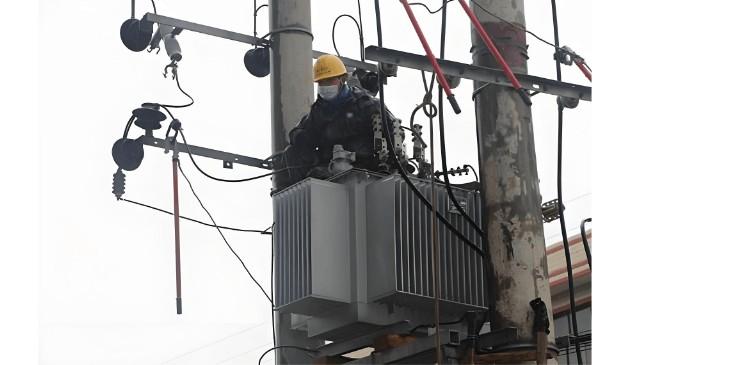
2. Abnormal Phenomena Caused by Multi-Point Grounding
Eddy currents are induced in the core, increasing core losses and causing localized overheating.
If severe multi-point grounding remains untreated for an extended period, continuous operation will overheat the oil and windings, gradually aging the oil-paper insulation. This may cause the inter-lamination insulation coating to deteriorate and peel off, leading to more severe core overheating and eventual core burnout.
Prolonged multi-point grounding degrades the insulating oil in oil-immersed transformers, producing flammable gases that may trigger the Buchholz (gas) relay.
Core overheating can carbonize wooden blocks and clamping components inside the transformer tank.
Severe multi-point grounding may burn through the grounding conductor, resulting in loss of the transformer’s normal single-point grounding—an extremely hazardous condition.
Multi-point grounding can also cause partial discharge phenomena.
3. Reason Why the Core Must Be Grounded at Only One Point During Normal Operation
During normal operation, an electric field exists between the energized windings and the transformer tank. The core and other metal parts are situated within this field. Due to uneven capacitance distribution and varying field strengths, if the core is not reliably grounded, charge-discharge phenomena will occur, damaging both solid and oil insulation. Therefore, the core must be grounded at exactly one point.
The core is composed of silicon steel laminations. To reduce eddy currents, each lamination is insulated from adjacent ones with a small resistance (typically only a few to several tens of ohms). However, due to the very high inter-lamination capacitance, the laminations act as a conductive path under alternating electric fields. Thus, grounding the core at a single point is sufficient to clamp the entire stack to ground potential.
If the core or its metal components have two or more grounding points (multi-point grounding), a closed loop is formed between these points. This loop links part of the magnetic flux, inducing electromotive force and circulating currents, which cause localized overheating and may even burn out the core.
Only single-point grounding of the transformer core constitutes reliable and normal grounding—i.e., the core must be grounded, and it must be grounded at exactly one point.
Core faults are primarily caused by two factors: (1) poor construction practices leading to short circuits, and (2) accessories or external factors causing multi-point grounding.