Sîstema Xweza Êzgeha Bexêya di Sîstema AGV de
Bi derketina çewtî ya tevînê yên bexêya, dersa zêdetir bikecîna arzî ya cihanê û pêşindiyayên xebitandina xebatê, êndazeyên bexêyê, wan ku li ser wê yekîneyên logistikên sereke ne, dikarin piştgiriyan rastî yên bermecel. Di demê de ku êndazeyên bexêyê zêde bikin, daqiqeyên karê zêde bibin, taybetmendîya agahdariya zêde bikin û karûbarên gerdkirinê çêtibin, destpeykirina xalatên berbi û pêşindiyayên xebatê bi sedeya xebitandina giranî yên bexêyê hatiye wergerandin. Ew hedef e ye ku kompaniyên ji bo rêjeya xwe birayên automatîk in.
Nivîska jêrîn li sîstema xweza bexêya di AGV (Vehicle Guided Automated) de dibe. Sîstem vîhicle yên AGV-yê wek carrier an, pelanên agahdariya derveyî yên derveyî rengin dibin û algoritmetên planekeşê yên xweza bikar mînin da ku routeka AGV bişopîne. Vê şêwekirin AGV-yên bi karên din bixebitandina, transportkirina, stokkirina û gerdkirina mallên, bi sedeya xebitandina efektivî û rastî yên sîstemê yên bexêyê û pêşindiyayên xebatê.
1. Analîzê Sîstemê
Navenda xweza sîstemê li ser xebitandina û shedulekirina ye. Sîstemê jêrîn li ser binêreke arkitektûra li ser data flow me îro di navbera input û storage containers û AGVs de. Li ser vegerên fonksiyonî û analîzê operaçyonan, sîstem divîse kirin da ku modûlan serekan: management of warehouse, station management, vehicle management, order management, û user management.
Warehouse Management:Ev modul map modelî û management of information êndaze bexêyê hate dayin. Êndaza bexêyê divîse kirin da ku 20 row û 12 column li ser three levels (upper, middle, lower). Her container divî ID ûnîk e. Map includet walls, doors, two temporary platforms, û charging station. Information of item based on container location, with data linked to a database via the container’s ID.
Station Management:Key locations—such as warehouse entrances, aisle entrances, column positions, charging stations, loading/unloading points, and parking spots—are predefined as AGV start or target points.
Path Management:Paths connect stations. AGVs follow pre-planned routes, which can be unidirectional or bidirectional, and linear or curved.
Rack Management:Racks are placed only at designated rack locations. Rack management supports AGV operations for moving racks between loading points, unloading points, and rack locations. Racks have four states: initial, waiting for retrieval, in transit, and returned.
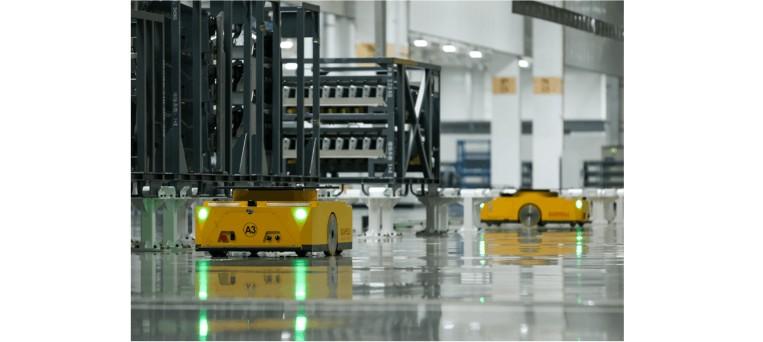
Vehicle Management:Given the simple warehouse setup, only one AGV is used, handling one container per task. AGV states include: standby (idle at entrance with sufficient charge), charging (moving to charger when low on power), and task execution (actively transporting a container).
Charging Management:When battery levels are low, the AGV automatically requests a charge. The system assigns a charging path, locks the charging station, and places the AGV in charging mode, during which no new tasks are assigned until the battery reaches a predefined level.
Exception Management:Potential AGV anomalies include deviating from planned routes, failing to request charging when low on power, or losing control. All exceptions are logged, and if the number of anomalies exceeds a preset threshold, an alert is triggered, indicating the need for maintenance.
Task Management:New tasks are assigned using predefined path-planning algorithms. Upon task initiation, the system assigns an AGV and transmits the full route. Tasks can be viewed, canceled, paused, or modified. Tasks are categorized into three types: outbound, inbound, and relocation.
User Management:This module manages user accounts and permissions. Users are classified into four levels: guest, operator, administrator, and super administrator, each with different access rights.
2. Overview of System Design
2.1 Design Principles
Visibility: User-friendly interface designed for intuitive data access and management.
Real-time Performance: The warehouse map must reflect real-time AGV positions, statuses, and rack information with minimal delay, ensuring reliable communication.
Stability: The system must remain stable under high data loads and during prolonged operation.
Scalability: Modular design allows future expansion and integration of new features.
2.2 System Architecture
The system comprises three layers:
Execution Layer (AGV Transport): Physical AGV operations.
Service Layer: Acts as a bridge between application and execution layers, including a central management system and access system. It communicates with AGVs, collects status data, and provides APIs for task assignment and control.
Application Layer: The top layer, directly interacting with users via a Unity3D-based interface. Users send requests, and results are displayed after backend processing.
2.3 Database Design
Key data includes:
User data: Basic information and access permissions.
Vehicle data: AGV status, charging/discharging logs, and anomaly records.
Task data: Task details and execution status.
Warehouse data: Layout, racks, stations, charging points, etc., forming the warehouse map.
Key relationships: users create tasks, AGVs execute tasks, AGVs operate within the warehouse, and users manage the warehouse.
2.4 Detailed System Design and Implementation
2.4.1 Basic Framework Implementation
A new Unity3D project is created, importing 3D models to simulate the warehouse environment. Logic is implemented using C#.
User Login:
Users must authenticate and obtain role-based permissions before accessing the system.
Warehouse Management Implementation:
Core functionality includes warehouse modeling, allowing users to view and edit container layouts, vehicle locations, and rack distributions. The system includes path and station lists, with vehicle management covering charging and anomaly handling.
2.4.2 Map Design Methodology
Common robotic mapping methods include:
Metric Maps: 2D/3D reconstructions of real space.
Direct Representation: Uses raw sensor data without discretization.
Grid Maps: Divides space into uniform cells, easily convertible to topological graphs.
Topological Maps: Represents key locations as nodes, connected by edges.
Coordinate Systems:
Layout Coordinates: Virtual interface positions in Unity.
Model Coordinates: Real-world (x, y, z) positions. Since layout coordinates are auto-generated, model coordinates must be explicitly defined for realistic simulation.
Point Types and Operations:
Points represent AGV positions (default: 0,0,0). Types include: normal, loading/unloading, entry/exit, rack, and charging points. Normal points cannot hold racks or allow long-term AGV stops.
3. Conclusion
With the rapid advancement of smart logistics and IoT technologies, warehouses are transitioning from "manual mechanization" to "goods-to-person" automated operations. Operators can now monitor inventory in real time, improving scanning accuracy, dynamic storage, and operational efficiency while reducing waste and labor costs.
However, as intelligent systems scale up and AGV fleets grow, challenges in task allocation and fleet control persist. This paper presents a practical AGV-based intelligent warehouse scheduling system, shifting warehouse management from traditional inventory tracking to real-time operational control. By leveraging fully automated technologies, the system enables autonomous inbound and outbound operations, driving the transformation from automation to intelligent logistics.