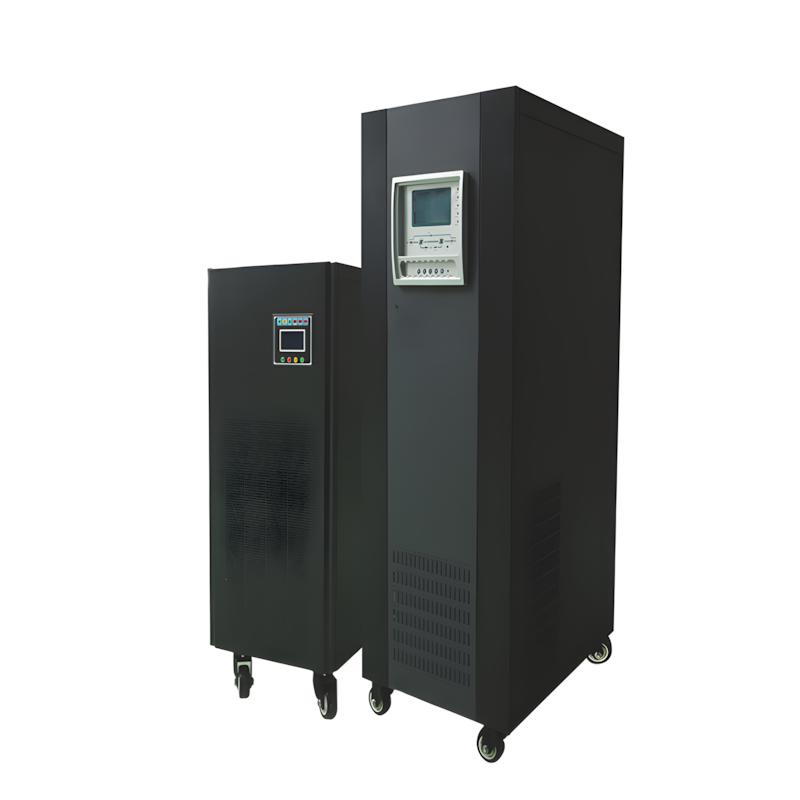
| Brand | Xinyouxiang |
| Model NO. | low frequency on-line UPs power supply (3phase input 1phase output) |
| Rated frequency | 50/60Hz |
| Output Voltage | 405VDC/220VDC |
| Input Voltage | 380V |
| Capacity | 15kVA |
| Series | HBD |
Product application
Suitable for industries such as finance, telecommunications, securities, taxation, transportation, insurance, government, building lighting, road traffic lighting, electricity, and industrial and mining enterprises.
Product Features
Intelligent digital control technology
Using Intel high-speed microcontrollers and programmable logic devices to achieve circuit control, parameter setting, operation management, advanced self-test and self detection functions, it can perform self-test and fault analysis on all independent circuit connections on the circuit board. You can fully trust the digitally transformed sine wave voltage and the new solution for perfect operation to meet your actual needs.
Efficient IGBT (Insulated Gate Bipolar Transistor) inverter technology
GBT has excellent high-speed switching characteristics; Having working characteristics of high voltage and high current; Using voltage type drive, only a small control power is required. The sixth generation IGBT has lower saturation voltage drop, higher inverter efficiency, and higher reliability.
Superior load characteristics
Fully meet the transition from 0 to 100% load without switching to a bypass, and protect stable and reliable output.
Humanized large screen LCD display in both Chinese and English
The large screen displays a menu in both Chinese and English, with a clear flow chart showing the operational status, allowing for flexible implementation of human-machine dialogue functions. Intuitive LED status indication, workflow style status indication, clear at a glance.
High performance dynamic characteristics
Multiple feedback controls such as instantaneous control and effective value are adopted to achieve high dynamic regulation and reduce output voltage distortion.
Complete protection function
Multiple system protection and alarm functions, including input/output overvoltage protection, input surge protection, phase sequence protection, battery low voltage protection, output overvoltage protection, and high temperature protection.
Intelligent battery management
Intelligent battery charging: Automatically adjust the charging parameters of the battery according to the user's battery configuration, and perform equalization and float charging conversion, temperature compensation charging and discharging management on the battery according to the power supply environment. Extend the lifespan of the battery and reduce the burden on administrators.
Adopting a 6-pulse (optional 12 pulse) rectifier charger while adding an input harmonic filter
Effectively suppress input harmonic pollution, improve the input power factor of UPS power supply, and reduce input harmonic current.
intelligent monitoring
RS232 and RS485 communication ports truly enable multi-purpose communication and remote monitoring. Optional SNMP card for remote monitoring and network management; Optional dry contact interface, using passive contacts to monitor the status of UPS.
Application field
Suitable for industries such as finance, telecommunications, securities, taxation, transportation, insurance, government, building lighting, road traffic lighting, electricity, and industrial and mining enterprises.
Technical Specifications
Model |
HBD-6KS |
HBD-10KS |
HBD-15KS |
HBD-20KS |
HBD-30KS |
HBD-40KS |
HBD-50KS |
HBD-60KS |
HBD-80KS |
Nominal Capacity |
6KVA |
10KVA |
15KVA |
20KVA |
30KVA |
40KVA |
50KVA |
60KVA |
80KVA |
Working Mode and Principle |
Online Power Supply, Static Bypass Switch (No-break Switching), Double Conversion Technology |
||||||||
AC Input |
|
|
|
|
|
|
|
|
|
Phase Number |
Three Phase (A, B, C+N+G) |
||||||||
Input Nominal Voltage |
380 VAC |
||||||||
Input Voltage Range |
± 25% |
||||||||
Nominal Frequency |
50Hz ± 10%, 60Hz ± 10% |
||||||||
Voltage Harmonic Distortion |
<5% |
||||||||
Soft Start |
0~100% 5sec |
||||||||
Battery (Maintenance-free Lead-acid Battery) |
|
|
|
|
|
|
|
|
|
Nominal Voltage |
360VDC/192VDC |
||||||||
Quantity Unit |
30 cells/12V in series (16 cells/12V in series) |
||||||||
Charging |
|
|
|
|
|
|
|
|
|
Maximum Output Voltage |
405VDC/220VDC |
||||||||
Float Voltage |
405VDC/220VDC (Automatic Battery Equalization Once Every 3 Months, Charging Voltage 435VDC/232VDC) |
||||||||
Microcomputer-set Charging Current |
1A~50A (Automatically Adjusted to 0.1C According to Battery Capacity) |
||||||||
AC Output |
|
|
|
|
|
|
|
|
|
Rated Power (KW COSφ=0.8) |
Nominal Power × 0.8 |
||||||||
Phase Number |
Single Phase (L+N+G) |
||||||||
Nominal Phase Voltage |
220VAC ± 1% (Stable Load), 220VAC ± 5% (Load Fluctuation) |
||||||||
Nominal Frequency |
50Hz ± 0.1% (Battery Power Supply) |
||||||||
Frequency Stability: Asynchronous |
< ± 0.1% |
||||||||
Frequency Stability: Synchronous |
< ± 5% |
||||||||
Crest Factor |
3: 1 |
||||||||
Output Waveform |
Sine Wave |
||||||||
Total Harmonic Distortion |
Linear Load < 3%; Non-linear Load < 5% |
||||||||
Operating Temperature |
0~40℃ |
||||||||
Relative Humidity |
30%~90% (No Condensation) |
||||||||
Operating Altitude |
< 1000 meters (Power Drops by 1% for Every 100 Meters Increase, Maximum 3000 Meters) |
||||||||
Options |
RS485 Network Adapter (SNMP) / Cabinet Size Can Be Designed According to Requirements |
||||||||
Dimensions (W×D×H) mm |
390×659×860 |
430×760×1350 |
710×720×1450 |
710×850×1500 |
- |
- |
- |
1100×860×1680 |
- |
Main Unit Weight |
150 |
199 |
220 |
305 |
380 |
480 |
566 |
590 |
986 |
Note: The model with built-in battery and special voltage requirements can be customized according to the actual situation of the user, and a separate quotation will be provided.
Its core function is to convert 3-phase mains power into stable 1-phase power, providing uninterrupted, pure power for single-phase critical loads while solving mains problems like voltage fluctuation, harmonic interference and power outage. Working principle: Adopt double conversion (AC-DC-AC) + low-frequency transformer design. When mains is normal, 3-phase AC is converted to DC to charge the battery, then DC is converted to 1-phase pure sine wave AC for load supply; when mains fails, it switches to battery power with 0ms transfer time,
① Overload alarm: Unplug non-essential single-phase loads, or replace with a larger capacity UPS; ② Phase loss alarm: Check 3-phase input wiring, repair loose or disconnected cables; ③ Battery low alarm: Charge continuously for 12 hours, replace aging batteries if the alarm persists; ④ Output voltage abnormal: Check output wiring, reset UPS (disconnect power and restart after 5 minutes); ⑤ Transformer overheating: Stop using immediately, check ventilation and load, contact after-sales for maintenance.











 Login
Login