Production Testing Procedures and Methods for Wind-Solar Hybrid Systems
To ensure the reliability and quality of wind-solar hybrid systems, several critical tests must be conducted during production. Wind turbine testing primarily includes output characteristic testing, electrical safety testing, and environmental adaptability testing. Output characteristic testing requires measuring voltage, current, and power under varying wind speeds, plotting wind-power curves, and calculating power generation. According to GB/T 19115.2-2018, testing equipment should use power transducers of class 0.5 or higher (e.g., SINEAX DM5S) to ensure measurement accuracy. Electrical safety tests cover overvoltage/undervoltage protection, short-circuit protection, and reverse polarity protection, ensuring safe turbine operation under abnormal conditions.
Solar panel testing involves I-V curve testing, MPPT efficiency testing, and environmental adaptability testing. I-V curve testing must be performed under Standard Test Conditions (STC): air mass AM1.5, irradiance of 1000 W/m², and temperature of 25°C. Test equipment includes a photovoltaic simulator system and a power quality analyzer, evaluating panel performance through parameters such as open-circuit voltage, short-circuit current, and peak power. MPPT efficiency testing focuses on whether the controller can effectively track the maximum power point, especially under rapidly changing irradiance conditions.
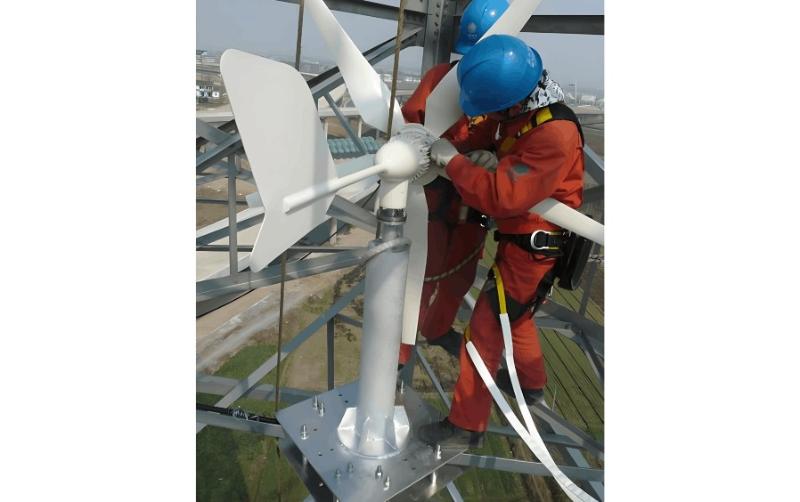
System integration testing is a key step to verify the overall performance of the hybrid system. Per GB/T 19115.2-2018, the system must undergo power quality testing (including voltage regulation, frequency stability, and waveform distortion), safety testing, and durability testing. Power quality testing ensures the system output meets grid requirements, such as voltage compliance, frequency stability, and harmonic distortion levels. Safety testing verifies protective functions under fault conditions, including overload protection, short-circuit protection, and islanding protection.
Special environmental testing is also essential during production. Salt spray testing is required for systems deployed in high-salinity areas to evaluate corrosion resistance, while low-temperature cycle testing is necessary for plateau regions to validate performance under cold conditions. These tests ensure the system can operate stably across diverse geographical and climatic environments.