Ra = (Rab * Rac) / (Rab + Rbc + Rac)
Rb = (Rab * Rbc) / (Rab + Rbc + Rac)
Rc = (Rbc + Rac) / (Rab + Rbc + Rac)
Rab = (Ra * Rb + Ra * Rc + Rb * Rc) / Rc
Rbc = (Ra * Rb + Ra * Rc + Rb * Rc) / Ra
Rac = (Ra * Rb + Ra * Rc + Rb * Rc) / Rb
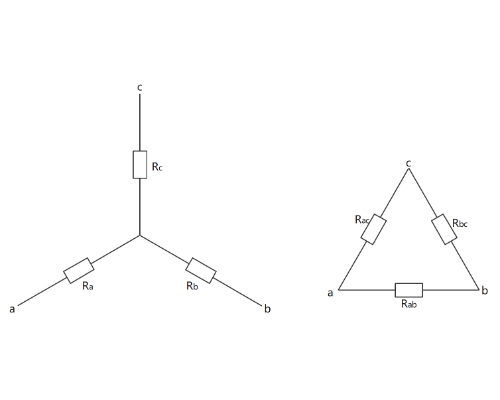
Convert delta (Δ) to wye (Y) or vice versa using the standard Δ-Y transformation formulas. Calculate equivalent resistances for circuit simplification in three-phase systems, bridge networks, and academic problems. Supports both directions with step-by-step results.
The Δ-Y transformation preserves terminal voltages and currents while replacing the delta network with an equivalent star network:
Ra = (Rab × Rbc) / (Rab + Rbc + Rac)
Rb = (Rbc × Rac) / (Rab + Rbc + Rac)
Rc = (Rac × Rab) / (Rab + Rbc + Rac)
Where:
Rab, Rbc, Rac: Resistances in the delta configuration (Ω)
Ra, Rb, Rc: Equivalent resistances in the wye configuration (Ω)
To convert from star to delta:
Rab = (Ra × Rb + Rb × Rc + Rc × Ra) / Rc
Rbc = (Ra × Rb + Rb × Rc + Rc × Ra) / Ra
Rac = (Ra × Rb + Rb × Rc + Rc × Ra) / Rb
| Parameter | Description |
|---|---|
| Rab | Resistance between terminals a and b in delta configuration (Ω) |
| Rbc | Resistance between terminals b and c in delta configuration (Ω) |
| Rac | Resistance between terminals a and c in delta configuration (Ω) |
Given:
Rab = 10 Ω
Rbc = 20 Ω
Rac = 30 Ω
Ra = (10 × 20) / (10 + 20 + 30) = 200 / 60 ≈ 3.33 Ω
Rb = (20 × 30) / 60 = 600 / 60 = 10 Ω
Rc = (30 × 10) / 60 = 300 / 60 = 5 Ω
Result: The delta network with resistances 10 Ω, 20 Ω, 30 Ω is equivalent to a star network with Ra = 3.33 Ω, Rb = 10 Ω, Rc = 5 Ω.
Circuit simplification in complex networks with multiple loops
Power system analysis for balanced and unbalanced loads
Electronics design of impedance matching and filter circuits
Academic learning in electrical engineering courses (e.g., Circuit Theory, Network Analysis)
Exam preparation for competitive exams like GATE, IIT JAM, IEEE
IEEE Std 145-2017: Standard for Electric Power Systems and Equipment
IEC 60034: Rotating electrical machines
Textbooks: "Electric Circuits" by James W. Nilsson, "Network Analysis" by M.E. Van Valkenburg
Yes, as long as the total resistance sum (Rab + Rbc + Rac) is not zero. If any resistance is zero or infinite, special care is needed. The transformation assumes linear, time-invariant components.
Use it when:
You have a bridge-like network that cannot be simplified by series/parallel combinations
You need to analyze three-phase systems with unbalanced loads
You're solving problems involving symmetry or equivalence
You want to reduce the number of nodes in a circuit
Use the reverse formulas:
Rab = (Ra × Rb + Rb × Rc + Rc × Ra) / Rc
Rbc = (Ra × Rb + Rb × Rc + Rc × Ra) / Ra
Rac = (Ra × Rb + Rb × Rc + Rc × Ra) / Rb
This calculator supports both directions: Δ → Y and Y → Δ.
It allows engineers to simplify complex circuits by replacing a delta network with a star (or vice versa), making analysis easier using series/parallel rules or nodal/mesh methods. It’s especially useful in three-phase systems and symmetric networks.
Yes, but only if the components are purely resistive. For AC circuits with inductance or capacitance, you must use impedance (Z) instead of resistance (R), and the same transformation formulas apply using complex numbers.
Delta (Δ): Three resistors connected end-to-end forming a triangle. Each resistor connects two terminals.
Wye (Y): Three resistors connected at a common central node (star). Each resistor connects one terminal to the center.
Both configurations can be made electrically equivalent through transformation.








 Login