1. Cad é an tuiscint atá le baint as an riachtanas sa Chlár 14.1.1.4 de "Na hAcht Déag Coireachta" (2018) ón Grid Náisiúnta?
14.1.1.4: Is gá an pointe neamhaimseartha trasfhoirithí a ceangal le dhá taobh éagsúil den mhóinéar grúndála príomhfhaisnéise trí dhá chonduiteoir grúndála, agus is gá gur sásíonn gach conduiteoir grúndála na rialacha stailchríochnachta téarmaíochta. Is gá go mbeidh dhá chonduiteoir grúndála ceangailte le trúnna éagsúla den mhóinéar grúndála príomhfhaisnéise ar an t-eochairbhuí agus ar struchtúir eochairbhuithe, agus is gá gur sásíonn gach conduiteoir grúndála na rialacha stailchríochnachta téarmaíochta freisin. Is gá na nascáin a chur in ord iontaofa chun seiceáil agus testáil rialta a éascaí.
Compared with the 2012 edition of the "Eighteen Anti-Accident Measures," the wording was changed from “main equipment and equipment structures should preferably have two grounding down conductors connected to different trunks of the main grounding grid” to “main equipment and equipment structures shall have two grounding down conductors connected to different trunks of the main grounding grid.” This change upgrades the requirement from a recommendatory (“should preferably”) to a mandatory (“shall”) one. Currently, all substations in China have implemented dual grounding down conductors as required. To better protect main equipment, dual grounding down conductors must be mandatorily applied.
Tuiscint ar an Chlár 14.1.1.4 de "Na hAcht Déag Coireachta" (2018) ón Grid Náisiúnta mar gheall ar GIS:
Tá GIS á dathú mar thacaíocht príomhfhaisnéise i staidéar agus is gá dó leanúint ar an alt seo:
Is gá do chosaint agus a struchtúr tacaíochta GIS a bheith leis dhá chonduiteoir grúndála, agus is gá go mbeidh na dha chonduiteoir sin ceangailte le trúnna éagsúla den mhóinéar grúndála príomhfhaisnéise (chun a chosc ar fhillteoireacht a bheith mar thoradh ar fhillt ar an ggrúndáil);
Is gá gach conduiteoir grúndála a bheith tar éis na rialacha stailchríochnachta téarmaíochta a sheiceáil (chun cinntiú nach mbeidh sé díoltas de bharr teolaíocht nuair a théann modh réaduillinneach trí;
Is gá an líneáil na n-conduiteoir grúndála a chur in ord iontaofa chun seiceáil agus testáil rialta a éascaí (chun lorg agus cothrom a shásamh maidir le cruinnas an grúndála).
This clause upgrades the 2012 version’s “recommendatory requirement” to a “mandatory requirement.” As a core piece of main equipment, GIS must be configured with dual grounding down conductors to enhance the redundancy and reliability of the grounding system.
Combined with the on-site situation as shown in the figure below.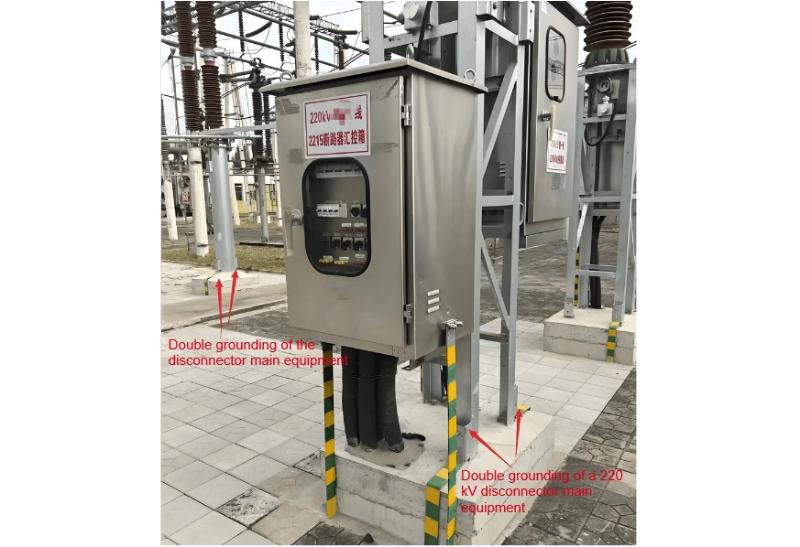
For the standalone main equipment shown in the figure above, the requirement for double grounding is relatively straightforward to understand. However, for GIS—where circuit breakers, disconnectors, and other major components are integrated together—interpretations of "double grounding for main equipment" may vary among individuals. In my view, the entire GIS should simply be regarded as one single main equipment unit. The basis for this is as follows:
Each bay’s enclosure base and support structure shall have no fewer than two reliable grounding points. Grounding down conductors shall be securely connected, free from corrosion, damage, or deformation, and maintain good electrical continuity. Exposed horizontal grounding busbars shall have additional supports installed at intervals of 0.5–1.5 m, vertical sections at intervals of 1.5–3 m, and bends at intervals of 0.3–0.5 m.
As applied on-site, this is illustrated in the figure below: Points A and B represent the two reliable grounding connections between the base and the main grounding grid. The base is then reliably bonded to the GIS support structure via the jumper at point C. Individual GIS modules are reliably interconnected through jumpers at point D (metal flanges do not require bonding jumpers). This configuration establishes a reliable dual-point grounding system for the entire GIS assembly (with the GIS enclosure itself serving as part of the grounding path).

Someone might then ask: "If that’s the case, what is the purpose of all those individual grounding leads on the GIS?" as shown in the figure below:

This leads to the second question:
2. Regarding GIS, how should the requirement for direct grounding be understood?
The figure above shows grounding conductors directly led from different parts of the GIS to dedicated grounding terminals or grounding blocks—rather than relying on the GIS enclosure for grounding. The reason is specified in the following regulation:
“Voltage transformers, surge arresters, and fast grounding switches shall be connected directly to the main grounding grid via dedicated grounding conductors, and shall not be grounded through the enclosure or support structures.”
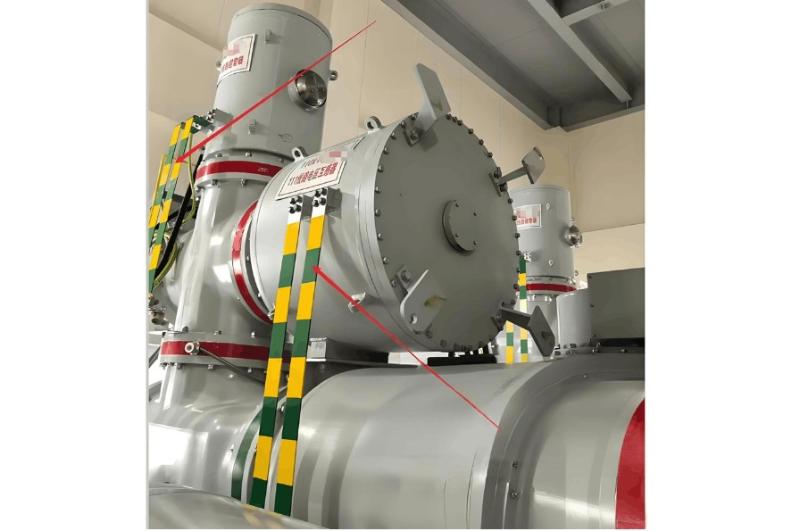
Looking at the figure above, another question arises:
3. For surge arresters, voltage transformers, and fast grounding switches inside GIS, is there a requirement for dual direct grounding?
As shown in the figure below:
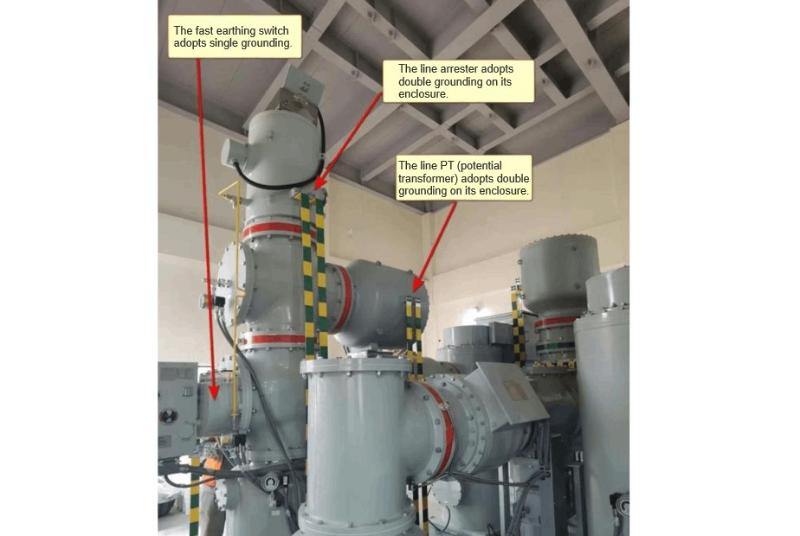
I dtaobh an stáisiúin trasmhaire atá léirithe sa físeán thuas, tá roinnt saineolaithe tar éis a lua go ba chóir don scuab talamh sciúrach a úsáid dhá ghearrán talamh díreach coitianta leis an mbloc talamh. I measc an cheist seo, chuir muid teagmháil go sonrach leis an bhfeirmeoir, agus dúirt an feirmeoir ina freagra nach bhfuil aon riachtanas do dhúalú ghearrán talamh díreach—tá an t-éifeacht díreach amháin riachtanach, agus mar aon leis sin, is féidir leis an nghearrán talamh an currachtoí thalamh réimseacha a chur isteach.