• Product
  • Suppliers
  • Manufacturers
  • Solutions
  • Free tools
  • Knowledges
  • Experts
  • Communities
Search


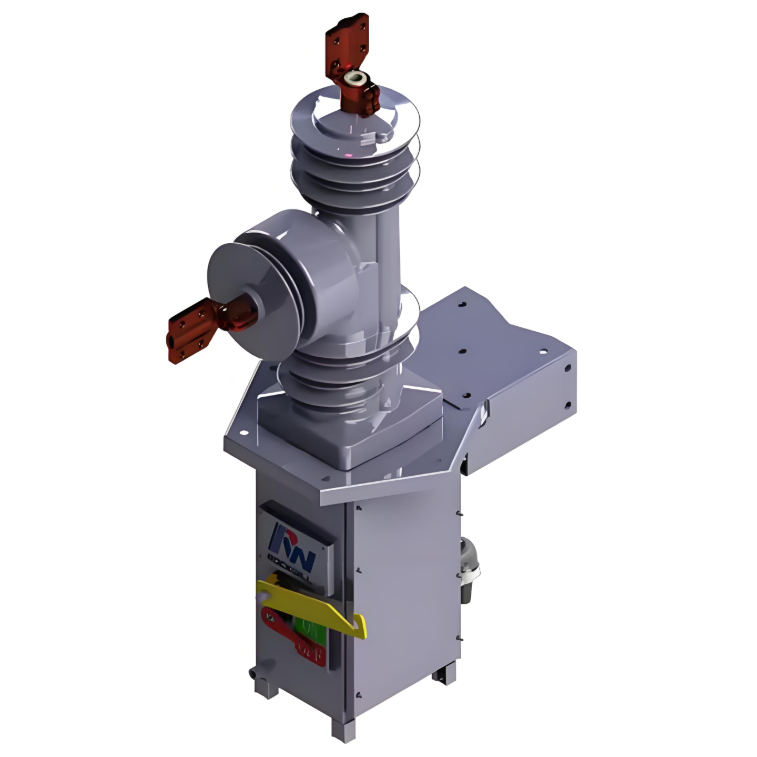
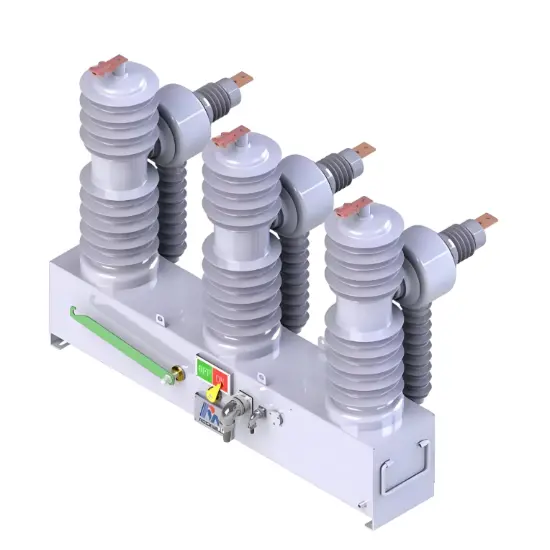
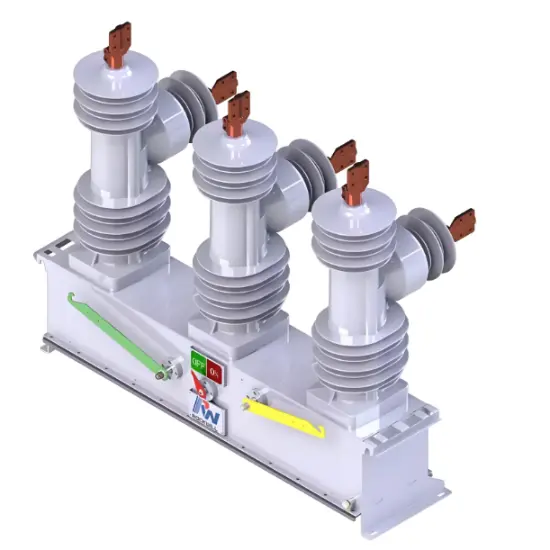
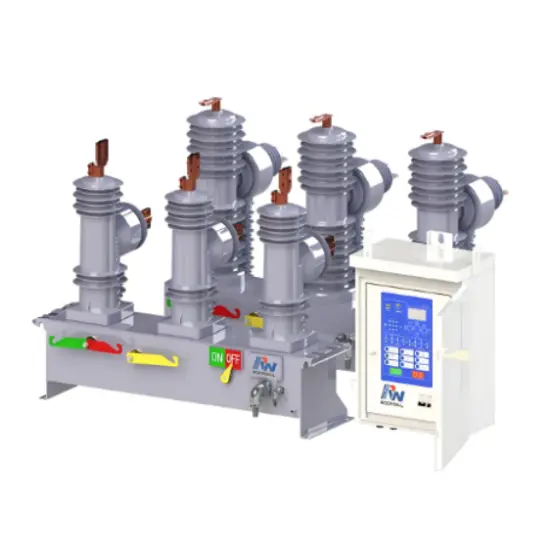
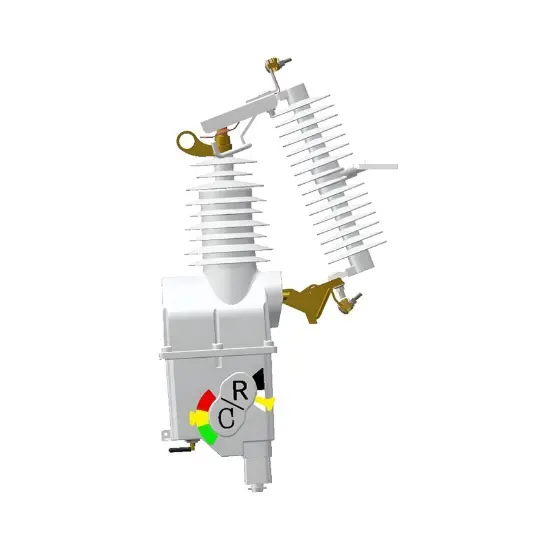
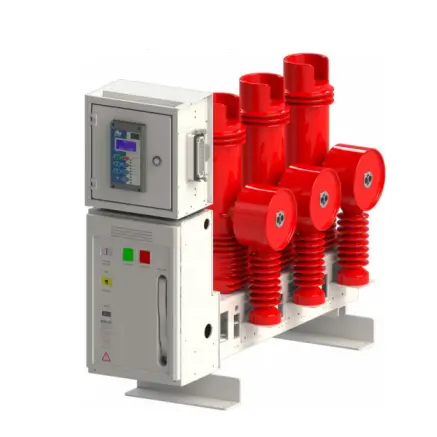
36kV 72.5kV Dry Air Insulated Dead Tank Vacuum Circuit Breaker(VCB)

  • 36kV 72.5kV Dry Air Insulated Dead Tank Vacuum Circuit Breaker(VCB)

Key attributes

Brand ROCKWILL
Model NO. 36kV 72.5kV Dry Air Insulated Dead Tank Vacuum Circuit Breaker(VCB)
Rated voltage 36kV
Rated normal current 2000A
Rated frequency 50/60Hz
Series NVBOA

Product descriptions from the supplier

Description

Description

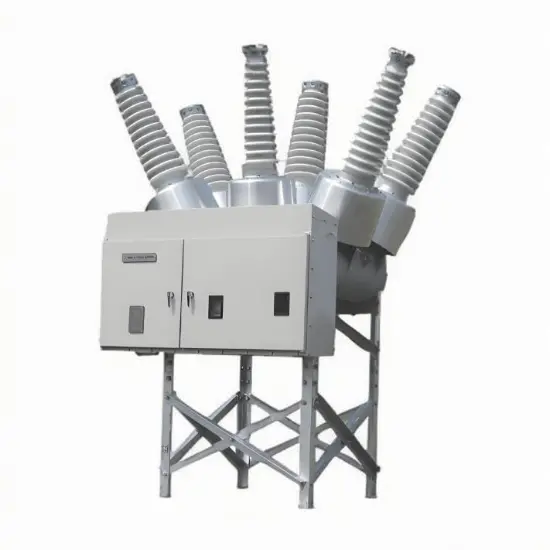
The Dry Air Insulated Dead Tank VCB was born of superb technology and abundant production experience of Meidensha Corporation.It is a circuit breaker employing vacuum interrupters and dry air for insulation. In order to use no SF6, which is global warming gas, there is no fear to decomposition of gas due to current interruption. It is therefore a highly reliable and high-performance circuit breaker.

Feature

Dead Tank Type VCB optimized for green procurement. It uses dry air for insulation in place of the SF6 which is specified as a greenhouse gas. Our basic design concept is to realize the environmental factors in design (The 3Rs (Reduce, Reuse, and Recycle) + LS (Longuse & Separable)) and life-cycle cost (LCC) reduction as basic concepts.

  • Contribution to global warming prevention

Dry air insulation are employed instead of SF6 gas insulation. GWP (Global Warning Potential) of SF6 is 23,900.

  • Excellent breaking performance

Since each current breaking section employs a vacuum interrupter, insulation recovery characteristics are excellent. It exhibits superb characteristics in cases of short-circuit interruption and short line fault interruption.

  • Sucient capability against multiple strokes and evolving faults

Since the vacuum interrupters used are of completely self-arc-diusion type, this circuit breaker is the only unit that is capable of disposing of multiple strokes and evolving fault currents.

  • Reduction of maintenance labor

Use of vacuum interrupters in the current breaking sections eliminates requirements of inspection for these sections. Therefore, man-hours can be saved for maintenance and inspection.

Type and Ratings

Specifications

Rated voltage (kV)

36

72.5

Withstand
voltage

1 min power frequency (kV rms)

70

140

1.2x50μs impulse (kV peak)

200

350

Rated frequency (Hz)

50/60

Rated normal current (A)

2000

2000/3150

Rated short circuit breaker current (kA)

31.5

40

Rated transient recovery voltage 

Rate of rise

(kV/μs))

1.19

1.47

First pole to clear factor

1.5

Rated short circuit making current (kA)

82

104

Rated short time current (kA)

31.5 (3s)

40 (3s)

Rated breaking time (cycle)

3

Rated opening time (s)

0.033

0.03

Make time with no load (s)

0.05

0.10

Operating duty

O-0.3s-CO-15s-CO

Closing control voltage (Vdc)

48, 100, 110, 125, 250

Rated tripping voltage (Vdc)

48, 100, 110, 125, 250

Supply voltage for

charging motor

(Vdc)

48, 100, 110, 125, 250

(Vac)

60, 120, 240

Rated dry-air pressure

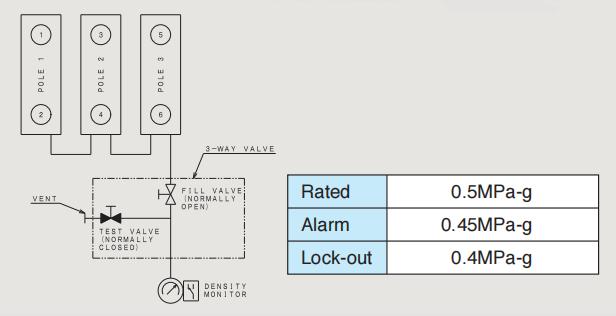
0.5MPa-g (at 20℃ )

Closing operation system

Spring

Tripping control system

Spring

Applicable standard

IEC 62271-100-2008, ANSI/IEEE C37.06-2009

Construction

Overall construction

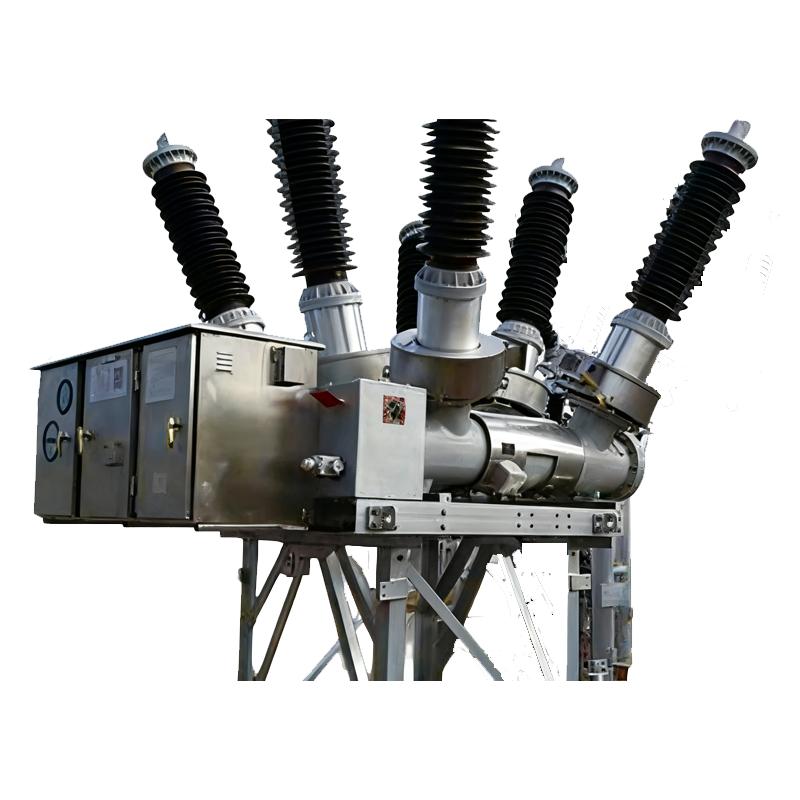
For each phase, a current breaking vacuum interrupter is accommodated in the grounded tank. The operation system is such that closing and tripping are effected by spring force.The operating mechanism and 3-phase interlinkage are assembled on a common base, which is installed on the frame legs.

Internal construction

The overall structure is composed mainly of grounded tank, vacuum interrupters (VI), insulating rods, bushings and main circuit terminals. Each grounded tank is filled with dry air maintained at a rated pressure of 0.5MPa-g (20℃).

Internal construction of vacuum circuit breaker
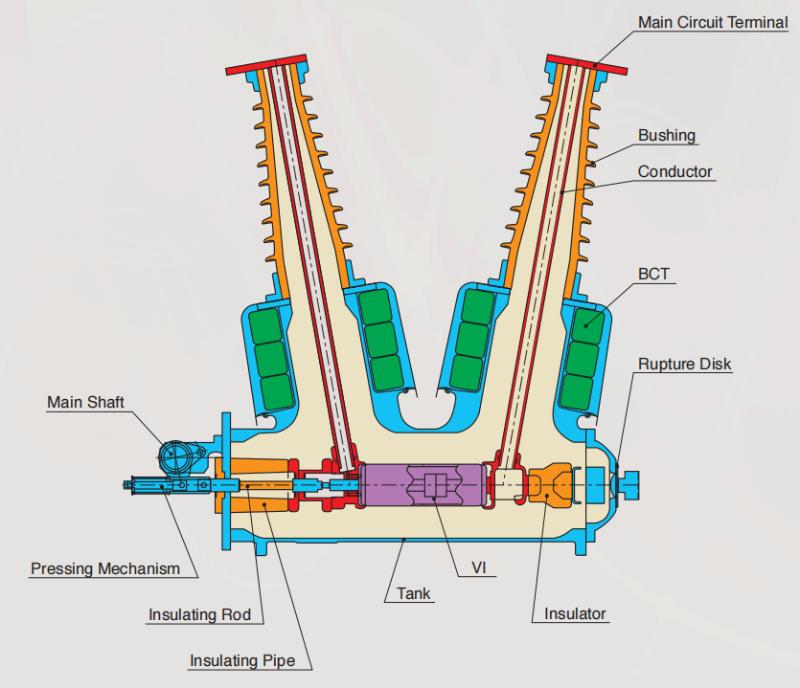
Dry air system
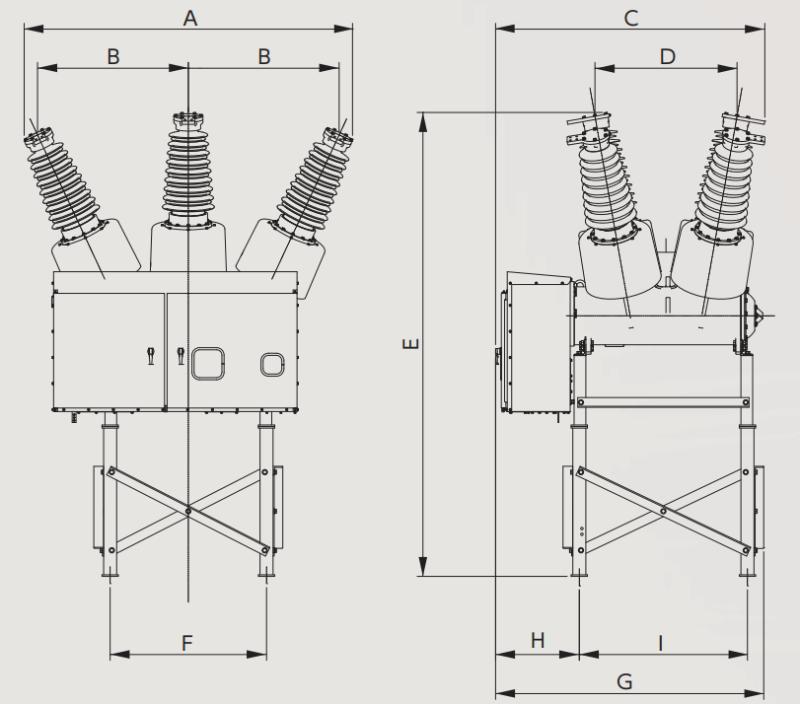
Outline drawing
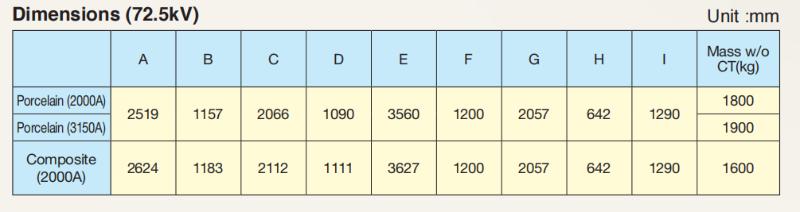
Dimensions (72.5kV)
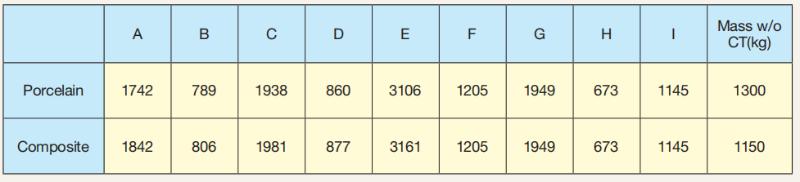
Dimensions (36kV)
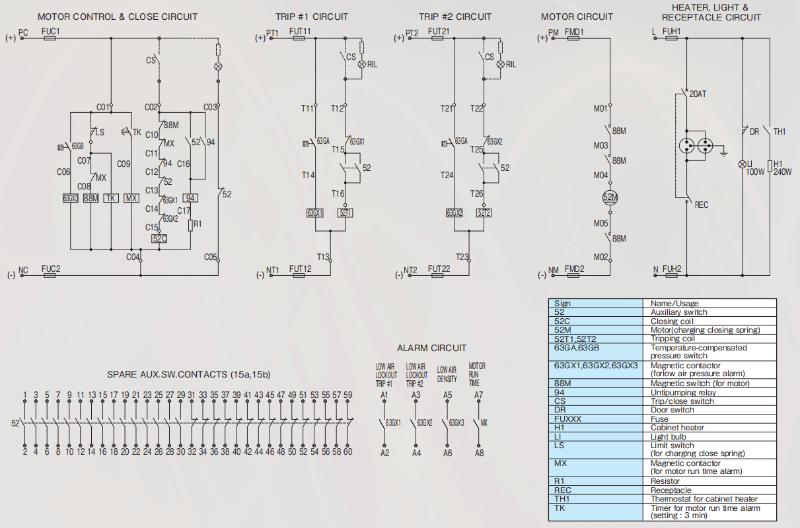
Standard connection diagram
Performance

Performance of the circuit breaker has been designed in accordance with ANSI and IEC standard, and verified by type test. All products are shipped after confirmation of various performances by acceptance test based on these standards.

  • Withstand voltage characteristics :Performance of withstand voltage is assured at the specified dry air pressure. Even though the dry air pressure has been lowered to the alarming level, the required insulation level can be assured.In addition, even though this pressure lowers to the atmosphericpressure, the circuit breaker withstands the rated voltage.

  • Current passing performance :Since the main contacts are located under vacuum, their surfaces are never oxidized and current passing performance is therefore stabilized. In the closing mode of circuit breaker, a pressing force is exerted between main contacts by the effect of pressing spring and sufficient tolerance is assured against closing current and short-time current.

  • Mechanical life :Due to adoption of simplified operating mechanism, switching characteristics are extremely stabilized. Frequent switching performance has also been verified through continuous mechanical switching test by repeating switching operations more than 10,000 times.

  • Electrical life :Since current breaking is performed in the vacuum interrupter,arcing energy generated during current interruption is extremely low and contact erosion is minimal. This implies long contact life.Load current switching : 10,000 times

  • Rated breaking current switching : 20 times
Documentation Resource Library
Restricted
Dead Tank Circuit Breakers Catalog
Catalogue
English
Consulting
Consulting
FAQ
Q: What is the difference between vacuum circuit breaker and SF6 circuit breaker?
A:
  1. Their core difference is arc-extinguishing media: Vacuum breakers use high vacuum (10⁻⁴~10⁻⁶Pa) for insulation and arc extinction; SF₆ breakers rely on SF₆ gas, which adsorbs electrons well to quench arcs.
  2. In voltage adaptation: Vacuum breakers fit medium-low voltages (10kV, 35kV; some up to 110kV), rarely 220kV+. SF₆ breakers suit high-ultra high voltages (110kV~1000kV), mainstream for ultra-high voltage grids.
  3. For performance: Vacuum breakers extinguish arcs fast (<10ms), have 63kA~125kA breaking capacity, suit frequent use (e.g., power distribution) with long life (>10,000 cycles). SF₆ breakers excel in stable large/inductive current breaking but work less frequently, needing insulation recovery time post-extinction.
  4. Compared to SF6 gas circuit breakers, vacuum circuit breakers can achieve zero greenhouse gas emissions and are more environmentally friendly because the arc extinguishing device does not contain any gas
Q: What are the structural characteristics of the tank circuit breaker?
A:

Integral Tank Structure:

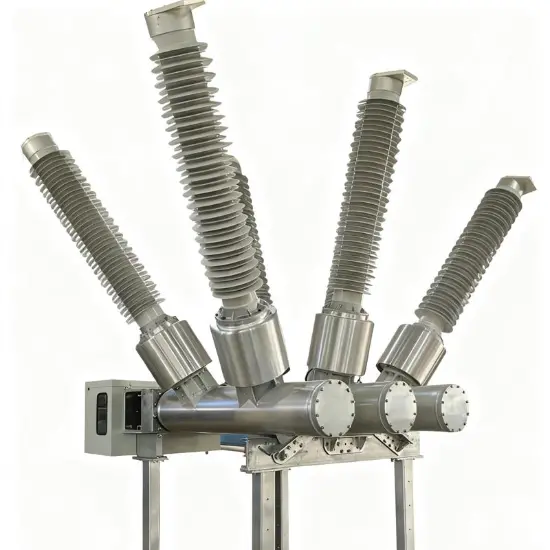
  • Integral Tank Structure: The breaker's arc quenching chamber, insulating medium, and related components are sealed within a metal tank filled with an insulating gas (such as sulfur hexafluoride) or insulating oil. This forms a relatively independent and sealed space, effectively preventing external environmental factors from affecting the internal components. This design enhances the insulation performance and reliability of the equipment, making it suitable for various harsh outdoor environments.

Arc Quenching Chamber Layout:

  • Arc Quenching Chamber Layout: The arc quenching chamber is typically installed inside the tank. Its structure is designed to be compact, enabling efficient arc quenching within a limited space. Depending on different arc quenching principles and technologies, the specific construction of the arc quenching chamber may vary, but generally includes key components such as contacts, nozzles, and insulating materials. These components work together to ensure that the arc is quickly and effectively extinguished when the breaker interrupts the current.

Operating Mechanism:

  • Operating Mechanism: Common operating mechanisms include spring-operated mechanisms and hydraulic-operated mechanisms.

  • Spring-Operated Mechanism: This type of mechanism is simple in structure, highly reliable, and easy to maintain. It drives the opening and closing operations of the breaker through the energy storage and release of springs.

  • Hydraulic-Operated Mechanism: This mechanism offers advantages such as high output power and smooth operation, making it suitable for high-voltage and high-current class breakers.
Know your supplier
Online store
On-time delivery rate
Response time
100.0%
≤4h
Company overview
Workplace: 108000m²m² Total staff: 700+ Highest Annual Export(usD): 150000000
Workplace: 108000m²m²
Total staff: 700+
Highest Annual Export(usD): 150000000
Services
Business Type: Design/Manufacture/Sales
Main Categories: High Voltage Electrical Apparatus/Electric transformer
Whole life care manager
Whole-life care management services for equipment procurement, use, maintenance, and after-sales, ensuring safe operation of electrical equipment, continuous control, and worry-free electricity consumption.
The equipment supplier has passed platform qualification certification and technical evaluation, ensuring compliance, professionalism, and reliability from the source.

Related Products

Related Knowledges

  • Main Transformer Accidents and Light Gas Operation Issues
    1. Accident Record (March 19, 2019)At 16:13 on March 19, 2019, the monitoring background reported a light gas action of No. 3 main transformer. In accordance with the Code for Operation of Power Transformers (DL/T572-2010), operation and maintenance (O&M) personnel inspected the on-site condition of No. 3 main transformer.On-site confirmation: The WBH non-electrical protection panel of No. 3 main transformer reported a Phase B light gas action of the transformer body, and the reset was ineff
    02/05/2026
  • Faults and Handling of Single-phase Grounding in 10kV Distribution Lines
    Characteristics and Detection Devices for Single-Phase Ground Faults1. Characteristics of Single-Phase Ground FaultsCentral Alarm Signals:The warning bell rings, and the indicator lamp labeled “Ground Fault on [X] kV Bus Section [Y]” illuminates. In systems with a Petersen coil (arc suppression coil) grounding the neutral point, the “Petersen Coil Operated” indicator also lights up.Insulation Monitoring Voltmeter Indications:The voltage of the faulted phase decreases (in
    01/30/2026
  • Neutral point grounding operation mode for 110kV~220kV power grid transformers
    The arrangement of neutral point grounding operation modes for 110kV~220kV power grid transformers shall meet the insulation withstand requirements of transformer neutral points, and shall also strive to keep the zero-sequence impedance of substations basically unchanged, while ensuring that the zero-sequence comprehensive impedance at any short-circuit point in the system does not exceed three times the positive-sequence comprehensive impedance.For 220kV and 110kV transformers in new constructi
    01/29/2026
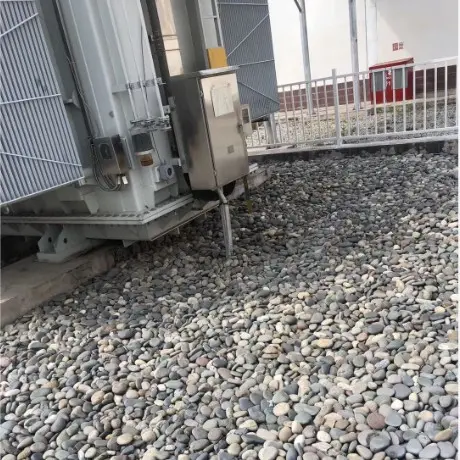
  • Why Do Substations Use Stones, Gravel, Pebbles, and Crushed Rock?
    Why Do Substations Use Stones, Gravel, Pebbles, and Crushed Rock?In substations, equipment such as power and distribution transformers, transmission lines, voltage transformers, current transformers, and disconnect switches all require grounding. Beyond grounding, we will now explore in depth why gravel and crushed stone are commonly used in substations. Though they appear ordinary, these stones play a critical safety and functional role.In substation grounding design—especially when multiple gr
    01/29/2026
  • Why Must a Transformer Core Be Grounded at Only One Point? Isn't Multi-Point Grounding More Reliable?
    Why Does the Transformer Core Need to Be Grounded?During operation, the transformer core, along with the metal structures, parts, and components that fix the core and windings, are all situated in a strong electric field. Under the influence of this electric field, they acquire a relatively high potential with respect to ground. If the core is not grounded, a potential difference will exist between the core and the grounded clamping structures and tank, which may lead to intermittent discharge.I
    01/29/2026
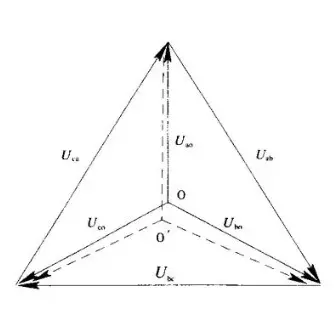
  • Understanding Transformer Neutral Grounding
    I. What is a Neutral Point?In transformers and generators, the neutral point is a specific point in the winding where the absolute voltage between this point and each external terminal is equal. In the diagram below, pointOrepresents the neutral point.II. Why Does the Neutral Point Need Grounding?The electrical connection method between the neutral point and earth in a three-phase AC power system is called theneutral grounding method. This grounding method directly affects:The safety, reliabilit
    01/29/2026

Related Solutions

  • Intelligent Operation Solution for 12kV Vacuum Circuit Breakers: Integrating Real-time Monitoring & Lifetime Optimization
    Ⅰ. Equipment Operation & MaintenanceIntelligent Monitoring System Integration​Multi-parameter Real-time Monitoring: Embedded sensors (temperature, displacement, Hall effect current sensors) track contact temperature rise, mechanical characteristics (opening/closing speed, overtravel), coil current, and partial discharge signals. Data undergoes preprocessing via edge computing prior to cloud upload.​Lifetime Prediction Model: Dynamically evaluates remaining lifespan using electrical wear data
    06/10/2025
  • SF6 Circuit Breaker Solutions for Outdoor Installation (Anti-Pollution & Seismic Resistance)
    I.Core Challenges in Outdoor Installation​In high-voltage transmission and distribution systems, SF6 circuit breakers are exposed to complex outdoor environments for extended periods, facing the following critical issues:​Pollution & Insulation Degradation​Dust, salt fog, and industrial pollutants in outdoor environments easily adhere to equipment surfaces. In coastal or industrial areas, pollution levels may reach ​Class IV, resulting in insufficient creepage distance and triggering ​flasho
    05/12/2025
  • 12kV Indoor Vacuum Circuit Breaker Southeast Asia Solution: Anti-Corrosion Compact Design
    12kV Indoor Vacuum Circuit Breaker Southeast Asia Solution: Anti-Corrosion Compact DesignⅠ. Executive Summary​Southeast Asia faces rapidly growing electricity demand alongside environmental challenges including high temperatures, humidity, salt spray corrosion, and grid instability. This solution recommends ​Solid Insulated Pole-Mounted Vacuum Circuit Breakers (VCB)​​ featuring ​high reliability, ​compact design, and ​smart monitoring. Tailored for tropical climates and industrial scenarios, it
    06/10/2025
Haven't found the right supplier yet? Let matching verified suppliers find you. Get Quotation Now
Haven't found the right supplier yet? Let matching verified suppliers find you.
Get Quotation Now
Send inquiry
+86
Click to upload file
Download
Get the IEE Business Application
Use the IEE-Business app to find equipment, obtain solutions, connect with experts, and participate in industry collaboration anytime, anywhere—fully supporting the development of your power projects and business.