• Product
  • Suppliers
  • Manufacturers
  • Solutions
  • Free tools
  • Knowledges
  • Experts
  • Communities
Search


Free Expert Guides on Power Systems, Circuit Design & Electrical Troubleshooting

Access free engineering resources from IEE Business—covering power design, circuit layout, equipment selection, and troubleshooting. Expert-developed guides help engineers, procurement, and project teams make better decisions. Stay ahead on smart grids, renewables, efficiency, and AI tools. Improve reliability, reduce downtime, and enhance outcomes with real-world solutions. Explore our knowledge hub today.
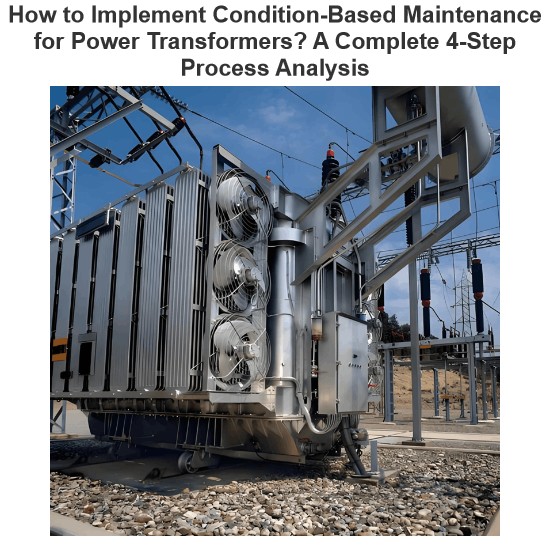
How to Implement Condition-Based Maintenance for Power Transformers? A Complete 4-Step Process Analysis
1. Definition of Condition-Based MaintenanceCondition-based maintenance refers to a maintenance method where decisions on whether and how to perform maintenance are determined based on the real-time operating status and health condition of equipment. It has no fixed maintenance methods or schedules. The prerequisite for condition-based maintenance is the establishment of equipment parameters and the comprehensive analysis of various operational information of the equipment, so as to make reasona
09/12/2025
Consult
Tip
Consult
Tip
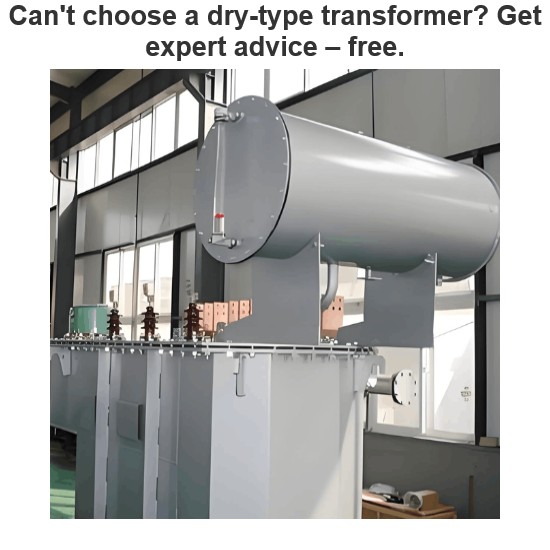
Can't choose a dry-type transformer? Get expert advice – free.
Traction Rectifier TransformersRated capacity: 800 to 4400 kVA; Voltage class: 10 kV and 35 kV; Rectifier pulse number: 12-pulse and 24-pulse. Compared with 12-pulse rectifier circuits, 24-pulse rectifier circuits can reduce the harmonic pollution of the power grid by 50%, and no filtering equipment is needed at this location. It is suitable for power supply systems of urban subways and rail transit.Excitation Rectifier TransformersRated capacity: 315 to 3000 × 3 kVA; Voltage class: 10 kV, 13.8
09/12/2025
Consult
Tip
Consult
Tip
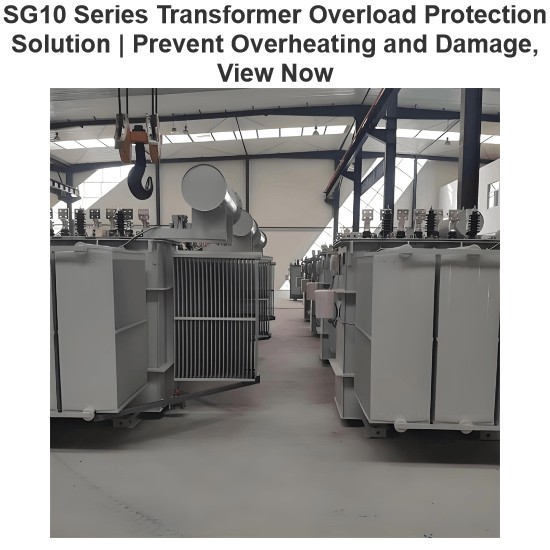
SG10 Series Transformer Overload Protection Solution | Prevent Overheating and Damage, View Now
Operating Conditions in National Standard GB 6450-1986Ambient temperature: Maximum ambient temperature: +40°C Daily average maximum temperature: +30°C Annual average maximum temperature: +20°C Minimum temperature: -30°C (outdoor); -5°C (indoor) Horizontal axis: Product load; Vertical axis: Average coil temperature rise in Kelvin (note: not in Celsius).For Class H insulation products, the long-term temperature resistance of insulation materials is stipulated by the state as 180°C. However, the in
09/12/2025
Consult
Tip
Consult
Tip
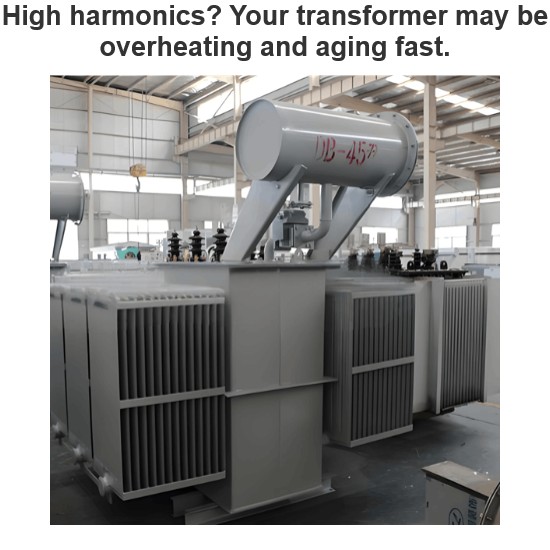
High harmonics? Your transformer may be overheating and aging fast.
This report is based on the analysis of one-day power quality monitoring data of your company's distribution system. The data shows that there is significant three-phase current harmonic distortion in the system (with a high total harmonic distortion of current, THDi). In accordance with international standards (IEC/IEEE), harmonic currents at this level have posed substantial risks to the safe, reliable, and economical operation of the power supply transformer, mainly manifested in additional h
09/12/2025
Consult
Tip
Consult
Tip
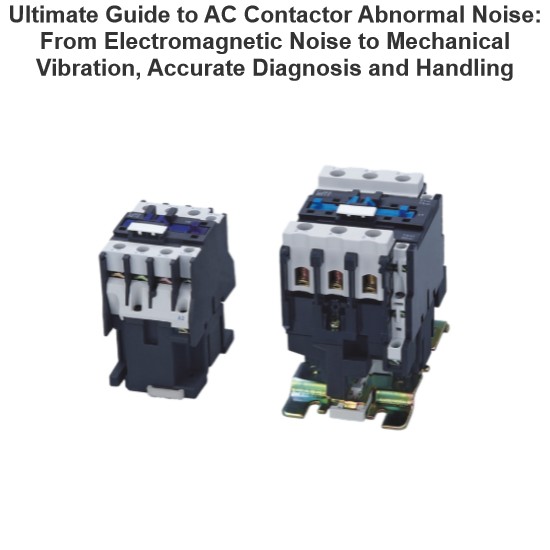
Ultimate Guide to AC Contactor Abnormal Noise: From Electromagnetic Noise to Mechanical Vibration, Accurate Diagnosis and Handling
In electrical control systems, AC contactors are among the commonly used electrical components, and they are also a common source of various electrical faults. After long-term use—especially in harsh environments with high levels of dust—AC contactors may sometimes emit squeaking or rattling noises after being pulled in and held. The causes of this phenomenon are analyzed as follows.Squeaking Noise After Pull-In and HoldingA fully functional AC contactor makes no noise when energized and pulled
09/11/2025
Consult
Tip
Consult
Tip
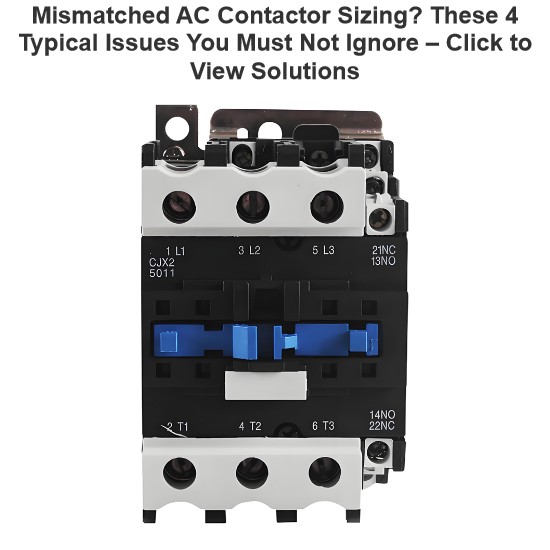
Mismatched AC Contactor Sizing? These 4 Typical Issues You Must Not Ignore – Click to View Solutions
AC contactors (with the electrical schematic code KM) are core electrical devices used to control the connection/disconnection between power supplies and loads in circuits, and they are also common equipment that electricians need to work with regularly. In practice, it is not uncommon to find that some peers make mistakes in selecting AC contactors, leading to improper sizing and subsequent persistent issues. Here, four of the most typical common mistakes are highlighted for reference.I. Over-R
09/11/2025
Consult
Tip
Consult
Tip
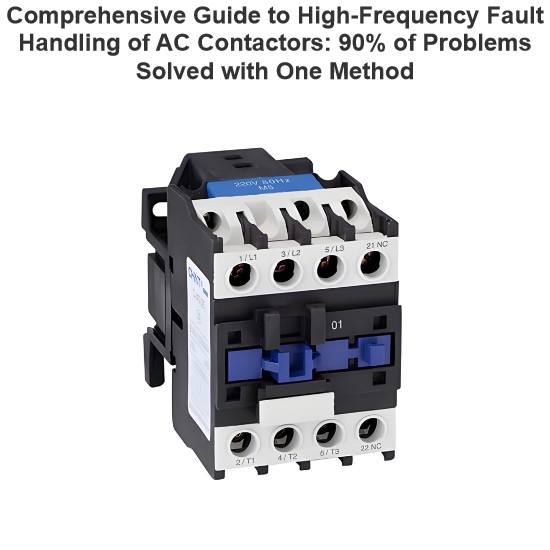
Comprehensive Guide to High-Frequency Fault Handling of AC Contactors: 90% of Problems Solved with One Method
1. Fault Phenomena, Cause Analysis and Handling MethodsContactor does not operate or operates abnormally after coil energization Open circuit in coil control circuit; Check if there is wire breakage or loosening at the terminal blocks. If there is a wire breakage, replace the corresponding wire; if there is loosening, fasten the corresponding terminal block. Coil damage; Measure the coil resistance with a multimeter. If the resistance is ∞, replace the coil. Thermal relay not reset after operati
09/11/2025
Consult
Tip
Consult
Tip
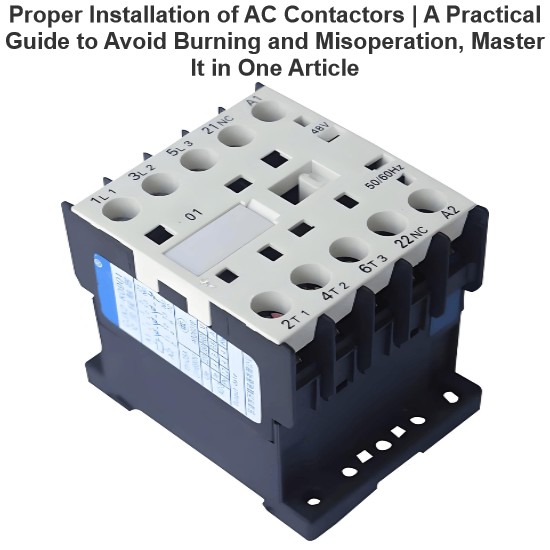
Proper Installation of AC Contactors | A Practical Guide to Avoid Burning and Misoperation, Master It in One Article
AC contactors are widely used for switching and controlling power circuits. They use main contacts to open and close circuits, and auxiliary contacts to execute control commands. Main contacts typically only have normally open contacts, while auxiliary contacts often have two pairs of contacts with normally open and normally closed functions. Small-sized contactors are also frequently used as intermediate relays to work with main circuits, thereby achieving the function of remote control or cont
09/11/2025
Consult
Tip
Consult
Tip
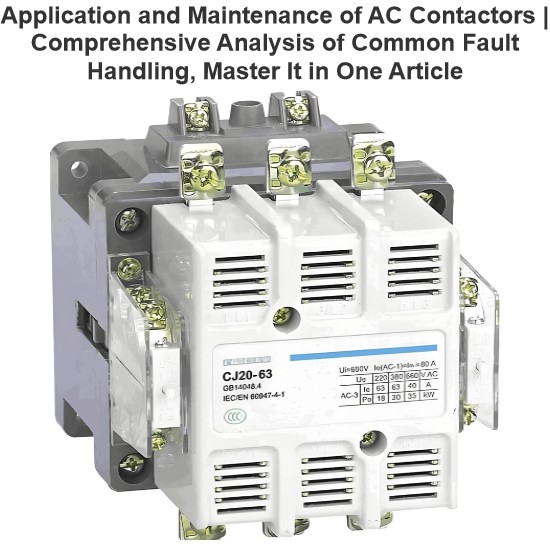
Application and Maintenance of AC Contactors | Comprehensive Analysis of Common Fault Handling, Master It in One Article
1 Analysis of Key Components of AC ContactorsAn AC contactor is an automated electromagnetic switch used for long-term, high-frequency switching of AC main circuits and control circuits. It features advantages such as automatic operation, under-voltage and no-voltage protection, high-capacity operation, strong stability, and low maintenance requirements. In the electrical control circuits of machine tools, AC contactors are mainly used to control electric motors and other loads.The key component
09/11/2025
Consult
Tip
Consult
Tip
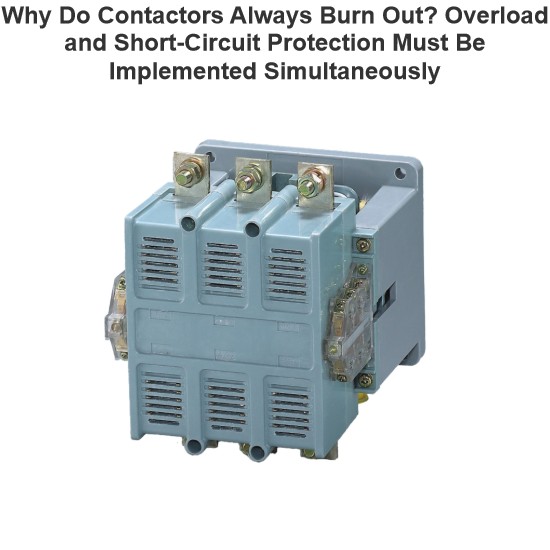
Why Do Contactors Always Burn Out? Overload and Short-Circuit Protection Must Be Implemented Simultaneously
Contactors are used to close and open loads that require such operations during normal use, particularly for specific activities like medium-voltage public lighting and industrial electric motors.The medium-voltage contactor + fuse combination controller (F-C) can control motors up to 12 kV. However, medium-voltage controllers are also suitable as feeders for other types of loads, especially transformers. For such loads, contactors are usually modified to include mechanical latching, so that the
09/11/2025
Consult
Tip
Consult
Tip
Send inquiry
+86
Click to upload file
Download
Get the IEE Business Application
Use the IEE-Business app to find equipment, obtain solutions, connect with experts, and participate in industry collaboration anytime, anywhere—fully supporting the development of your power projects and business.