Search


Rockwill RHP HGIS SF6 Pressure Protection Logic and Field Handling Procedure

Rockwill RHP HGIS SF6 pressure protection logic with alarm/block thresholds and field handling for gas leaks and density monitoring.

Rockwill
Field: Manufacturing
10Year<
China
Add us on Google
 

1. Protection Logic

1.1 Stage 1 — Low Pressure Alarm (First Stage)

When the SF6 equivalent pressure drops to the first alarm setpoint, the microswitch inside the density relay operates and sends an "SF6 gas pressure low" alarm signal to the remote monitoring system, prompting maintenance personnel to investigate and handle the situation promptly. At this stage the circuit-breaker can still perform normal opening and closing operations, but gas replenishment or leak investigation must be arranged as soon as possible; prolonged operation under alarm conditions is not permitted.

1.2 Stage 2 — Low Pressure Lockout (Second Stage)

When the equivalent pressure continues to fall to the second alarm setpoint (lockout value), the gas has leaked severely and the SF6 density in the interrupter is no longer sufficient to extinguish an arc reliably. The density relay, through its auxiliary contacts, disconnects the circuit-breaker's trip and close control circuits, thereby implementing an operational lockout. The monitoring system issues an "SF6 device lockout" alarm and an audible signal; the circuit-breaker is forced to remain in its current position and any opening or closing operation is prohibited, to prevent a sustained power arc that could cause phase-to-phase short circuits, busbar faults, or tank rupture.

Note: The alarm and lockout functions use two independent microswitch contacts; even if the alarm circuit fails, the lockout function will still operate correctly.

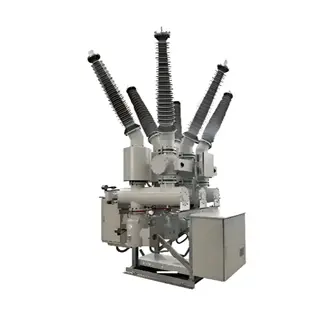
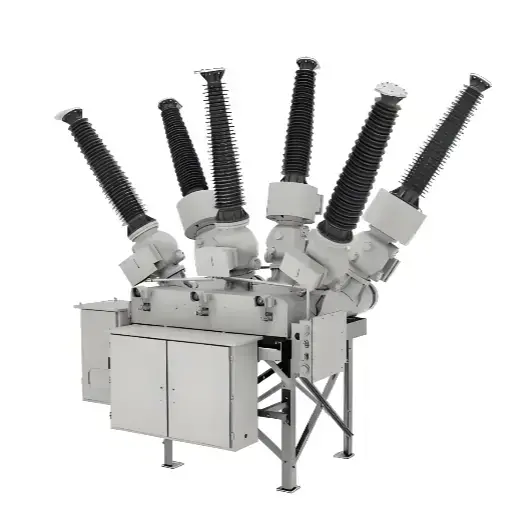
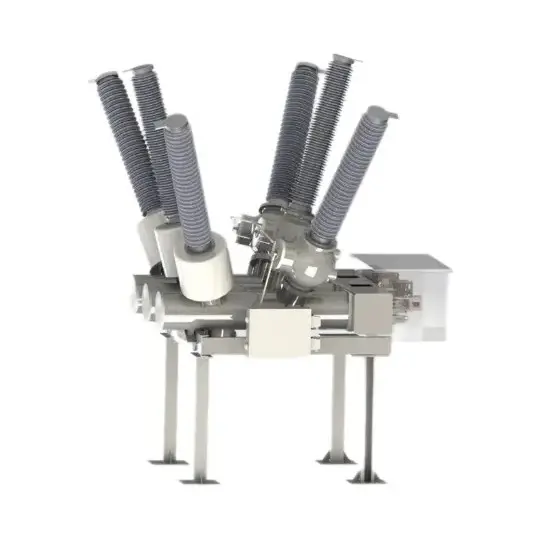
Hybrid Gas-Insulated Switchgear HGIS 145kV

Hybrid Gas-Insulated Switchgear


2. Field Handling Procedure

2.1 Low Pressure Alarm Handling

  • Safety protection: Approach from the upwind side; confirm that the HGIS compartment SF6 leak detector shows no alarm and the oxygen concentration is acceptable (≥19.5%). If any pungent odour or physical discomfort is sensed, evacuate immediately and return only after donning a positive-pressure self-contained breathing apparatus (SCBA).
  • Signal and gauge verification:Check the on-site SF6 density relay indication to confirm the alarm is genuine. If the gauge reads normally, treat the alarm as a false signal from the secondary circuit and notify maintenance personnel. When reading the pressure, apply temperature-compensation correction.
  • Leak check and gas replenishment:If the pressure has dropped but has not reached the lockout value and no obvious leak point is found, notify maintenance personnel to perform live gas replenishment to the rated pressure. After replenishment, continuously monitor the pressure trend; if the pressure drops again within 24 hours, a leak point exists and must be investigated further.
  • Isolation: If an obvious leak point is found or the pressure continues to drop and cannot be maintained, report immediately to the dispatcher, request load transfer or busbar switching, and take the compartment out of service for repair.

2.2 Low Pressure Lockout Handling

  • Cut off operating power:After confirming the circuit-breaker is locked out, immediately disconnect the trip and close operating power supplies of that circuit-breaker (do not disconnect the signal power supply, to avoid losing monitoring). Lock the operating mechanism in its current position (normally the closed position) to prevent inadvertent operation.
  • Report to dispatcher:Immediately report the findings (pressure value, lockout status, equipment ID) to the duty dispatcher and request isolation and withdrawal from service of the faulty bay.
  • Load transfer:If the system topology permits, transfer the load to the bypass breaker or bus-coupler via switching operations, then open the isolators on both sides of the bay to achieve electrical isolation. Before operating the isolators, verify that the circuit-breaker is open or that the locked-out bay is confirmed de-energised.
  • Emergency shutdown:If load transfer is impossible, request opening of the upstream breaker or the entire busbar section to take the leaking bay out of service.
  • Earthing:After isolation, close the earthing switches on both sides of the bay (or install temporary earthing leads per procedure if no earthing switch is provided) to ensure reliable maintenance earthing.
  • Safety warnings:Attach "Do Not Close" and "Do Not Open" warning tags on the operating handle and mechanism box of the affected bay; assign a dedicated watchman if necessary.
 

When the SF6 pressure reaches the lockout value or drops to zero, it is absolutely forbidden to forcibly override the lockout and perform any opening or closing operation. At this point the SF6 density in the interrupter is insufficient to extinguish an arc, and any operation will cause:

  • Sustained arc across the contacts → phase-to-phase or phase-to-earth short-circuit fault
  • High-temperature arc decomposition of SF6 producing toxic by-products (HF, SO2, SF4, etc.) → severe respiratory and skin injuries
  • Rapid SF6 expansion and pressure surge from arc energy → tank rupture or rupture-disc operation
  • Step-voltage and touch-voltage hazards from short-circuit current → personal injury or death

Violation of this prohibition will result in severe equipment damage, power-system accidents, and loss of life.


4. Supplementary Requirements

4.1 SF6 Gas Management

  • Recovery: During leak repair and maintenance, SF6 must be recovered into storage cylinders using approved recovery equipment; direct atmospheric release is strictly prohibited (SF6 GWP = 23,900, i.e., 23,900 times that of CO2).
  • Moisture detection: Before refilling, verify that the new gas moisture content is ≤250 ppm (IEC 60376). Re-test the compartment moisture 24 hours after refilling to confirm no moisture ingress.
  • Cylinder handling: New SF6 cylinders must stand upright for 24 hours before use; only the gaseous phase shall be used; the liquid phase is strictly prohibited.

4.2 Online Monitoring and Periodic Maintenance

  • Pressure monitoring: Daily recording of the density relay indicated pressure is recommended; trend curves should be plotted. Annual leakage rate target ≤0.5%. If the daily equivalent pressure drop exceeds 0.01 MPa, immediate investigation is required.
  • Density relay calibration: Every two years, calibrate the alarm and lockout setpoints to confirm both contacts operate independently and reliably. Calibration must not disable the protection of the running equipment.
  • Rupture disc inspection: Every six months inspect the tank rupture disc for corrosion, deformation, or blockage.

4.3 PPE Requirements for Leak Handling

  • Respiratory protection: Positive-pressure self-contained breathing apparatus (SCBA); filter-type gas masks are prohibited.
  • Body protection: Acid-resistant chemical protective suit (butyl rubber or equivalent).
  • Hand protection: Acid-resistant rubber gloves.
  • Eye protection: Full-seal goggles or face shield.
  • Foot protection: Acid-resistant boots.

4.5 Records and Reports

After every pressure anomaly event (alarm or lockout), the following information must be recorded and archived:

  • Event time, gas compartment ID, pressure reading, and ambient temperature
  • Density relay setpoints (alarm / lockout)
  • Gas refill quantity (kg) and post-refill pressure
  • Leak location method and rectification result
  • Moisture test results
 

Summary

Rockwill RHP HGIS SF6 pressure protection employs two independent logic stages: the alarm stage prompts timely gas replenishment and leak investigation; the lockout stage forcibly prohibits operation to ensure safety. The key principle of field handling is — rapid response, gas replenishment, and leak investigation during the alarm stage; strict prohibition of operation, isolation, and earthing during the lockout stage. Under no circumstances shall the lockout be overridden. Strict adherence to the above procedure effectively reduces the risk of equipment damage and personal injury from SF6 leakage, ensuring reliable operation of the HGIS throughout its service life.

Edited From:Garca

Give a tip and encourage the author!
Topics:

Comments

Share your question or perspective
WhatsApp
Send inquiry
+86
Click to upload file
Download
Get the IEE Business Application
Use the IEE-Business app to find equipment, obtain solutions, connect with experts, and participate in industry collaboration anytime, anywhere—fully supporting the development of your power projects and business.
Login
or continue with
New here?
Register