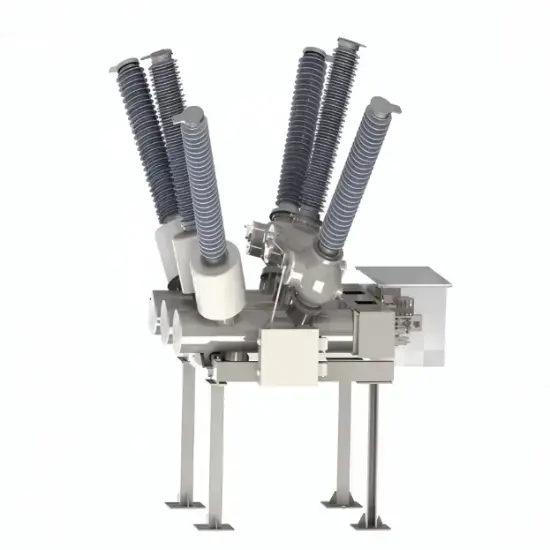
HGIS encapsulates core components such as the circuit breaker, disconnector, earthing switch, and current transformer within SF₆-insulated metal enclosures, while the busbar remains air-insulated and externally exposed. When adopting a three-phase segregated tank design (with each phase enclosed in its own independent tank) rather than a three-phase common tank, the following core advantages are achieved:
1. Fault Isolation — Single-Phase Faults Do Not Propagate
Each phase has its own independent sealed gas compartment. An internal arc or insulation fault occurring in one phase is contained within that phase's enclosure, without affecting the other two phases. This significantly enhances system-level safety and reliability.
2. Maintenance Flexibility — Single-Phase Outage for Servicing
When servicing or replacing components of one phase, only that phase's gas compartment needs to be vented and opened, while the other two phases can remain energized (subject to grid dispatch requirements), substantially reducing outage windows.
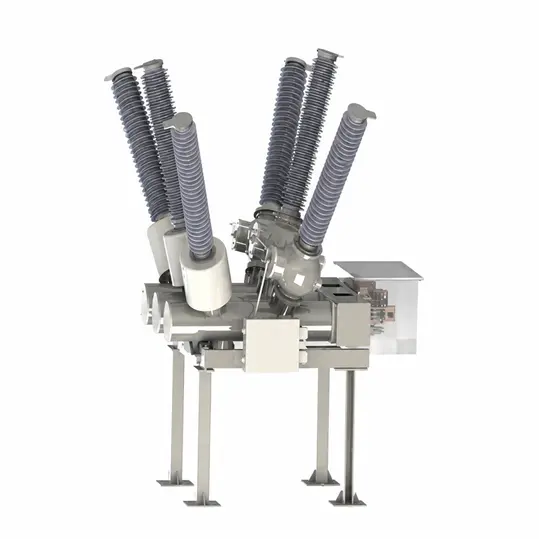
Rockwill RHP Series HGIS Hybrid Gas Insulated Switchgear
The Rockwill HGIS RHP Series employs factory pre-assembly and high-voltage pre-testing processes, which further reduce on-site maintenance workload and significantly shorten power interruption durations.
3. Precise SF₆ Gas Management
- Each phase features independent gas filling and density monitoring, enabling accurate leak localization
- Gas recovery/refilling operations involve only a single phase, reducing SF₆ consumption and emissions
- Eliminates the risk of simultaneous pressure drop across all three phases due to a leak in a common-tank configuration
The Rockwill HGIS RHP Series is equipped with a digital gas monitoring system that supports remote supervision and fault pinpointing, further enhancing the intelligence of gas management.
4. Greater Insulation Design Margin
Within each single-phase enclosure, only phase-to-ground insulation needs to be considered, while phase-to-phase insulation is provided by the clearance between enclosures and external air. This results in a more uniform electric field distribution and lower partial discharge risk.
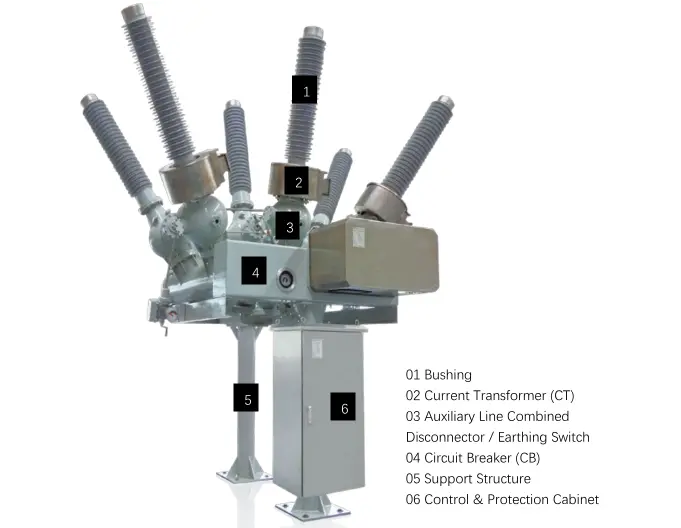
RHP Series HGIS Schematic
5. Superior Heat Dissipation Performance
The total external surface area of three independent enclosures is significantly larger than that of a single common tank, facilitating natural heat dissipation during high-current operation and providing greater thermal margin for temperature rise control.
6. More Comprehensive Factory Testing
Each phase can be independently subjected to lightning impulse, power-frequency withstand voltage, and partial discharge tests, with test conditions more closely replicating actual operating conditions, enabling finer quality control granularity.
7. Comparison: Segregated Tank vs. Common Tank
| Aspect |
Three-Phase Segregated Tank |
Three-Phase Common Tank |
| Fault Isolation |
Single-phase independent isolation |
Interlinked across three phases; wider impact zone |
| Maintenance Flexibility |
Allows single-phase servicing |
Requires simultaneous outage of all three phases |
| Gas Management |
Independent monitoring; precise leak localization |
Shared gas compartment; one leak affects all phases |
| Insulation Margin |
Phase-to-ground only; greater margin |
Must accommodate both phase-to-ground and phase-to-phase |
| Heat Dissipation Area |
Larger |
Relatively smaller |
| Footprint |
Slightly larger |
More compact |
| Operating Mechanism |
Motor/hydraulic (phase-segregated operation) |
Spring-loaded (three-phase gang-operated) |
| Preferred Voltage Range |
≥126kV (preferred) |
≤126kV |
8. Summary
The three-phase segregated tank design offers comprehensive superiority in reliability, maintainability, and fault isolation. The common tank design, by contrast, provides advantages in compactness, smaller footprint, and slightly lower cost. For high-voltage substation projects where power supply reliability is paramount, the three-phase segregated tank is the preferred choice.
The Rockwill HGIS RHP Series, through the deep integration of modular design, factory pre-assembly, and digital monitoring technologies, effectively translates the technical advantages of three-phase segregated construction into quantifiable engineering benefits, delivering an ideal solution that combines both economic efficiency and reliability for high-voltage power transmission and distribution systems.
Edited From:Garca

 Login