• Product
  • Suppliers
  • Manufacturers
  • Solutions
  • Free tools
  • Knowledges
  • Experts
  • Communities
Search


Understanding Power Transformer Efficiency: Key Factors and Performance

Vziman
Field: Manufacturing
China

The efficiency of a power transformer is influenced by a variety of factors, including its design, size, and operating conditions. In general, power transformers are highly efficient, with typical efficiencies exceeding 95%, and often reaching 98% or higher. However, actual efficiency can vary depending on load levels, voltage ratings, and specific design characteristics.

Transformer efficiency (η) is defined as the ratio of output power to input power, expressed as a percentage:

η = (Output Power / Input Power) × 100%

Several key factors affect transformer efficiency:

  • Load Level: Transformers typically achieve peak efficiency when operating near their rated load. Efficiency tends to decrease at both very light loads (due to fixed core losses) and under heavy overloads (due to increased copper losses).

  • Core and Copper Losses:

    • Core losses (comprising hysteresis and eddy current losses) occur in the magnetic core and are present whenever the transformer is energized, even at no load.

    • Copper losses (I²R losses) occur in the windings due to the electrical resistance of the conductors and vary with the square of the load current.
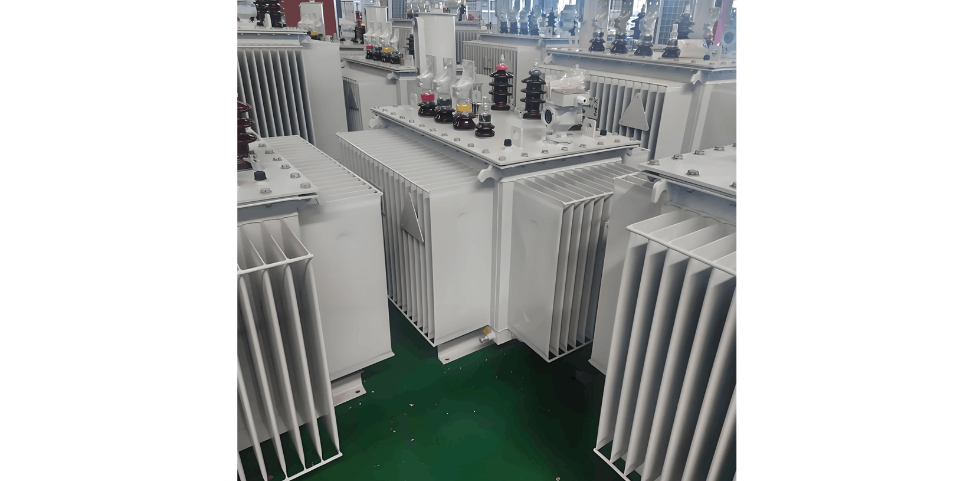
  • Voltage Level: Higher-voltage transformers generally exhibit higher efficiency. Elevated voltage reduces the current for a given power level, thereby minimizing copper losses in the windings.

  • Transformer Design: Design choices—such as core material (e.g., grain-oriented silicon steel), conductor material (copper vs. aluminum), winding configuration, and cooling method (ONAN, ONAF, etc.)—significantly impact overall efficiency.

  • Operating Temperature: Transformers are designed to operate within a specified temperature range. Exceeding these limits can accelerate insulation aging and increase resistive losses, negatively affecting efficiency and longevity.

It is important to recognize that energy losses in transformers are inherent and are classified into two main categories: no-load losses (primarily core losses) and load-dependent losses (mainly copper losses). While manufacturers continuously optimize designs to minimize losses, transformers cannot achieve 100% efficiency, as some energy is inevitably dissipated as heat.

Efficiency standards and regulatory requirements vary by region and application (e.g., DOE in the U.S., IEC standards internationally). When selecting a transformer, it is essential to evaluate expected load profiles, operating conditions, and applicable efficiency standards to ensure optimal performance, energy savings, and long-term reliability within the electrical system.
Give a tip and encourage the author!

Recommended

Impact of DC Bias in Transformers at Renewable Energy Stations Near UHVDC Grounding Electrodes
Impact of DC Bias in Transformers at Renewable Energy Stations Near UHVDC Grounding ElectrodesWhen the grounding electrode of an Ultra-High-Voltage Direct Current (UHVDC) transmission system is located close to a renewable energy power station, the return current flowing through the earth can cause a rise in ground potential around the electrode area. This ground potential rise leads to a shift in the neutral-point potential of nearby power transformers, inducing DC bias (or DC offset) in their
01/15/2026
HECI GCB for Generators – Fast SF6 Circuit Breaker
1.Definition and Function1.1 Role of the Generator Circuit BreakerThe Generator Circuit Breaker (GCB) is a controllable disconnect point located between the generator and the step-up transformer, serving as an interface between the generator and the power grid. Its primary functions include isolating generator-side faults and enabling operational control during generator synchronization and grid connection. The operating principle of a GCB is not significantly different from that of a standard c
01/06/2026
Distribution Equipment Transformer Testing, Inspection, and Maintenance
1.Transformer Maintenance and Inspection Open the low-voltage (LV) circuit breaker of the transformer under maintenance, remove the control power fuse, and hang a “Do Not Close” warning sign on the switch handle. Open the high-voltage (HV) circuit breaker of the transformer under maintenance, close the grounding switch, fully discharge the transformer, lock the HV switchgear, and hang a “Do Not Close” warning sign on the switch handle. For dry-type transformer maintenance: first clean the porcel
12/25/2025
How to Test Insulation Resistance of Distribution Transformers
In practical work, insulation resistance of distribution transformers is generally measured twice: the insulation resistance between thehigh-voltage (HV) windingand thelow-voltage (LV) winding plus the transformer tank, and the insulation resistance between theLV windingand theHV winding plus the transformer tank.If both measurements yield acceptable values, it indicates that the insulation among the HV winding, LV winding, and transformer tank is qualified. If either measurement fails, pairwise
12/25/2025
Related Products
Send inquiry
+86
Click to upload file

IEE Business will not sell or share your personal information.

Download
Get the IEE Business Application
Use the IEE-Business app to find equipment, obtain solutions, connect with experts, and participate in industry collaboration anytime, anywhere—fully supporting the development of your power projects and business.