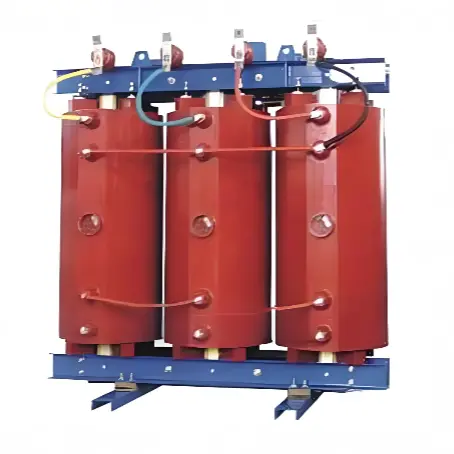
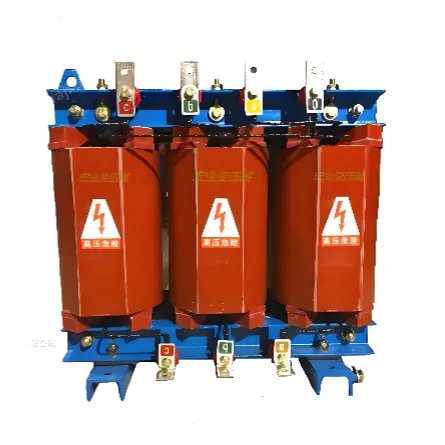
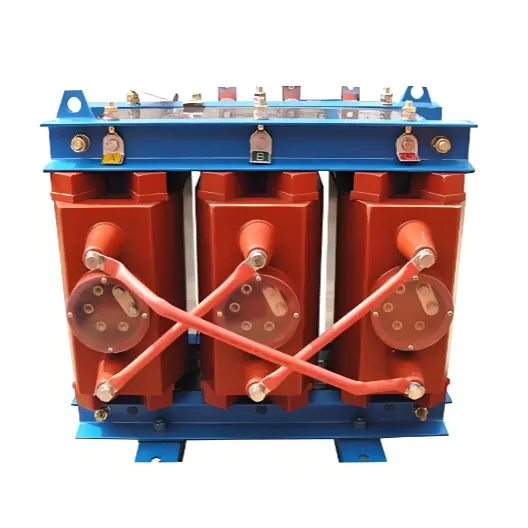
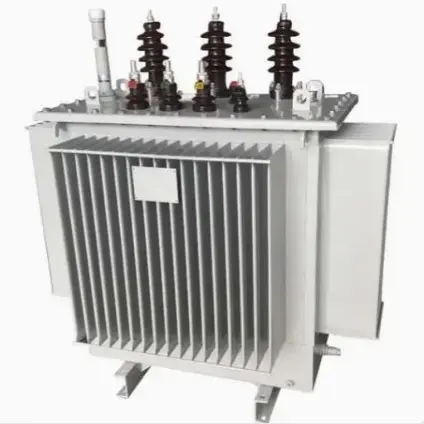
Epoxy Resin Cast Dry-Type Grounding Transformer
This product provides an artificial neutral point for grids with an insulated neutral, which can be grounded via an arc suppression coil, resistor, or directly. In the event of a single-phase earth fault in the grid, it performs compensation to prevent the expansion or even eliminate the fault, ensuring the quality of power supply. It is widely used in distribution substations, power plants, and other facilities.
The product adopts a ZN connection and can be equipped with a secondary winding to serve as an auxiliary power source for substations. The high-voltage coil is divided into inner and outer groups by an air duct, adopting a radial concentric distribution structure to meet the requirements of low zero-sequence impedance.
Grounding transformers are used in three-phase power systems with an insulated neutral to provide an artificial neutral point for such systems. The connection groups include Ynd11 and ZNyn11. The ZNyn11 secondary winding can carry load or be omitted.
Scope of Application
- This product is suitable for three-phase, 50 Hz power grids of 6 kV, 10 kV, and 35 kV.
- It is mainly used to provide an artificial, loadable neutral point for unearthed neutral systems for system grounding.
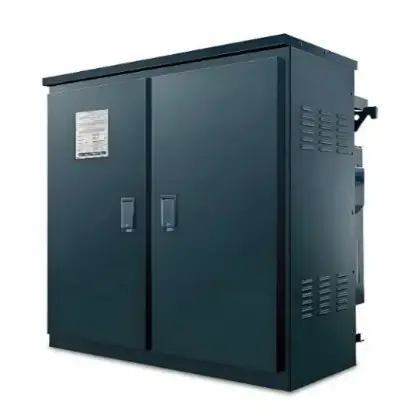
- It features Class F insulation, designed for indoor use, and can be used outdoors when equipped with an enclosure.
Detailed Information
A grounding transformer is used in a three-phase power system with an insulated neutral to provide an artificial neutral point. This neutral point can be grounded directly or via a reactor, resistor, or arc suppression coil.
The purposes of grounding the artificial neutral point derived from an insulated neutral system are as follows:
-
Overhead lines are susceptible to electrostatic charges induced by nearby charged clouds, dust, hail, fog, and rain, which alter the line-to-earth voltage. As these induced charges accumulate, the line and connected equipment develop a high floating potential to earth, endangering their insulation. Artificially grounding the neutral point conducts these induced charges to earth, preventing potential damage to lines and equipment.
-
High-voltage oscillations are common in systems with an insulated neutral. Grounding the neutral point minimizes these oscillations.
-
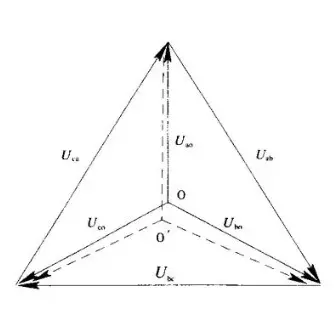
In systems with an insulated neutral, a single-phase earth fault typically manifests as an arcing earth fault, producing intermittent arcs. The voltage of the healthy phase lines to earth rises to the line voltage, and the line-to-earth capacitive current increases to 1.732 times its normal value. The capacitive current at the fault point is 1.732 times that of a healthy phase-to-earth capacitive current, resulting in a total fault point capacitive current three times the normal line-to-earth capacitive current. By connecting an arc suppression coil between the system neutral and earth, the inductive current flowing through the coil compensates for the capacitive current at the fault point, quickly extinguishing the intermittent arc automatically.
-
Deriving an artificial neutral point from an insulated neutral system and grounding it (without an arc suppression coil), in conjunction with automatic protective devices, allows isolation of the faulty section at the initial stage of the fault.
The requirements for a grounding transformer are as follows:
- It must have a neutral point that can be grounded to facilitate system neutral grounding.
- In the event of a single-phase earth short circuit, the earth current at the fault point must flow smoothly through the grounding transformer windings back to the line, providing sufficient fault current information to the automatic protective devices.
|
Product Model
|
HV Tap Range (%)
|
Connection Group
|
Rated Capacity (kVA)
|
Zero-sequence Impedance (Ω)
|
No-load Loss (kW)
|
Load Loss (kW)
|
No-load Current (%)
|
Short-circuit Impedance (%)
|
Weight (kg)
|
|
DKSC-100/10.5
|
±2×2.5
|
ZNyn11
|
ZN
|
100
|
27.6
|
0.42
|
2
|
2.2
|
2.5
|
600
|
|
DKSC-200/10.5
|
±2×2.5
|
200
|
13.8
|
0.68
|
3.33
|
2.2
|
2.5
|
930
|
|
DKSC-315/10
|
±2×2.5
|
315
|
12.7
|
0.96
|
4.72
|
1.8
|
4
|
850
|
|
DKSC-400/10.5
|
±2×2.5
|
400
|
6.89
|
1.08
|
5.47
|
1.8
|
2.5
|
1200
|
|
DKSC-500/10.5
|
±2×2.5
|
500
|
5.51
|
1.28
|
6.66
|
1.8
|
2.5
|
1300
|
|
DKSC-630/10.5
|
±2×2.5
|
630
|
4.41
|
1.48
|
7.77
|
1
|
2.5
|
1570
|
|
DKSC-1000/38.5
|
±2×2.5
|
1000
|
59.3
|
1.96
|
12.9
|
1.3
|
4
|
3130
|
|
DKSC-2000/38.5
|
±2×2.5
|
2000
|
37.1
|
3.68
|
22.4
|
1.3
|
5
|
5130
|
Application Scenarios
- Suitable for urban distribution substations with insulated neutral at 30kV, 34.5kV and 35kV, providing an artificial neutral point for the system, suppressing single-phase earth faults with arc suppression coils, and ensuring stable urban power supply.
- Applied in 34.5kV power supply systems in industrial parks such as petrochemical and manufacturing plants, protecting sensitive production equipment by artificial neutral grounding and preventing fault expansion from affecting production.
- Adapted to the collector systems of 30kV wind farms, photovoltaic power stations and other new energy power stations, providing a grounded neutral point to meet grid connection standards and ensure stable grid-connected operation.
- Used in auxiliary systems of 35kV indoor/outdoor power plants, capable of supplying auxiliary power through the secondary winding with ZN connection, realizing system earthing protection and reducing insulation risks.
- Suitable for 30kV/34.5kV/35kV distribution networks mainly composed of overhead lines, deriving artificial neutral point to discharge electrostatic charges, reduce high-voltage oscillations and protect line and equipment insulation.