In October 2025, the pressure-sintered nano-copper paste independently developed by the Chongqing Pingchuang Semiconductor Research Institute secured a design win from a leading automaker. The material was successfully applied to power semiconductor modules across multiple smart connected new energy vehicle (NEV) models, achieving batch delivery. This marks a major breakthrough for Chinese enterprises against international technological barriers in key third-generation semiconductor packaging materials, as well as the world's first large-scale automotive adoption of nano-copper paste.
For a long time, the high-end semiconductor packaging materials sector has been monopolized by foreign enterprises in the U.S., Germany, and Japan, with China's domestic self-sufficiency rate standing at less than 10%. In power semiconductor modules, the massive amount of heat generated during chip operation must be efficiently conducted to the cooling circuit board via a specialized "glue"—sintered silver paste. The Pingchuang Semiconductor team overcame copper's inherent tendency to oxidize by introducing specialized additives into the formulation. This allows the material to actively reduce the oxide layer on the copper surface back to pure copper during thermal sintering, overcoming a long-standing industry bottleneck.
The three core value propositions of this "Bishan-made" nano-copper paste have now been fully validated by the market:
Dramatic Cost Optimization: Material costs are reduced by approximately 70% compared to imported silver paste, with 100% localization of core raw materials.
Leapfrog Performance Enhancement: Thermal resistance is reduced by over 10% compared to traditional solder preforms, and power module lifespan in electric vehicles is extended by more than 30%. Based on a scale of 1 million modules, this translates to cost reductions of approximately RMB 140 million.
Expanding Application Horizons: Applications are extending beyond NEVs into solar inverters, energy storage systems, low-altitude aircraft, AI servers, and avionics, with the long-term market size projected to exceed RMB 100 billion.
In April 2025, Pingchuang Semiconductor's nano-copper paste successfully transitioned from the laboratory to the production line, realizing commercial mass production. The Phase II expansion project has already been launched; once fully operational, its capacity will satisfy the chip packaging demands of 100,000 NEVs per month, generating an estimated annual sales revenue exceeding several hundred million RMB. Simultaneously, Pingchuang Semiconductor is advancing R&D for composite nano-copper/silver hybrid pastes and new low-temperature pressureless sintering processes. Partnering with an electric drive industry innovation cluster, the company is building integrated power packaging modules to drive end-to-end local R&D and manufacturing across materials, devices, and modules in Bishan.
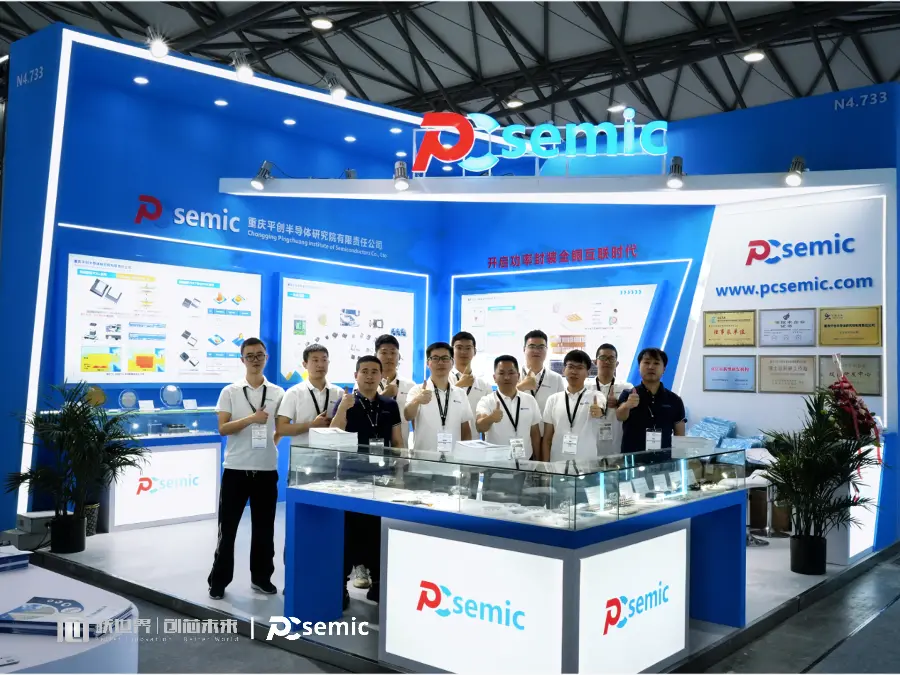
At electronica China 2025 (Munich Shanghai Electronics Show), Pingchuang Semiconductor further presented its full-chain technical capabilities spanning foundational materials, chip packaging, and driving solutions:
Industry’s first mass-production pressure-sintered nano-copper paste
Double-sided cooling TOLL packaging
Top-side cooling TOLT/QDPAK discrete devices
Low-stray-inductance SiC MOS power modules (15 nH parasitic inductance, supporting 400 kHz high-frequency applications)
Standardized smart driving solutions
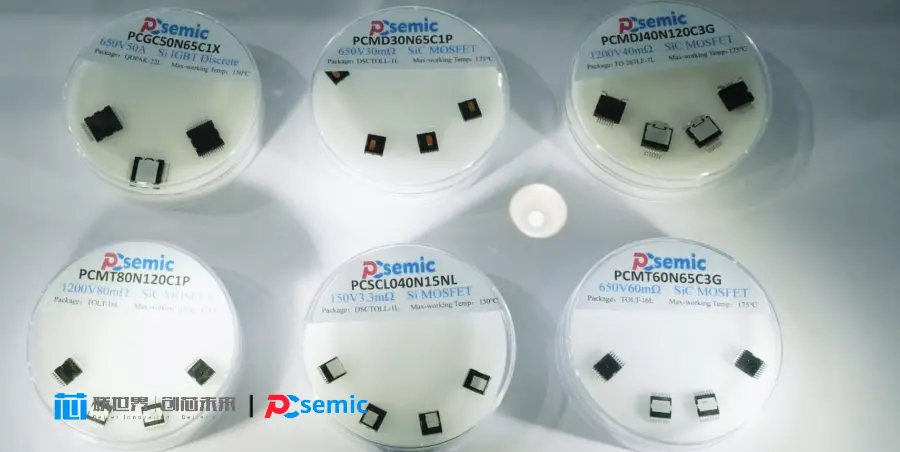
Together, these form a complete, vertically integrated capability spanning "Material – Chip – Device – Module – Driver – System."
In 2026, Pingchuang Semiconductor spearheaded and participated in drafting the industry group standard Short-Circuit Test Method for p-GaN HEMT Power Devices. It also jointly filed a patent with Chongqing University titled "Power Conversion Equipment, SiC MOSFET Device, and Device Preparation Method" (Publication No. CN122318266A), continuing to drive progress in SiC device reliability and third-generation semiconductor standardization.
💡 Takeaway: The breakthrough journey of a single nano-copper paste reflects a fundamental shift in China's third-generation semiconductor packaging materials—moving from foreign technological dependence to achieving a global first in commercial vehicle deployment. Through nearly a decade of effort, Pingchuang Semiconductor has proven that Chinese companies can deliver not only domestic substitution, but global innovation.

 Login