
Replacing the oil in a power transformer is a critical maintenance task. Improper execution can lead to reduced insulation performance, trapped air bubbles, or internal contamination, which may result in serious safety incidents. The entire process must strictly comply with electrical equipment operating procedures.
The essential precautions are outlined below, organized by the four main stages of the operation:
Safety Isolation: Before starting, ensure the transformer is completely de-energized, fully discharged, and properly grounded. Post warning signs at the work site and assign dedicated personnel to supervise the operation.
Weather Conditions: The replacement should preferably be carried out on a clear, dry day (ambient relative humidity below 75%). Never open the transformer in rain, snow, fog, or dusty conditions to prevent moisture and foreign particles from entering the core and windings.
New Oil Preparation and Testing:
Oil Compatibility: The grade and performance of the new oil must match the existing oil. If mixing oils of different grades is unavoidable, a miscibility (compatibility) test must be conducted beforehand and must pass before use.
Quality Certification: Before filling, the new oil must undergo rigorous testing, including breakdown voltage (dielectric strength), moisture content, and dielectric dissipation factor (tan δ) measurements, to ensure it meets required standards.
Pipeline Cleaning: All equipment used—including storage tanks, drums, filling hoses, oil purifiers, and pumps—must be thoroughly cleaned and dried in advance to prevent cross-contamination.

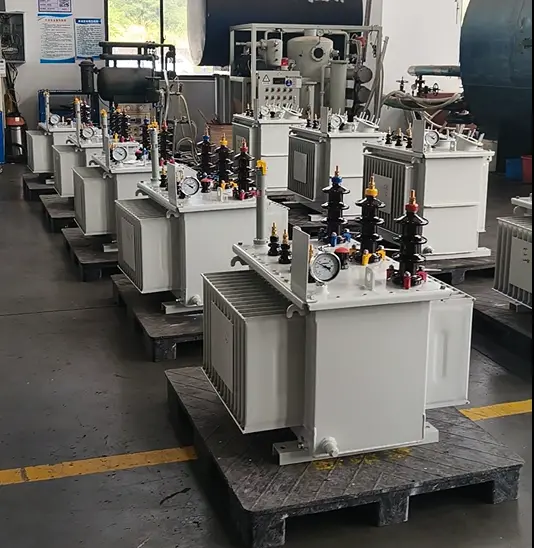
Vziman Oil-Immersed Fully Sealed Transformer Site Assembly Drawing
Complete Draining: Drain the old oil as completely as possible from the bottom drain valve using an oil pump.
Internal Cleaning and Inspection:
After draining, clean out any sludge, sediment, and debris from the tank bottom. If conditions permit (e.g., during a tank or core lift inspection), flush the core assembly and inner tank walls with clean new transformer oil.
Replace Seals: Use this opportunity to inspect and replace all aged or hardened oil-resistant rubber gaskets to prevent future leaks.
Vacuum Degassing: For large or high-voltage transformers (e.g., 110 kV and above), the tank must be evacuated (placed under vacuum) before filling to remove moisture and air from the solid insulation.
Bottom Filling: Oil must be injected from the bottom filling (drain) valve. This allows the oil level to rise smoothly and forces air out from the top. Never pour oil directly from the top, as this will entrap large amounts of air within the windings.
Oil Purifier Circulation: Filling is typically done through a vacuum oil purifier. The oil temperature should be maintained at approximately 50–70 °C (hot oil circulation), which helps further eliminate trace moisture and gases.
Oil Level Control: Monitor the oil level in the conservator (oil tank) carefully during filling. The final level must correspond to the ambient temperature as indicated on the oil level-temperature curve. The level should be neither too high (risking overflow during expansion) nor too low (risking exposure of the core during contraction). Also, ensure the oil cup at the base of the breather (silica gel dehydrator) is filled to the proper mark.
Adequate Settling Time: After filling, do not immediately energize the transformer. A sufficient settling period is essential to allow microscopic air bubbles to escape from the oil.
For transformers up to 110 kV, a minimum settling time of 24 hours is recommended.
For large transformers (220 kV and above), allow 48 to 72 hours or more.
Frequent Venting: During the settling period, repeatedly open the vent plugs at the top of the transformer, Buchholz relay, bushings, radiators, and other high points to release accumulated air. Close each vent only when oil begins to flow out steadily.
Final Acceptance Testing: After settling, take an oil sample from the bottom drain valve for final breakdown voltage and moisture content analysis. Additionally, perform the required electrical tests (e.g., insulation resistance, DC winding resistance). The transformer may only be connected to the grid and put into service after all test results are confirmed to be within acceptable limits.
Transformer oil replacement must follow the core principle of "rigorous prevention before, strict control during, and meticulous verification after" the operation. Techniques such as vacuum degassing and hot oil circulation are critical for thoroughly eliminating internal moisture and micro-bubbles. When combined with the superior fully sealed design and stringent manufacturing and maintenance standards of a transformer like the Vziman series, this process perfectly restores the insulation integrity, ensuring long-term, stable, and efficient performance even under harsh operating conditions.
Edited From:Echo