1. Specific Design
1.1 Design Concept
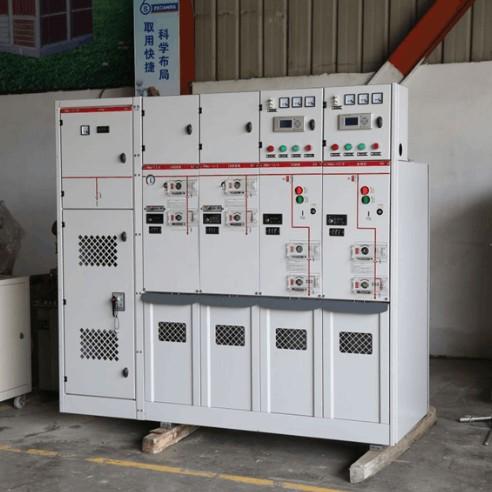
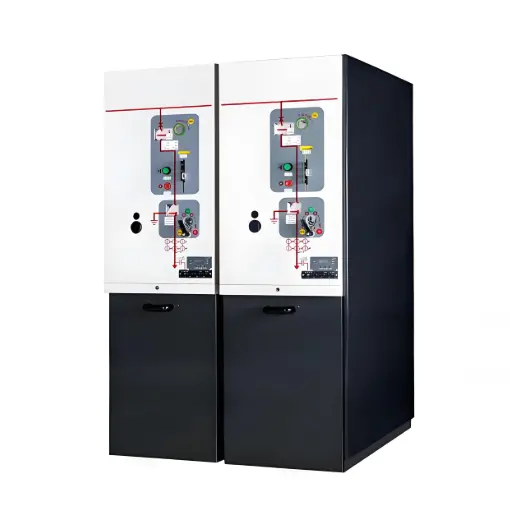
State Grid Corporation of China actively promotes grid energy conservation and low-carbon development to achieve national carbon peak (2030) and neutrality (2060) goals. Environmentally friendly gas-insulated ring main units represent this trend. A new 12kV integrated environmentally friendly gas-insulated ring main unit was designed combining vacuum interrupter technology with three-position disconnectors and vacuum circuit breakers. The design utilized SolidWorks for 3D modeling with modular structure (gas tank, pressure relief chambers, cabinet body, instrument rooms). The unit consists of separate metal-enclosed compartments (mechanism room, circuit breaker room, cable room, instrument room), each with independent pressure relief channels. The design supports both independent unit and common box configurations.
1.2 Integration of Three-Position Disconnector and Vacuum Circuit Breaker
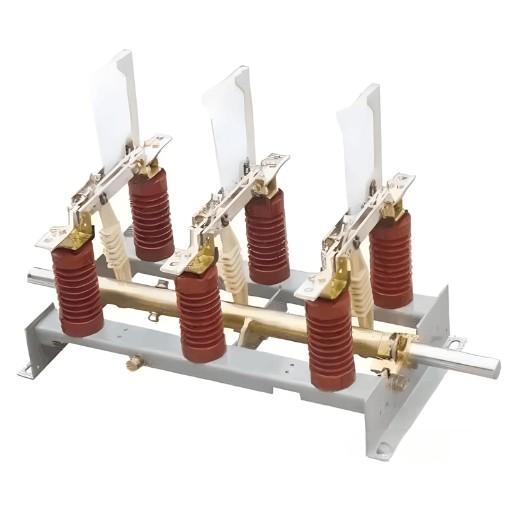
The integration of three-position disconnectors and vacuum circuit breakers is key to this design, comprising interconnected upper three-position disconnectors and lower two-position circuit breaker devices. The three-position disconnector operates in ground, closed, and isolation positions, while the circuit breaker functions in open/closed states. The isolation blade support frame uses high-strength nylon material with good toughness and heat resistance. Mubea disc spring technology provides contact pressure.
A uniform cover on moving contacts ensures electric field uniformity and reduces partial discharge. Insulating covers on three-phase bushings enhance interphase insulation. During testing, multiple optimizations ensured proper mechanical characteristics (engagement depth, bounce, three-phase synchronization, operating speed). The vacuum circuit breaker features solid sealed pole columns mounted with four screws.
The vacuum interrupter's terminal serves as the rotation center for the disconnector blade, with a Z-shaped plastic lever arm utilizing lever principle for operation. Copper busbars with vulcanized surfaces connect the circuit breaker's lower terminals. As shown in Figure 1, this integration design recognizes the vacuum interrupter as the core component determining overall reliability, with contact structure and arc extinguishing method being critical design elements.
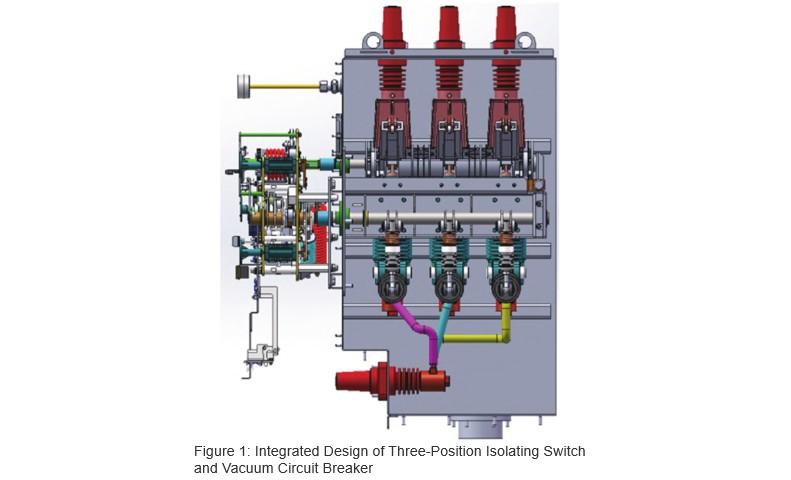
To achieve miniaturization and enhanced reliability, longitudinal magnetic field cup-shaped contacts with coil windings and iron cores were implemented. Unlike transverse magnetic fields, longitudinal fields increase the transition current from diffuse to constricted arcs, offering minimal electrical wear, extended service life, and superior breaking capacity. The rotating magnetic field generated by three-phase AC combines with the cup-shaped contact's longitudinal field to form eddy currents that reduce arc voltage and distribute the arc evenly across the anode surface. This design increases short-circuit breaking capacity from 20kA to 25kA at identical volume.
1.3 Switch Operating Mechanism
The switch operating mechanism, mounted directly on the insulation tank front, drives both vacuum circuit breaker and three-position disconnector via direct shaft connections without intermediate components. This design minimizes vacuum circuit breaker opening time to prevent contact erosion. The mechanism supports both manual and electric operation with energy storage via overrunning clutch principle. The three-position disconnector employs torsion spring drive with coaxial rotation design ensuring three-phase synchronization and reliable grounding switch performance. Its dual operation holes separately control grounding and isolation functions.
1.4 Main Circuit
The main circuit—comprising cable bushings, disconnector blades, vacuum interrupter contacts, flexible connections, and busbars—is sealed within a stainless steel tank using lip seals for dynamic parts and O-rings for static sealing, filled with 0.02 MPa nitrogen or dry air. The integrated longitudinal design of the three-position disconnector and vacuum circuit breaker enables modular withdrawal. Phase-to-phase distances are maintained at 150mm for proper insulation. The vacuum interrupter's terminal serves as the rotation center for the disconnector blade, with Z-shaped plastic lever arms translating operating mechanism motion to contact movement.
1.5 Gas Tank and Production Line
Gas tank design prioritized precision manufacturing and airtightness. Laser cutting ensures burr-free stainless steel components while robotic welding guarantees seam integrity and mechanical strength. Production employs linear layout with track transport vehicles moving between workstations to optimize workflow efficiency.
2 Insulation Analysis
2.1 Three-Position Disconnector Insulation
The knife-switch type three-position design provides visible disconnection points and reliable grounding. Using high-strength nylon material for the rotating shaft and aluminum equalizing covers on blade heads enhances field uniformity. Simulation and testing confirmed insulation performance withstands 90kV lightning impulse voltage.
2.2 Overall Ground Insulation
Analysis focused on critical areas: phase-to-phase and phase-to-tank clearances (minimum 125mm center distance), and insulating components. Strategic placement of solid insulation in high-field areas and gas insulation in low-field areas optimizes field distribution. Additional measures include epoxy encapsulation of contacts, improved Z-arm materials, fiber insulating rods, and shielding covers at busbar connections to prevent field concentration.
3 Conclusion
The new environmentally friendly gas-insulated ring main unit combines vacuum arc extinguishing with eco-friendly gas insulation, featuring complete sealing, maintenance-free operation, compact size, and full insulation. All high-voltage components are sealed within the stainless steel tank, making it suitable for outdoor and indoor applications including switch stations, distribution rooms, and box-type substations. Designed for three-phase AC 50Hz, 12kV systems, it offers reliable power distribution for residential, commercial, industrial, transportation, and infrastructure applications with excellent reliability, environmental adaptability, and safety characteristics.