1. Têkiliyên Xas
1.1 Konsepti ya Têkiliyê
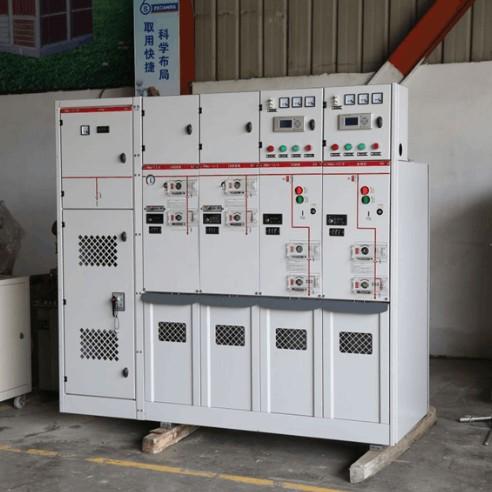
Kompaniya Nîvendîna Çinê bi xewelanî têne çalakkirina nîvendîna ênereya serdemî û derbasdar kirina karkirina karbona serdemî biborê (2030) û netayetiya (2060). Sisteman rûgiran îlberên gazî yên serdemî bingehatên wan têne pêşan dide. Birîkarînî da têne pêşan dide di têkilîna birîkarînî yên vacuum interrupter, disconnectorên sê pozîsîyan û circuit breakerên vacuum de. Têkiliya SolidWorks bi modulanî (tanka gas, chamberekên pressure relief, body cabinet, instrument rooms) hatî têne bikar anîn. Unit ek têne gorîn ji kompartimentên metal enclosed yên ser parê (mechanism room, circuit breaker room, cable room, instrument room), her yek bi kanalekên pressure relief independent. Têkiliya da hêliya unitên independent û common box.
1.2 Birîkarînî Disconnector û Circuit Breaker Vacuum
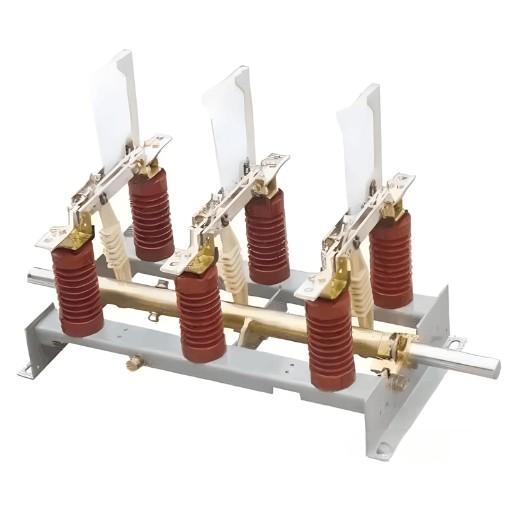
Birîkarînî disconnectorên sê pozîsîyan û circuit breakerên vacuum key têne pêşan dide, têne gorîn ji disconnectorên sê pozîsîyan yên vir û deviceên circuit breaker yên du pozîsîyan yên jêr. Disconnector sê pozîsîyan di pozîsîyonên ground, closed û isolation de têne gerdî, wate circuit breaker di pozîsîyonên open/closed de têne gerdî. Frame support isolation blade material nylon high-strength bi toughness û heat resistance ên zêdetir têne bikar anîn. Teknolojî Mubea disc spring contact pressure têne pêşan dide.
Cover uniform di moving contacts de electric field uniformity û partial discharge reduce têne pêşan dide. Insulating covers di bushings three-phase de interphase insulation enhance têne pêşan dide. Di testing de, optimizations çend têne pêşan dide li ser mechanical characteristics (engagement depth, bounce, three-phase synchronization, operating speed). Circuit breaker vacuum features solid sealed pole columns mounted with four screws.
Terminal vacuum interrupter rotation center têne gorîn ji disconnector blade, Z-shaped plastic lever arm utilizing lever principle for operation. Copper busbars with vulcanized surfaces connect the circuit breaker's lower terminals. As shown in Figure 1, this integration design recognizes the vacuum interrupter as the core component determining overall reliability, with contact structure and arc extinguishing method being critical design elements.
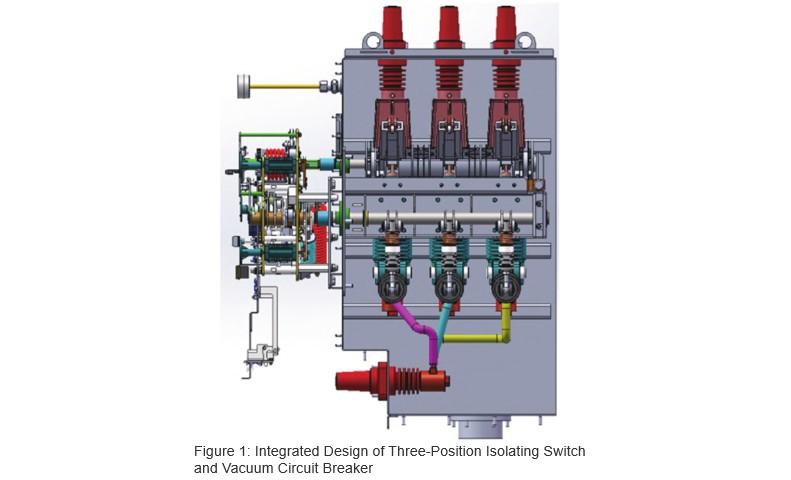
Bi rêjiya miniaturization û enhanced reliability, longitudinal magnetic field cup-shaped contacts with coil windings and iron cores têne pêşan dide. Unlike transverse magnetic fields, longitudinal fields increase the transition current from diffuse to constricted arcs, offering minimal electrical wear, extended service life, and superior breaking capacity. The rotating magnetic field generated by three-phase AC combines with the cup-shaped contact's longitudinal field to form eddy currents that reduce arc voltage and distribute the arc evenly across the anode surface. This design increases short-circuit breaking capacity from 20kA to 25kA at identical volume.
1.3 Switch Operating Mechanism
Switch operating mechanism, mounted directly on the insulation tank front, drives both vacuum circuit breaker and three-position disconnector via direct shaft connections without intermediate components. This design minimizes vacuum circuit breaker opening time to prevent contact erosion. The mechanism supports both manual and electric operation with energy storage via overrunning clutch principle. The three-position disconnector employs torsion spring drive with coaxial rotation design ensuring three-phase synchronization and reliable grounding switch performance. Its dual operation holes separately control grounding and isolation functions.
1.4 Main Circuit
Main circuit—comprising cable bushings, disconnector blades, vacuum interrupter contacts, flexible connections, and busbars—is sealed within a stainless steel tank using lip seals for dynamic parts and O-rings for static sealing, filled with 0.02 MPa nitrogen or dry air. The integrated longitudinal design of the three-position disconnector and vacuum circuit breaker enables modular withdrawal. Phase-to-phase distances are maintained at 150mm for proper insulation. The vacuum interrupter's terminal serves as the rotation center for the disconnector blade, with Z-shaped plastic lever arms translating operating mechanism motion to contact movement.
1.5 Gas Tank and Production Line
Gas tank design prioritized precision manufacturing and airtightness. Laser cutting ensures burr-free stainless steel components while robotic welding guarantees seam integrity and mechanical strength. Production employs linear layout with track transport vehicles moving between workstations to optimize workflow efficiency.
2 Insulation Analysis
2.1 Three-Position Disconnector Insulation
The knife-switch type three-position design provides visible disconnection points and reliable grounding. Using high-strength nylon material for the rotating shaft and aluminum equalizing covers on blade heads enhances field uniformity. Simulation and testing confirmed insulation performance withstands 90kV lightning impulse voltage.
2.2 Overall Ground Insulation
Analysis focused on critical areas: phase-to-phase and phase-to-tank clearances (minimum 125mm center distance), and insulating components. Strategic placement of solid insulation in high-field areas and gas insulation in low-field areas optimizes field distribution. Additional measures include epoxy encapsulation of contacts, improved Z-arm materials, fiber insulating rods, and shielding covers at busbar connections to prevent field concentration.
3 Conclusion
Yenî biri çevresel dost yarışa hêmanên gas-yan qablan de dixwazîn ya vakûm û yarışa hêmanên gas-yan nîşan dike. Li ser xoseriyên wekha, karbikirina bêdewlet, mezûn peyva, û parastina her demekir. Hemî komponentên bi tenya meh de di tanka berstînan de qebûl in, ku ji bo serketin û navbera dest pê dikin, wê re kesandîna tenya, odaên barkirina, û istasyonên substation-a box an. Ji bo sistemên AC têrîn 50Hz, 12kV dizayn kirin, ku barkirina tenya piştgu rengkirin ji bo vîtên endamyar, tijara, endamger, transport, û infrastruktûra da bikin, bi xoseriyên weraz, adaptiviyeteya çevreser, û xoseriyên ewle.