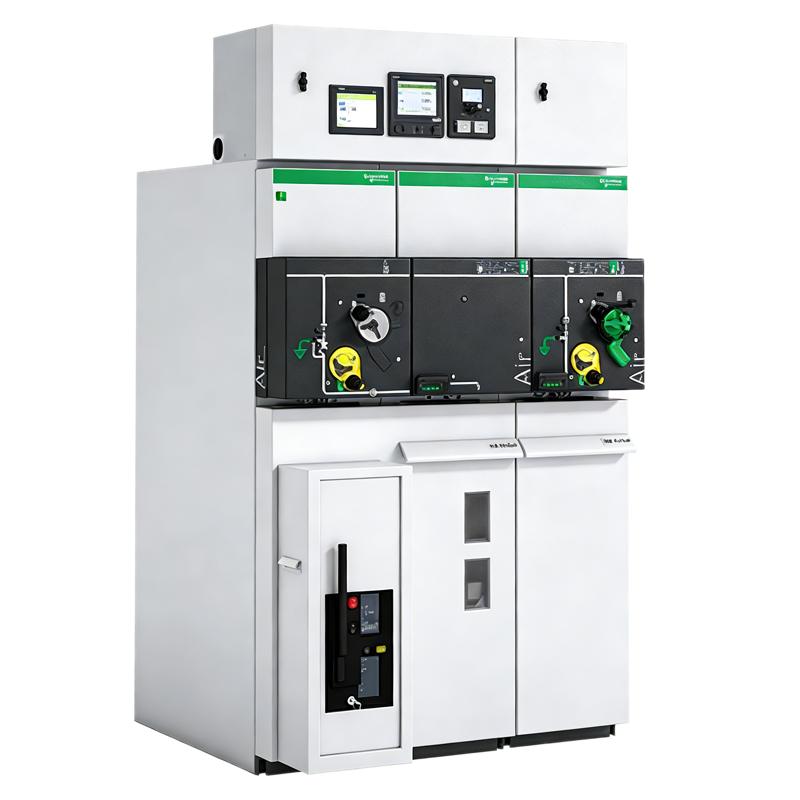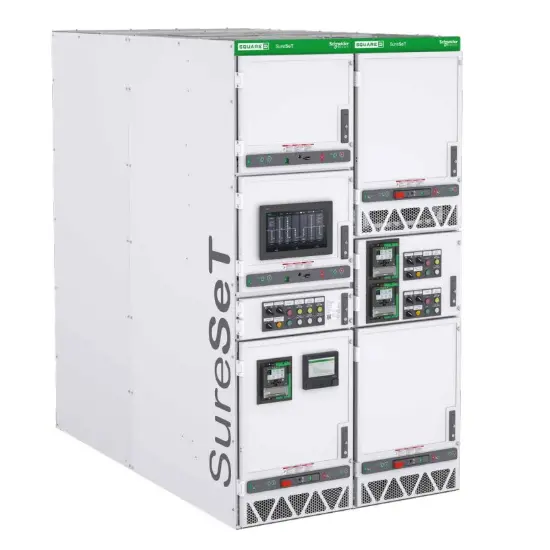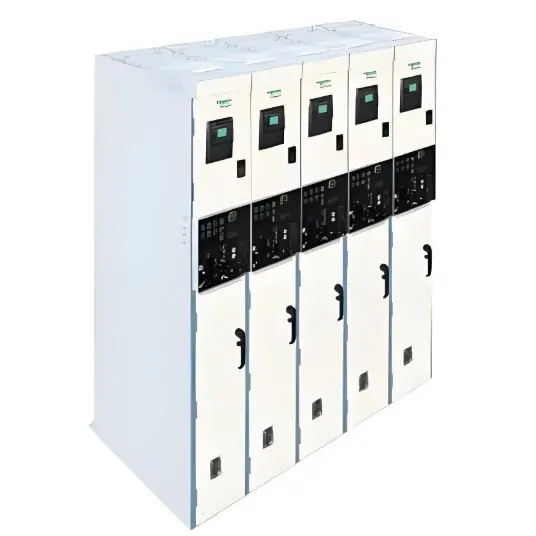
A "2-in 4-out 10 kV solid-insulated ring main unit" refers to a specific type of ring main unit (RMU). The term "2-in 4-out" indicates that this RMU has two incoming feeders and four outgoing feeders.
10 kV solid-insulated ring main unit are equipment used in medium-voltage power distribution systems, primarily installed in substations, distribution stations, and transformer stations to distribute high-voltage power to low-voltage distribution networks. They generally consist of high-voltage incoming feeder cabinets, low-voltage outgoing feeder cabinets, control cabinets, and other components. Depending on different applications and requirements, the number of incoming and outgoing feeders in medium-voltage solid-insulated RMUs may vary. For example, a "2-in 4-out" RMU means it has two incoming circuits and four outgoing circuits.
The design of a 2-in 4-out 10 kV solid-insulated ring main unit takes into account scenarios such as multiple branch connections and parallel feeders in distribution systems to better meet diverse power supply demands. For instance, in urban residential areas, power needs to be branched to different residential zones and also distributed to various commercial facilities and public power distribution equipment; therefore, RMUs with multiple output circuits—such as the 2-in 4-out configuration—are required.
Due to the relatively large number of outgoing feeders, the structural design and electrical connections are correspondingly more complex. Considerations must include proper cable routing, selection of appropriate circuit breakers, fuses, and other protective devices, as well as load balancing among output circuits to ensure the safe, stable, and reliable operation of the distribution system.
The 2-in 4-out 10 kV solid-insulated ring main unit can better fulfill requirements for branching, transferring, protection, and control in medium-voltage distribution systems. Its design and application must take into account the characteristics and actual needs of the distribution system.
2-in 4-out 10 kV High-Voltage Ring Main Unit
A 2-in 4-out 10 kV solid-insulated ring main unit is a type of medium-voltage power distribution equipment primarily used to distribute high-voltage power to four branch circuits in the distribution network.
The main structure of this RMU includes a primary incoming feeder cabinet, a secondary partition compartment, a secondary transformer compartment, and a control cabinet. The primary incoming feeder cabinet mainly consists of a circuit breaker, disconnector switch, and current transformer, which receive electrical energy from the high-voltage source and feed it into the RMU. The secondary partition compartment mainly includes disconnector switches, load switches, and capacitors, distributing the stepped-down power to four secondary load feeders. The secondary transformer compartment contains a secondary transformer, fuses, and other electrical components to achieve voltage conversion from 10 kV to 0.4 kV. The control cabinet is responsible for data measurement, electrical control, protection, and other management functions.

In addition, this RMU features communication capabilities for ring network systems, enabling remote management and data transmission of the distribution system. Its high level of informatization significantly enhances grid reliability and maintenance efficiency.
The 2-in 4-out 10 kV solid-insulated ring main unit is an important medium-voltage distribution device. Through its modular design, it safely and efficiently distributes high-voltage power, providing strong support for the stable operation of power systems.
Why Does a Ring Main Unit Have Two Incoming Feeder Cabinets?
Ring main units typically have two incoming feeder cabinets (also known as "tie cabinets" or "feeder cabinets") to ensure reliability and safety and to meet the power grid’s requirements for dependable power supply.
Specifically, the dual-incoming-feeder design serves the following purposes:
Reliability: If one incoming feeder cabinet fails, the other can serve as a backup, ensuring continuous system operation. The two feeders can act as mutual backups, enhancing the RMU’s overall reliability.
Safety: The two incoming feeder cabinets enable isolation between incoming and outgoing circuits and support interlock functions. This isolation ensures personnel safety during maintenance and repair. Interlock mechanisms also control access and operation of the RMU, preventing unauthorized operation or entry.
Operational Flexibility: The two incoming feeders allow switching operations. During testing or maintenance, one feeder can be de-energized for work while the other remains energized to maintain continuous power supply.
Having two incoming feeder cabinets improves the RMU’s reliability, safety, and operational flexibility, reduces the risk of power outages due to faults, and fulfills the grid’s requirement for reliable power supply.