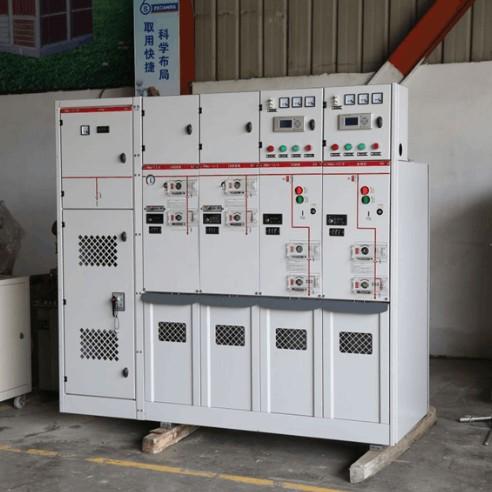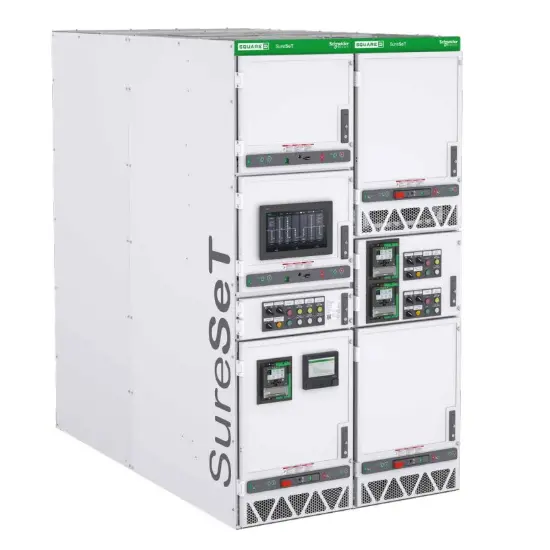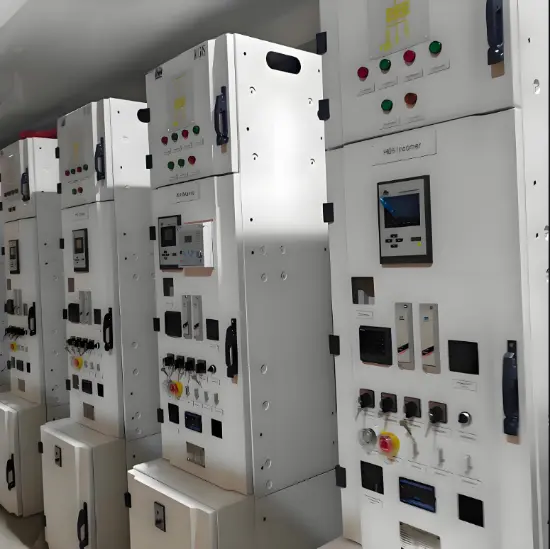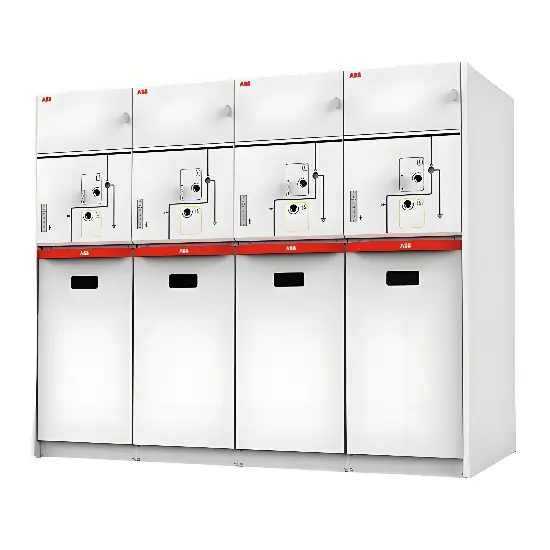
Gas-insulated ring main units are compact and expandable switchgear suitable for medium-voltage power distribution automation systems. These devices are used for 12~40.5 kV ring network power supply, dual radial power supply systems, and terminal power supply applications, serving as control and protection devices for electrical energy. They are also suitable for installation in pad-mounted substations.
By distributing and scheduling electrical energy, they ensure the stable operation of power systems. The core components of these devices employ circuit breakers or combinations of load switches and fuses, offering advantages such as simple structure, small size, low cost, improved power supply parameters and performance, and enhanced power supply safety. They are widely used in distribution stations and pad-mounted substations at load centers such as urban residential communities, high-rise buildings, large public facilities, and industrial enterprises. Various insulating gases serve as the insulating medium, including SF₆, dry air, nitrogen, or mixed gases, providing high insulation performance and environmental benefits, leading to widespread application in power systems.
The main components of this type of ring main unit are installed within a sealed welded tank filled with insulating gas (hereinafter referred to as the "gas compartment"). The gas compartment is the core component of gas-insulated ring main units. Its primary function is to ensure that the high-voltage components inside operate unaffected by external environmental factors such as contamination, humidity, and corrosion. It simultaneously guarantees both the operating environment of components and normal electrical performance. All internal components are protected by the sealed gas compartment. The compartment is equipped with pressure or gas density monitoring devices, such as pressure gauges or density meters, typically measuring the pressure differential between the interior and exterior of the compartment.
This article primarily addresses problems affecting the mechanical and electrical performance of ring main units in high-altitude environments.
1. Common High-Altitude Design Schemes for Gas-Insulated Ring Main Units and Existing Issues
Gas-insulated ring main units feature fully insulated designs, with their main conductive circuits enclosed by a fully insulated system comprising sealed gas compartments, fully insulated bushings for incoming/outgoing lines, and fully insulated cable terminations. Since the internal environment of the gas compartment remains unaffected by external conditions, gas density and humidity stay constant. Theoretically, insulation performance is immune to external factors like humidity, contamination, or corrosive gases. Similarly, the insulation performance of bushings and cable terminations—designed with insulating materials such as epoxy resin and silicone rubber—is unaffected by the external environment. Superficially, conventionally designed gas-insulated ring main units appear adaptable to plateau environments, leading many manufacturers to believe they meet high-altitude operational requirements and deploy them directly in such regions.
Currently, two primary technical schemes are used when applying gas-insulated ring main units in high-altitude environments:
1.1 Direct Deployment in High-Altitude Areas
Design Concept: This approach relies on the principle that the main conductive circuit is fully enclosed by the insulated system (sealed gas compartment, fully insulated bushings, and cable terminations), making insulation performance unaffected by high-altitude conditions.
Existing Issues: In actual operation, reduced external atmospheric pressure at high altitudes increases the pressure differential between the interior and exterior of the gas compartment. This causes significant bulging deformation of the compartment, affecting the mechanical performance of electrical components such as circuit breakers and disconnectors. This may lead to operational jamming and changes in mechanical characteristics.
1.2 Reduced Factory Gas Pressure Setting
Design Concept: To address the increased internal-external pressure differential at high altitudes, this scheme reduces the gas pressure inside the compartment at the factory. When the unit arrives at high-altitude sites, the reduced atmospheric pressure causes the pressure differential to rise to the value required by technical specifications, making the pressure gauge display the required operational pressure.
Existing Issues: This design effectively reduces the density of the insulating gas inside the compartment. Although the pressure gauge shows the designed value at high altitudes, the insulation performance of gases is intrinsically linked to gas density according to the Paschen curve (see Fig. 1) formulated by German physicist Friedrich Paschen. The Paschen curve plots the function derived from Paschen’s Law. Its physical meaning: The breakdown voltage U (kV) is a function of the product of electrode distance d (cm) and gas pressure P (Torr), expressed as U = apd / [ln(Pd) + b] (see Fig. 1), where a and b are constants.
The curve’s primary significance: For a fixed insulation distance, increasing pressure or reducing pressure toward vacuum (e.g., 10⁻⁶ Torr) both raise the gap breakdown voltage. At near-vacuum pressures, reduced vacuum level (i.e., increased air density) makes electrical breakdown between electrodes easier. Beyond a certain pressure threshold, insulation performance gradually improves as pressure rises. In this phase (beyond point a in Fig. 1), reducing pressure—and thus gas density—lowers the breakdown voltage, meaning insulation performance deteriorates. The operational pressure range of gas-insulated ring main units falls entirely within this region (the section beyond point a in Fig. 1).

1.3 Summary of Issues with Conventional High-Altitude Designs
Increased pressure differential between the interior and exterior of the gas compartment causes greater deformation of the compartment, affecting the mechanical operation and performance of switches.
Under increased internal-external pressure differential conditions, pressure relief devices are more prone to activation.
Pressure gauges measure the relative pressure difference between the interior and exterior of the gas compartment. Gas density meters add temperature compensation functionality to pressure gauges. Neither can accurately display the actual gas density inside the compartment at high altitudes, yet gas density is intrinsically linked to insulation performance.
Reduced atmospheric density at high altitudes simultaneously degrades the comprehensive insulation performance of external insulating components of the gas compartment.
2. Design Scheme for High-Altitude Gas-Insulated Ring Main Units
Based on the above analysis, although the fully insulated structure of gas-insulated ring main units (with main conductive circuits fully enclosed by sealed gas compartments, fully insulated bushings, and fully insulated cable terminations) theoretically maintains unaffected insulation performance, it is impacted by factors arising at high altitudes: increased internal-external pressure differential in the gas compartment, the inability to reduce insulating gas density inside the compartment, and the requirement for accurate gas density indication. Consequently, the design key for high-altitude gas-insulated ring main units lies in the gas compartment and pressure relief device design, meeting high-altitude environmental requirements for gas compartment pressure gauges, and resolving the reduced comprehensive insulation capability of external insulating components at high altitudes.
2.1 Design of Gas Compartment and Pressure Relief Device for High-Altitude Applications
To address the aforementioned technical issues, this paper proposes a novel design concept for high-altitude gas-insulated ring main units, differing from ordinary units without specialized design or those merely employing simple pressure reduction. This ring main unit features targeted design in the following aspects:
(1) Enhanced Structural Strength of the Gas Compartment
To counteract the increased internal-external pressure differential caused by high altitudes, the structural strength of the gas compartment is reinforced. This ensures compartment deformation at high altitudes remains within technical specifications, guaranteeing unaffected mechanical performance of high-voltage components inside.
According to the International Standard Atmosphere model, the standard atmospheric pressure at a given altitude can be calculated using the formula:
P = P₀ × (1 – 0.0065H/288.15)^5.256
where P is the atmospheric pressure at a given altitude; P₀ is the standard atmospheric pressure at sea level; H is the altitude.
Taking an altitude of 4000 m as an example:
P = P₀ × (1 – 0.0065 × 4000 / 288.15)^5.256 ≈ 0.064 MPa.
Using a typical 10 kV SF₆ gas-insulated ring main unit as an example, the gas compartment design pressure in non-high-altitude areas is usually 0.07 MPa. Considering the reduced atmospheric pressure at high altitudes, the actual design pressure for the gas compartment at 4000 m altitude can be calculated as:
P₁ = P₀ – 0.064 + 0.07 = 0.107 MPa.
(2) Design of Pressure Relief Device for High-Altitude Applications
Per the latest national standard GB/T 3906—2020 "AC metal-enclosed switchgear and controlgear for rated voltages above 3.6 kV and up to and including 40.5 kV", Section 7.103 stipulates that the gas compartment of gas-insulated ring main units must withstand 1.3 times the design pressure (P₁) for 1 minute without activation of the pressure relief device. If pressure continues to rise between 1.3 times (P₁) and 3 times (P₂) the design pressure, the pressure relief device may activate. This is acceptable provided it meets the design specifications of the manufacturer. After testing, the gas compartment may deform but must not rupture.
Designing the strength of the gas compartment and pressure relief device according to these requirements satisfies national standards. Gas compartments and pressure relief devices for different altitudes can all be calculated and designed using this method:
P₁ = 0.107 × 1.3 = 0.139 MPa
P₂ = 0.107 × 3 = 0.321 MPa
Through structural reinforcement of the gas compartment—such as using thicker steel plates or adding stiffeners—the compartment fully meets the strength requirements imposed by the increased internal-external pressure differential at high altitudes. This avoids mechanical and electrical performance impacts on high-voltage switches inside the compartment caused by deformation, ensuring stable operation at rated gas pressure and delivering identical mechanical and electrical performance in high-altitude environments as in plains areas.
Through design calculations and experimental validation, increasing the thickness and strength of the pressure relief diaphragm enhances its pressure tolerance capability. This ensures the gas compartment’s pressure relief range complies with the specified pressure range requirements, preventing premature activation of the pressure relief device due to increased internal-external pressure differential in high-altitude environments. This maintains the internal insulation level and ensures the electrical performance of the ring main unit.
2.2 Design of Gas Density Indication Device for High-Altitude Applications
The insulating gas density indication device employs a sealed-type density meter. Its displayed value remains unaffected by temperature changes or external atmospheric pressure variations.
For high-altitude gas-insulated ring main units, the density meter selected for the gas compartment is a sealed-type full-condition density meter, immune to temperature and altitude effects. Its principle of operation involves a compensation element inside the density meter enabling temperature compensation (unaffected by temperature). Simultaneously, the meter head features a sealed structure where the sealed chamber maintains standard atmospheric pressure. The density meter’s displayed pressure value represents the pressure difference between the gas compartment interior and standard atmospheric pressure.
This design ensures the scale of the density meter installed on the ring main unit’s gas compartment always accurately reflects the actual gas density inside the compartment. The displayed value remains unaffected by temperature and altitude, fully meeting operational requirements for high-altitude regions.2.3 Design of Fully Insulated Bushings for High-Altitude Gas-Insulated Ring Main Units
In addition to affecting the gas compartment and measuring instruments, high altitudes also impact externally mounted fully insulated components such as incoming/outgoing line bushings and cable terminal joints. The insulation performance of these external fully insulated components is influenced by both the insulation strength of the insulating material and the creepage insulation strength relative to ground. At high altitudes, reduced air density diminishes the creepage insulation strength relative to ground. In practical applications, conventionally designed gas-insulated ring main units often fail power frequency withstand voltage tests for external insulating components (e.g., insulating bushings or top-expansion busbars) after deployment at high altitudes.
To address this, this paper proposes a new design scheme for fully insulated bushings in high-altitude gas-insulated ring main units: adding a grounded shielding layer to the outer surface of such insulating components. This design improves electric field uniformity and prevents ground discharge from the main circuit busbars.
In an outdoor 10 kV switching station project in Nagqu, Tibet, a company encountered a situation during acceptance testing where equipment could only pass a power frequency withstand voltage test of 29 kV/1 min relative to ground. After adding a grounded shielding layer to the outer insulation of incoming/outgoing bushings and external busbars of the gas compartment, the equipment met the national standard requirement of 42 kV/1 min for power frequency withstand voltage relative to ground.
2.4 Summary of Technical Key Points
The critical design aspects for high-altitude gas-filled insulated ring main units are as follows:
Strengthen the structural strength of the gas compartment by increasing steel plate thickness or adding stiffeners to meet requirements for pressure tolerance range and deformation limits caused by increased internal-external pressure differential at high altitudes.
Enhance the strength design of the pressure relief diaphragm in the gas compartment’s pressure relief device. After reinforcement, it satisfies the pressure tolerance range requirements for the pressure relief device under increased internal-external pressure differential at high altitudes.
Adopt sealed-type density meters for pressure indication devices. Their displayed values remain unaffected by temperature changes or external atmospheric pressure variations, making them suitable for high-altitude environments.
Design a grounded shielding layer on the outer surface of external insulating components of the gas compartment to improve electric field uniformity and prevent ground discharge from main circuit busbars.
3. Significance of High-Altitude Gas-Insulated Ring Main Unit Design
This design scheme aims to provide gas-insulated ring main units that genuinely meet high-altitude operational requirements. By simultaneously enhancing gas compartment strength, improving pressure tolerance capability of pressure relief devices, enabling accurate measurement of internal gas density, and rationally designing related insulating components, the ring main unit achieves complete technical adaptability to high-altitude environments. This ensures the mechanical and electrical performance of the ring main unit and enables normal operation of gas-insulated ring main units in high-altitude environments.
China’s high-altitude regions are vast, creating enormous demand for power equipment adapted to high-altitude conditions. The standardization and rationality of product design urgently need improvement. Actual environmental variations in high-altitude regions impose new requirements on product design. This technical scheme provides a new design theory and methodology, representing a meaningful exploration.