

• Product
  • Suppliers
  • Manufacturers
  • Solutions
  • Free tools
  • Knowledges
  • Experts
  • Communities
Search


CSP Single-Phase Pole-Mounted Transformer Common Fault Troubleshooting and Handling Guide

Vziman
Field: Manufacturing
10Year<
China
 
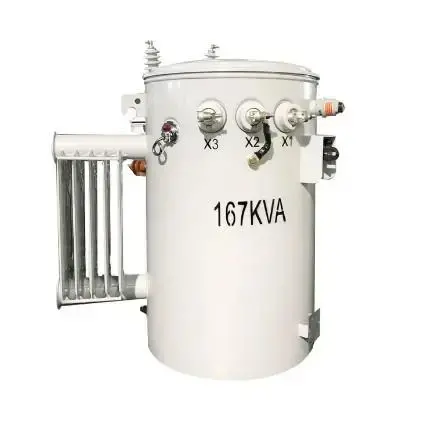
A CSP (Completely Self-Protected) single-phase pole-mounted transformer integrates protective elements such as a protective fuse, surge arrester and circuit breaker, significantly improving operational reliability. However, various faults can still occur under complex operating conditions. The following covers common fault types and troubleshooting points.
iee-business

I. What Are the Core Faults That Usually Occur in CSP Transformers?

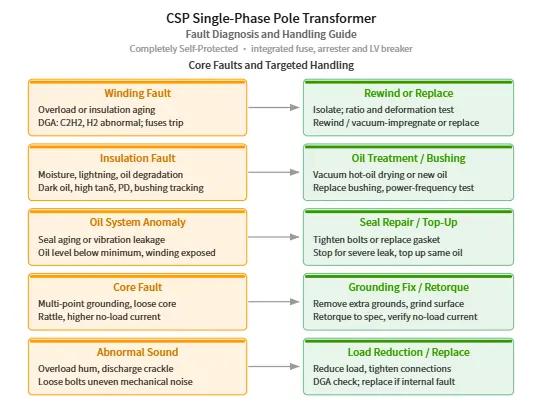
Fault Type Causes Symptoms
Winding faults Long-term overload or insulation aging Local overheating; abnormally rising concentrations of dissolved gases in the oil (e.g., acetylene, hydrogen); in severe cases, blowing of the HV protective fuse or tripping of the LV circuit breaker
Insulation system faults Moisture ingress, lightning strikes or oil quality deterioration Darkened insulating oil, excessive dielectric loss, abnormal partial discharge signals, discharge marks or corona noise on the bushing surface
Oil system anomalies Aging seals or mechanical vibration Oil level falling below the lower limit; an overly low oil level exposes the windings and greatly increases the risk of insulation breakdown
Core faults Damaged varnish film on silicon steel sheets or foreign objects A "hissing" abnormal noise, increased no-load current, abnormal core grounding current
Abnormal sound and vibration Overload; poor internal contact or insulation breakdown; loose core bolts Heavy "humming" under overload; "crackling" discharge sound; uneven mechanical noise from loose bolts
 

II. How to Handle Faults in a Targeted Way Once Detected?

  • Winding faults:shut down immediately and disconnect the supply on both sides. Locate the fault through turns-ratio testing and winding deformation testing. Partial short circuits require rewinding and vacuum impregnation; if the winding is damaged as a whole, replace the complete winding set or return the unit to the factory for major overhaul.
  • Insulation system faults :for oil quality deterioration, use vacuum hot-oil circulation drying or replace with new oil; for bushing faults, light contamination can be cleaned and monitored, while severely damaged bushings must be replaced with the unit de-energized, followed by a power-frequency withstand voltage test.
  • Oil system anomalies :for light leakage, tighten the screws or replace the gaskets; for severe leakage, shut down immediately, top up with the same type of qualified transformer oil and completely repair the leak.
  • Core faults :for multi-point grounding, remove the redundant grounding points and polish the contact surfaces to ensure reliable single-point grounding; for core looseness, retighten the clamping screws to the specified torque and test the no-load current.
  • Abnormal sound and vibration :for external overload, reduce the load; for loose wiring, tighten and clean the connections. If accompanied by internal discharge sounds, judge in combination with dissolved gas analysis (DGA). If an internal serious fault is confirmed, replace the entire unit. On-site blind opening of the tank is strictly prohibited.

iee-business

III. How to Perform Dedicated Troubleshooting on CSP-Specific Protective Devices?

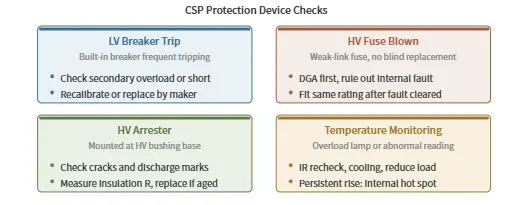
  • LV built-in circuit breaker:if the breaker trips frequently, check whether it is caused by secondary-side overload or short circuit. Verify that the load/temperature sensing elements inside the breaker are sensitive; if necessary, have the breaker re-calibrated or replaced by the manufacturer.
  • HV protective fuse (weak-link type) :never blindly replace the fuse after it blows. First confirm, through methods such as DGA, that there is no internal short-circuit fault in the transformer. Only after excluding internal insulation breakdown or severe overload may a fuse of the same rating be installed.
  • HV surge arrester:inspect the arrester directly connected to the HV bushing (mounted on the cover seat) for cracks or discharge marks on its appearance, and measure its insulation resistance. If the arrester is aged or failed, lightning surges will directly break down the HV side of the transformer, so it must be replaced promptly.
  • Temperature monitoring / overheating :if the overload signal lamp lights up or abnormal temperature readings appear, immediately re-measure the body temperature with an infrared thermometer, check the cooling conditions, and appropriately reduce the load. If the temperature keeps rising abnormally, investigate whether there is an internal overheating fault.

iee-business

IV. How to Perform Preventive Maintenance in Daily Operation?

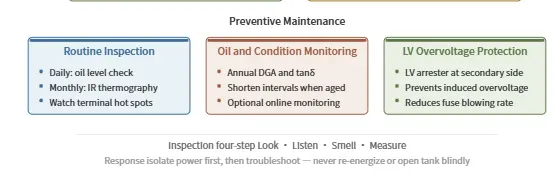
  • Regular inspection and temperature measurement:confirm daily that the oil level is within the normal scale, and use an infrared thermal imager monthly to check the body and terminal temperatures for abnormal hot spots.
  • Oil condition and condition monitoring:perform DGA and dielectric loss testing at least once a year; for transformers with longer service years, appropriately shorten the test intervals. If conditions allow, deploy fiber-optic temperature measurement and online dissolved gas monitoring systems.
  • Secondary-side overvoltage protection:install high-energy, low-voltage surge arresters at the transformer secondary terminals to eliminate frequent blowing of the internal protective fuse caused by secondary induced overvoltage, further reducing the fault rate.

iee-business

V. Summary

Although CSP single-phase pole-mounted transformers have strong self-protection capability, operation and maintenance personnel still need to follow the principle of "prevention first, precise troubleshooting." During routine inspections, strictly apply the four-step method of "look, smell, listen and measure" to keenly catch early hidden dangers such as abnormal sounds, oil level fluctuations and sudden temperature changes.

When sudden faults occur, always hold the safety bottom line of "de-energize and isolate first, then investigate and repair," and strictly prohibit blindly restoring power or opening the tank for unauthorized on-site maintenance.

At the same time, given the special structure of CSP equipment, regularly calibrate and maintain the core protective elements including the built-in protective fuse, circuit breaker and high-voltage surge arrester, so as to prevent problems before they occur, maximize the service life of the equipment, and ensure the safe and stable operation of the distribution network.

Edited From:Leon

Give a tip and encourage the author!

Comments

Share your question or perspective
WhatsApp
Send inquiry
+86
Click to upload file
Download
Get the IEE Business Application
Use the IEE-Business app to find equipment, obtain solutions, connect with experts, and participate in industry collaboration anytime, anywhere—fully supporting the development of your power projects and business.
Login
or continue with
New here?
Register