I. Background
Ang mga kable sa elektrisidad, nga nagserbiha isip core medium para sa pagpadala og enerhiya ug mga signal, adunay performance nga direkta nakaapekto sa efficiency sa sistema, operational safety, ug long-term stability. Sa komplikado nga kondisyon sa operasyon, ang mga problema sama sa insuficiente nga electrical properties sa mga materyales sa conductor, aging/failure sa insulation layers, o mahinungdanong mechanical protection mahimong madaling mobati sa pagtaas sa energy loss, pagtaas sa panganib sa short circuits, ug mao na fire hazards. Kini nga rason, ang scientific selection sa mga materyales ug pag-optimize sa structure aron mapataas ang overall cable performance kay importante kaayo aron masiguro ang reliable operation sa power ug communication systems.
II. Solution
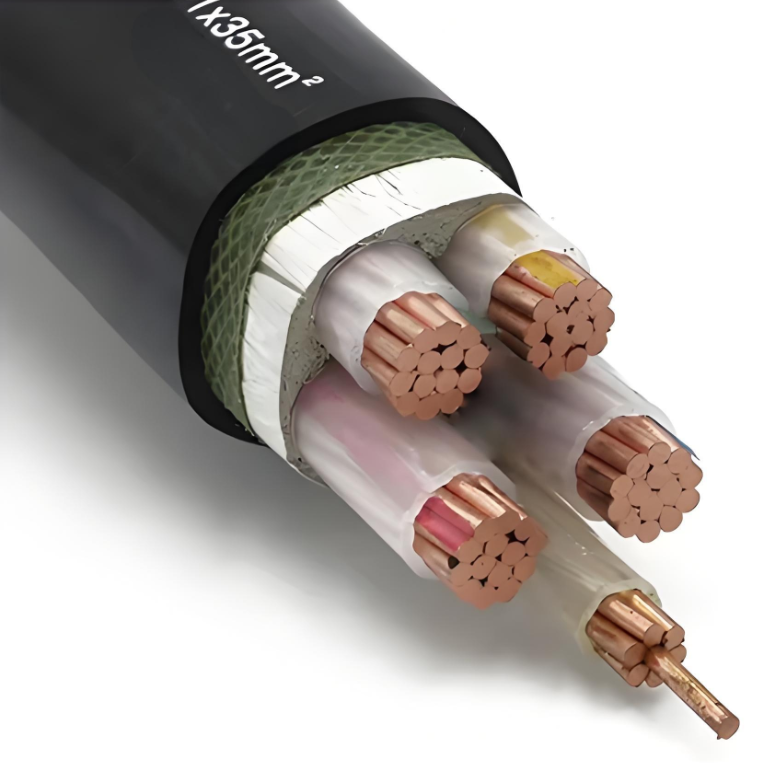
1. Conductor Material Optimization: Balancing Conductivity and Economics
- Core Strategy: Prioritize ang paggamit og high-purity oxygen-free copper (OFC). Ang iyang conductivity gibabaw sa 58 MS/m, labi pa sa aluminum (aprox. 35 MS/m), nga makatabang sa pagbawas sa Joule heating losses (I²R losses) sa panahon sa transmission ug pag-improve sa energy efficiency.
- Scenario Segmentation:
- Medium/Short Distance & High Current Applications: Insist sa paggamit og copper conductors. Ang design sa cross-sectional area kinahanglan molabay sa ampacity requirements (e.g., power cables ≥70mm²), aron masiguro ang low impedance ug low heat generation.
- Long-Distance Overhead Transmission: Pili og conductive aluminum alloy (AA-8000 series). Para sa equivalent ampacity, ini apila 50% lighter kaytud sa copper, nga makatabang sa pagbawas sa tower loads ug installation costs. Note: Ang connection points sa aluminum conductor kinahanglan og special treatment (anti-oxidant paste, torque bolts) aron maprevent ang poor contact ug pag-init.
- Innovative Solution: Para sa cost-sensitive applications nga nagkinahanglan og weight reduction (e.g., new energy vehicle wiring harnesses), makapili og Copper-Clad Aluminum (CCA) conductors, nga magmaintain og high surface conductivity tungod sa pagbawas sa weight apila 30%.
2. Insulation Layer Reinforcement: Enhancing High-Temperature Resistance and Durability
- Preferred Material: Cross-Linked Polyethylene (XLPE). Ang iyang key advantages include:
- Thermal Performance: Continuous operating temperature reaches 90°C (30°C higher than standard PE), short-circuit withstand temperature of 250°C, significantly retarding thermal aging.
- Dielectric Properties: Volume resistivity > 10¹⁴ Ω·cm, power frequency dielectric loss < 0.001, ensuring insulation reliability in high-voltage environments (e.g., 35kV power cables).
- Mechanical Strength: The cross-linked structure enhances cut-through resistance and offers excellent Environmental Stress Crack Resistance (ESCR).
- Special Condition Response:
- High-Frequency Signal Transmission: Utilize physically/chemically foamed PE insulation to reduce the dielectric constant (εr≈1.4), minimizing signal attenuation.
- Extreme Temperature Environments: Use high-temperature resistant fluoroplastic insulation (e.g., ETFE), with an operating temperature up to 150°C.
3. Structural Design Optimization: Mechanical Protection and Safety Enhancement
- Layered Protection System:
- Filling Layer: Fill gaps within stranded conductors with water-blocking yarns (super absorbent polyacrylate resin) or water-blocking compounds to achieve longitudinal water blocking (complying with IEC 60502). For multi-core cables, use polypropylene filler rope to ensure circular integrity.
- Inner Sheath: Select High-Density Polyethylene (HDPE) or Thermoplastic Polyurethane (TPU) to provide radial water resistance and resistance to lateral compression (crush resistance ≥2000N/100mm).
- Armoring (Optional):
- Heavy mechanical stress environments (e.g., direct burial): Use galvanized steel tape armor (thickness ≥ 0.2mm).
- Torsional resistance required (e.g., mining cables): Use fine steel wire braided armor.
- Outer Sheath:
- Basic Protection: Polyvinyl Chloride (PVC), cost-effective with good weather resistance (operating temperature: -20°C ~ 70°C).
- Enhanced Safety: Low Smoke Zero Halogen (LSZH) compound, Oxygen Index ≥32, smoke density Dₛ ≤60 (complying with GB/T 19666), significantly reducing toxic gas emission (HCl <5mg/g) and visual obscuration risk during fires.
- Abrasion Resistance: Nylon 12 sheath, Rockwell Hardness R120, suitable for dynamic bending applications like robot drag chain cables.
- Electromagnetic Compatibility (EMC) Design: Add a copper wire screen (coverage ≥85%) for medium/high-voltage cables. For variable frequency drive (VFD) cables, utilize an aluminum-polyester composite tape + tinned copper braid dual shield to suppress high-frequency interference (≥60dB attenuation in the 30MHz~1GHz band).
III. Scheme Value Summary
Through scenario-specific conductor selection (copper/aluminum), a dynamic equilibrium between conductivity efficiency and cost is achieved. The XLPE insulation ensures dielectric stability in high-temperature environments. The multi-layer composite structure (Filling + Sheath + Optional Armoring) builds mechanical and fire barriers. This scheme reduces cable transmission loss by 15%~20% (Copper vs. Aluminum), extends service life beyond 30 years (XLPE vs. PVC), and reduces fire risk by 70% (LSZH vs. PVC) through the flame-retardant sheath, comprehensively meeting the core requirements of efficiency, safety, and stability.