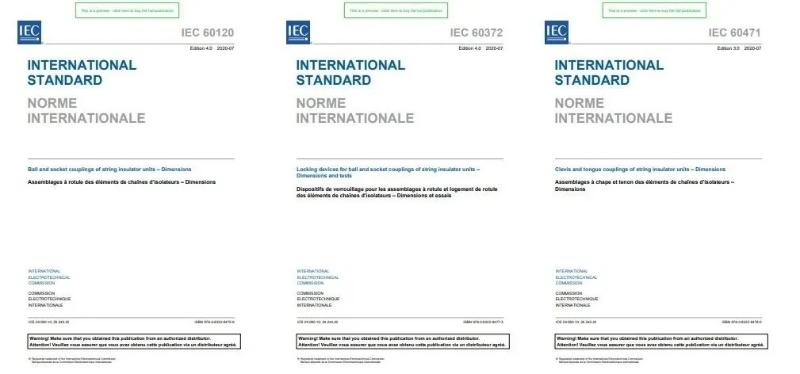
Recently, three IEC standards on insulators, led by China for the first time, have been officially published. These standards primarily address the coupling markings, dimensions, and tests of insulator end fittings, specifically including IEC 60120:2020, IEC 60372:2020, and IEC 60471:2020. These three standards were jointly completed under the leadership and coordination of numerous experts from the National Technical Committee on Insulators of China (SAC/TC80). The publication of these standards marks another breakthrough in Chinese insulator manufacturers’ active participation in international standardization activities, further enhancing the Group’s and China’s technological advancement and international influence in the field of insulators.
With the construction and operation of ultra-high-voltage (UHV) and extra-high-voltage (EHV) power transmission and transformation projects, the previous maximum mechanical strength rating of 530 kN for insulators can no longer meet engineering requirements. In the revisions of national standards GB/T 7253 and GB/T 4056, mechanical strength ratings of 700 kN and 840 kN have been added as standard levels for insulators, specifying the corresponding ball-and-socket coupling structures, dimensions, and gauges required for these higher strength ratings. With the comprehensive standardization of dimensions and interchangeability of insulator hardware in China’s national standards, SAC/TC80 urgently hopes to lead the development and revision of relevant IEC standards based on China’s advanced technologies and practical experience in this field.
In October 2016, at the IEC/TC36 annual meeting held in Frankfurt, China’s proposal was approved, initiating the revision process under Working Group IEC/TC36 MT21. Numerous committee members from SAC/TC80 served as conveners of this working group. To support the conveners’ work, SAC/TC80 coordinated the establishment of a domestic counterpart working group for IEC/TC36 MT21, providing strong technical support to the conveners and members of the international working group. In April 2017, the MT21 working group, composed of experts from China, France, Japan, Spain, Switzerland, and other countries, was formally established and began its work.
Through the joint efforts of the Chinese expert team, after five domestic working group meetings and three international working group meetings featuring intensive discussions, China successfully incorporated multiple innovative achievements and operational experiences from its UHV insulator technologies into the clauses of the IEC standards. This includes practical engineering experience from China’s UHV projects regarding two new coupling markings—designated as “36” and “40”—corresponding to higher mechanical strength ratings.
Chinese insulator manufacturers have consistently taken it as their mission to drive technological innovation and lead industry development, striving to be reliable builders of national key projects and pioneers in power transmission and transformation technology innovation. They have upheld the backbone of China’s power transmission and distribution equipment manufacturing industry and written a brilliant chapter in the journey of China’s power equipment manufacturing sector—from catching up and surpassing to achieving world-class status. In terms of leading industry development, Chinese insulator manufacturers possess strong authority in formulating and revising standards.
They are the primary drivers behind China’s technical product standards for high-voltage electrical apparatus, capacitors, insulators, surge arresters, and major contributors to transformer-related standards. They also undertake the domestic secretariat responsibilities for multiple IEC technical committees (and subcommittees), host the IEC/TC28 international secretariat, and chair IEC/SC22F, representing China in international standard-setting activities. By the end of 2019, they had cumulatively participated in or led the formulation and revision of 460 standards (including international, national, and industry standards), among which 31 were international standards. The release of these three IEC insulator standards not only represents China’s first-time leadership in the insulator field but also epitomizes the global outreach of Chinese standards.