Oriented Silicon Steel Impact on Transformer Efficiency & Noise
1. Development Trends of Power Transformer Manufacturing Technology in China
Power transformers are primarily developing in two directions:
First, development toward extra-large ultra-high voltage transformers, with voltage levels advancing from 220kV, 330kV, and 500kV toward 750kV and 1000kV.
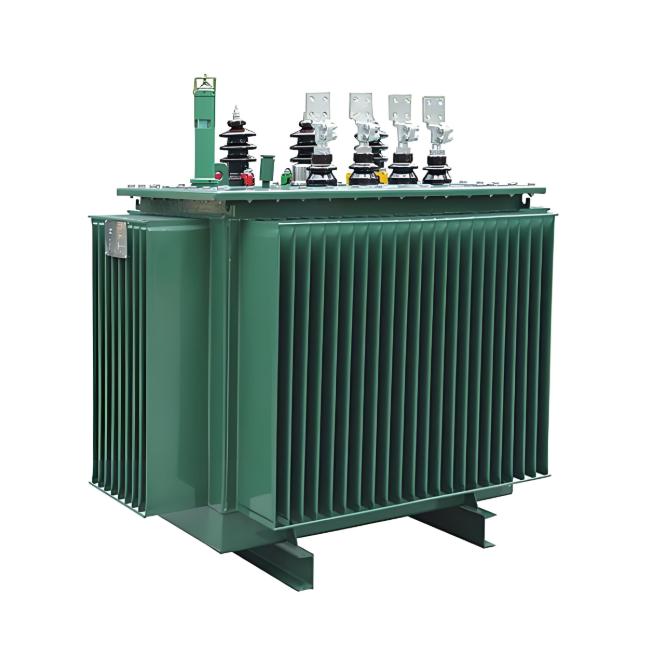
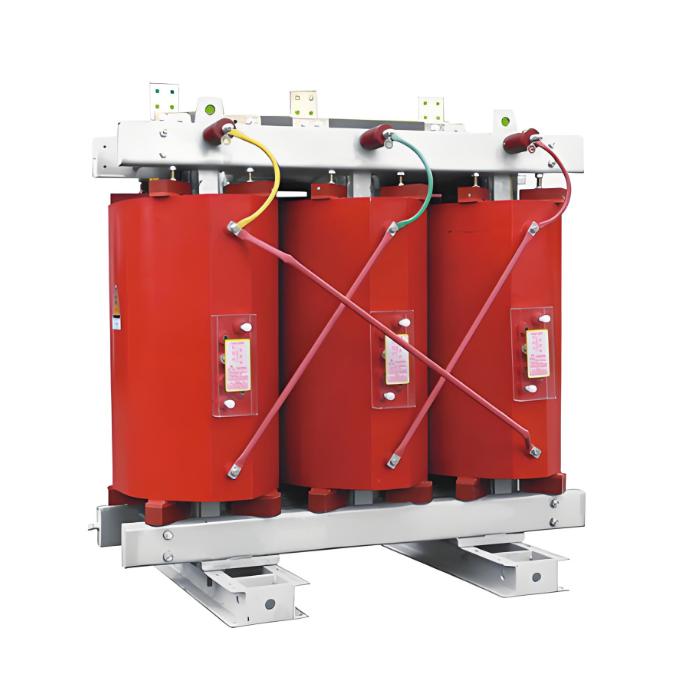
Second, development toward energy-saving, miniaturized, low-noise, high-impedance, and explosion-proof types. These products are mainly small and medium-sized transformers, such as the new S13 and S15 distribution transformers currently recommended for urban and rural power grid upgrades.
China's future transformer development direction will still focus on energy-efficient, low-noise, fire and explosion-proof types, and high reliability.
2. Influence of Oriented Silicon Steel Material on Power Transformer Performance
In developed industrial countries, electrical energy consumed due to iron loss in transformer-oriented silicon steel accounts for approximately 4% of total power generation. Therefore, reducing the iron loss of oriented silicon steel has always been an important research topic for silicon steel enterprises worldwide. Iron loss can be decomposed into eddy current loss and hysteresis loss.
Regarding silicon steel material, the main methods to reduce iron loss in oriented silicon steel are increasing silicon content, reducing sheet thickness, and magnetic domain refinement technology.
(1) Increasing Silicon Content
Currently, industrially produced silicon steel contains over 3.0% silicon by mass. Once increased to 6.5%, silicon steel losses significantly decrease, making it the optimal material for use in the 400Hz to 10kHz frequency range.
(2) Reducing Sheet Thickness
Currently used oriented silicon steel is becoming increasingly thinner. 0.35mm thickness has been phased out, with common thicknesses now being 0.3mm, 0.27mm, 0.23mm, and 0.18mm, which can reduce eddy current losses in oriented silicon steel.
0.20mm oriented silicon steel thin strip can be used at 400Hz or below, with magnetic flux density reaching 1.5T and relatively low iron loss.
0.15mm oriented silicon steel thin strip, when operating at 1kHz frequency with magnetic flux density of 1.0T, has an iron loss value less than 30W/kg. Therefore, this specification of thin strip is suitable for use at 1kHz or below.
0.10mm and 0.08mm oriented silicon steel thin strips are more qualified for use at frequencies below 3kHz. At 3kHz frequency, 0.10mm oriented silicon steel thin strip is used with a magnetic flux density of about 0.50T. Under the same conditions, 0.08mm specification can use slightly higher magnetic flux density values, such as 0.50-0.80T.
0.05mm oriented silicon steel thin strip, when operating at 5kHz frequency, can have a magnetic flux density value of 0.5-0.6T. Therefore, 0.05mm oriented silicon steel thin strip has the widest application range among the five specifications mentioned above and is suitable for use at 5kHz and below.
(3) Magnetic Domain Refinement
Grooving Technology: Japan's Narita reported on the effect of grooving on domain structure and losses in oriented silicon steel, pointing out that grooving perpendicular to the strip direction can effectively reduce domain wall spacing and eddy current losses.
Laser Processing Technology utilizes the characteristics of rapid heating and cooling to treat the surface of oriented silicon steel sheets through line marking, promoting micro-plastic deformation and high-density dislocations in the heated area, reducing main domain wall length, while simultaneously producing residual tensile stress, achieving the purpose of refining magnetic domains and reducing iron loss.
There are two laser processing methods: pulsed and continuous laser processing.
3. Influence of Oriented Silicon Steel Surface on Transformer Noise
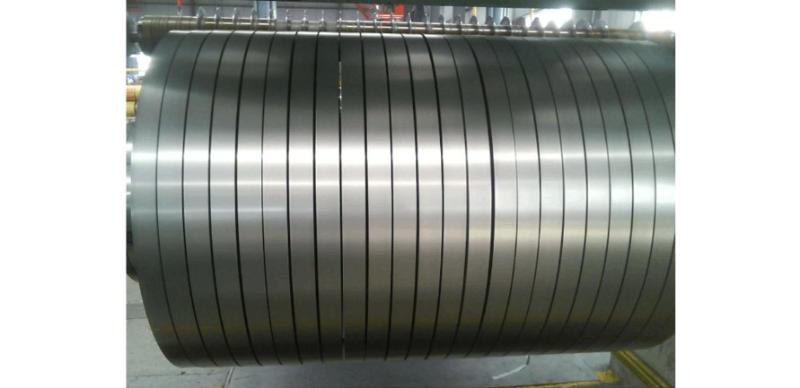
One of the main causes of transformer noise is the magnetostriction of oriented silicon steel cores.
Magnetostriction refers to the change in length of ferromagnetic material during magnetization. The magnetostriction of oriented silicon steel is greatly related to whether there is a surface insulation coating. The tension from the coating on silicon steel sheets can counteract compressive stresses generated by materials and transformer assembly, thereby reducing transformer noise. Uncoated steel sheets are very sensitive to compressive stress. As pressure increases, the magnetostriction value rises sharply, while coated sheets show less significant increases in magnetostriction value with increased compressive stress, indicating lower sensitivity to compressive stress.
It is desirable for oriented silicon steel to have low magnetostriction to reduce its sensitivity to stress, while also reducing noise. Since stress is generated during transformer core assembly, it is necessary to reduce the material's sensitivity to stress. Due to the coating, oriented silicon steel's sensitivity to stress during magnetostriction is reduced, and transformer noise is also lowered.
Additionally, applying insulation coating to oriented silicon steel generally still has the effect of reducing specific loss, reducing iron loss by 9%-14%. The quality of the insulation coating should preferably be above 5g/m².
4. Influence of High-Permeability Oriented Silicon Steel on No-Load Loss and Noise Level of Power Transformers
The advantages of Hi-B high-permeability oriented silicon steel are as follows:
(1) Excellent Magnetization Characteristics
Magnetization characteristics are typically measured by magnetic flux density at 800A/m to evaluate their quality. Hi-B high-permeability oriented silicon steel has a relative permeability of about 1920 at 800A/m, while CGO steel is 1820. Using Hi-B high-permeability oriented silicon steel as core material to reduce no-load loss is the most effective for energy saving.
(2) Low Magnetostriction
Magnetostriction refers to the length expansion and contraction of the core in the magnetization direction during AC magnetization, which is one of the main causes of transformer noise. Since Hi-B high-permeability oriented silicon steel has low magnetostriction, it greatly reduces transformer noise and environmental pollution.
5. Influence of Power Transformer Core Processing Technology
During manufacturing and processing, oriented silicon steel is subjected to shear stress and manual handling impacts. Mechanical processing and external deterioration factors significantly affect the specific loss of silicon steel sheets, sometimes increasing specific loss by 3.08%-31.6%.
Burrs from longitudinal shearing of oriented silicon steel: If cutting quality is poor with large dimensional deviations, when stacking the core, it will cause large gaps between sheets, many overlaps, and uneven core laminations, resulting in increased no-load current, sometimes exceeding standards. After deburring, specific loss decreases. Tests show that after deburring 30QG120, specific loss P1.5 decreases by 2.1%-2.6% (average 2.3%), and P1.7 decreases by 1.6%-3.5% (average 2.5%).
Improving the cutting quality of oriented silicon steel, reducing burrs, while improving flatness, and applying appropriate clamping force to the core columns. Feedback from transformer manufacturers indicates that reducing burrs by 0.02mm decreases total stacked thickness (at clamping points) by 2-3mm, and noise decreases by 3-4dB. Therefore, burrs should be controlled within 0.03mm.
Oriented silicon steel needs to undergo cutting, stamping, and stacking, which generates internal stresses, causing grain deformation, leading to decreased magnetic permeability and increased specific iron loss. The stresses generated in oriented silicon steel during cutting, stamping, stacking, and other processing operations can be reduced by annealing treatment, which can decrease the specific iron loss of cold-rolled oriented silicon steel by approximately 30%.