The performance of circuit breaker operating mechanisms is decisive for reliable and safe power supply. While various mechanisms each have their advantages, the emergence of a new type does not completely replace traditional ones. For example, despite the rise of eco-friendly gas insulation, solid insulation ring main units still hold about 8% of the market, showing new technologies rarely fully displace existing solutions.
The permanent magnet actuator (PMA) consists of permanent magnets, a closing coil, and an opening coil. It eliminates mechanical linkages, tripping and latching mechanisms found in spring-operated mechanisms, resulting in a simple structure with very few parts. Only one primary moving component operates during switching, providing high reliability. It uses permanent magnets to maintain the breaker’s position, belonging to the category of electromagnetic actuation with permanent magnetic latching and electronic control. However, due to the high electromagnetic energy required for closing and opening, a large-capacity energy storage capacitor is typically needed.
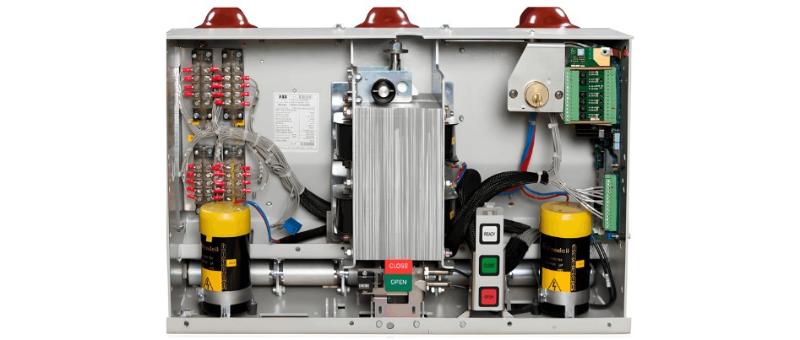
PMA mechanisms are classified into different types, mainly single-stable and bi-stable, and single-coil or dual-coil configurations, with no clear superiority among them.
A bi-stable permanent magnet mechanism uses permanent magnets at both the closing and opening positions for latching. Closing and opening actions are achieved by energizing separate excitation coils to drive the moving iron core. Under the same conditions, the bi-stable type has a lower peak closing current. Smaller currents simplify control circuitry, enhance reliability, and reduce the risk of controller damage. Additionally, smaller capacitor capacity is required—typically a 100V/100,000μF electrolytic capacitor can support reclosing operations. However, the initial opening speed of a bi-stable PMA vacuum circuit breaker is lower than its average speed over full contact travel.
A single-stable permanent magnet mechanism uses a permanent magnet for closing position latching, while a spring maintains the open position. Closing is achieved by energizing the closing coil to drive the moving core, simultaneously storing energy in the opening spring. Opening is accomplished by releasing the stored energy in the spring.
Since the single-stable PMA relies on a spring for opening, its initial opening speed and average opening speed are superior to those of the bi-stable type, better matching the breaker’s opening counter-force characteristics. However, because energy must be stored in the opening spring during closing, the peak closing current is significantly higher than in a bi-stable mechanism under comparable conditions.
The AMVAC permanent magnet actuated vacuum circuit breaker has a maximum rated voltage of 27kV. The 15kV model supports a rated current up to 3000A, a short-circuit breaking current of 50kA, and a short-circuit making current of 130kA.
1. Cost-Effectiveness (Value for Money)
PMA circuit breakers have fewer moving parts, a simpler structure, and electromagnetic force characteristics well-matched to vacuum interrupters. They offer mechanical endurance exceeding 100,000 operations—significantly higher than the 30,000 operations typical of spring mechanisms. This makes them ideal for frequent switching and high-operation-count applications. Their electronic control also facilitates automation. However, high-quality PMA breakers are significantly more expensive. As a result, they are primarily used in premium applications abroad, such as in petrochemical plants and offshore platforms, where maintenance-free operation, high reliability, and improved power continuity are critical.
2. Quality Concerns
PMA breakers demand extremely high-quality components, including capacitors, permanent magnets, electromagnets, and electronic circuits. Comparing low-end PMA breakers with standard spring mechanisms is unfair and misleading. Using inferior capacitors or other components compromises overall product quality. Unlike spring-operated mechanisms, which allow individual component replacement and repair, PMA mechanisms are difficult and costly to repair. This high replacement cost further hinders the widespread adoption of PMA circuit breakers.