• Product
  • Suppliers
  • Manufacturers
  • Solutions
  • Free tools
  • Knowledges
  • Experts
  • Communities
Search


Free Expert Guides on Power Systems, Circuit Design & Electrical Troubleshooting

Access free engineering resources from IEE Business—covering power design, circuit layout, equipment selection, and troubleshooting. Expert-developed guides help engineers, procurement, and project teams make better decisions. Stay ahead on smart grids, renewables, efficiency, and AI tools. Improve reliability, reduce downtime, and enhance outcomes with real-world solutions. Explore our knowledge hub today.
EMF Equation of Transformer
EMF Equation of Transformer DefinitionThe EMF equation of a transformer is derived using Faraday’s law, indicating the induced EMF based on flux changes and winding turns.Magnetizing CurrentAn alternating current in the primary winding generates a magnetizing current that produces alternating flux in the transformer’s core.Sinusoidal Flux and EMFThe sinusoidal primary current creates a sinusoidal flux, and its rate of change (cosine function) determines the induced EMF.Voltage and Turns RatioThe
08/05/2024
Consult
Tip
Consult
Tip
What is a  Transformer?
What is a Transformer?Transformer DefinitionA transformer is a passive device that transfers electrical energy from one circuit to another using electromagnetic induction.Transformer Parts And Construction Primary Winding of Transformer Magnetic Core of Transformer Secondary Winding of TransformerWorking PrincipleThe working principle of a transformer involves mutual induction between coils to transfer electrical energy.Core FunctionThe core of a transformer provides a path with low reluctance,
08/05/2024
Consult
Tip
Consult
Tip
What is the  Transformer of Efficiency?
What is the Transformer of Efficiency?Transformer Efficiency DefinitionTransformer efficiency is the ratio of its output power to input power, usually between 95% and 99%.Factors Affecting EfficiencyEfficiency depends on copper losses, iron losses, dielectric losses, and stray load losses.Efficiency CalculationEfficiency is calculated using OC and SC tests, which measure core and winding losses.Maximum Efficiency ConditionsMaximum efficiency is achieved when copper losses equal core losses, typi
08/05/2024
Consult
Tip
Consult
Tip
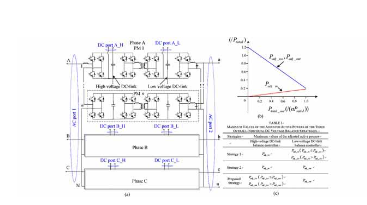
Individual DC Voltage Balance Control for Cascaded H-Bridge Electronic Power Transformer With Separated DC-Link Topology
In this paper, an overall individual dc voltage (including high-voltage and low-voltage dc-link voltages) balance strategy is proposed for the electronic power transformer with separated dc-link topology. The strategy adjusts active powers flowing through the isolation and output stages in different power modules to enhance the dc voltage balance capability. Through the strategy, the high-voltage and low-voltage dc-links can be well balanced when unbalance occurs among different power modules
03/07/2024
Consult
Tip
Consult
Tip
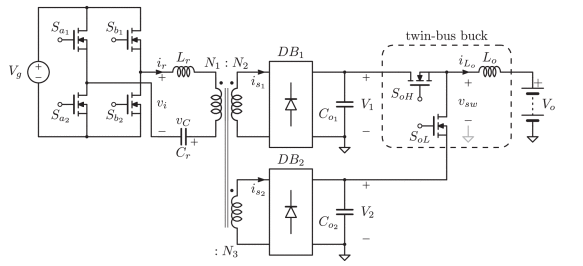
A Two-Stage DC-DC Isolated Converter for Battery-Charging Applications
This paper proposes and analyzes a two-stage dc-dc isolated converter for electric vehicle charging applications, where high efficiency over a wide range of battery voltages is required. The proposed conversion circuit comprises a first two-output isolation stage with CLLC resonant structure and a second two-input buck regulator. The transformer of the first stage is designed such that its two output voltages correspond, ideally, to the minimum and maximum expected voltage to be supplied to th
03/07/2024
Consult
Tip
Consult
Tip
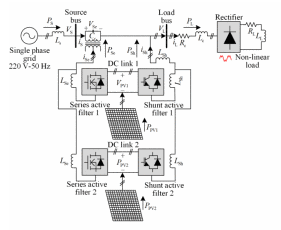
Dual Fuzzy-Sugeno Method to Enhance Power Quality Performance Using a Single-Phase Dual UPQC-Dual PV Without DC-Link Capacitor
This paper proposes a novel configuration of a dual UPQC supplied by a dual photovoltaic (PV), hereinafter referred to as 2UPQC-2PV,to improve the power quality performance of a single-phase 220 V/50 Hz distribution system. The 2UPQC-2PV configuration is proposed to anticipate the possible failure of both inverters in one of the UPQC circuits. The PV array replaces the DC-link capacitor to maintain its voltage connected to the DC-link of the UPQC constant while at the same time supplying active
03/06/2024
Consult
Tip
Consult
Tip
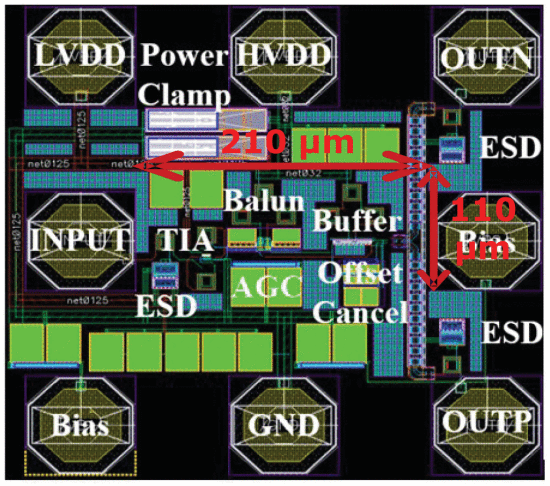
A Low-Noise High-Gain Broadband Transformer-Based Inverter-Based Transimpedance Amplifier
In this paper, a transformer-based bandwidth (BW) extension technique is employed to improve the BW, noise, and silicon area of inverter-based transimpedance amplifiers (TIAs) even when they use inductive peaking. A TIA based on the proposed technique, designed and laid out in a 16-nm FinFET process, demonstrates a 36% increased in BW, a 19% reduction in input-referred noise, and a 57% reduction in silicon area compared to the conventional TIA with inductive peaking. In the proposed TIA architec
03/06/2024
Consult
Tip
Consult
Tip
Send inquiry
+86
Click to upload file

IEE Business will not sell or share your personal information.

Download
Get the IEE Business Application
Use the IEE-Business app to find equipment, obtain solutions, connect with experts, and participate in industry collaboration anytime, anywhere—fully supporting the development of your power projects and business.