• Product
  • Suppliers
  • Manufacturers
  • Solutions
  • Free tools
  • Knowledges
  • Experts
  • Communities
Search


Free Expert Guides on Power Systems, Circuit Design & Electrical Troubleshooting

Access free engineering resources from IEE Business—covering power design, circuit layout, equipment selection, and troubleshooting. Expert-developed guides help engineers, procurement, and project teams make better decisions. Stay ahead on smart grids, renewables, efficiency, and AI tools. Improve reliability, reduce downtime, and enhance outcomes with real-world solutions. Explore our knowledge hub today.
What is Oil Circuit Breaker?
Oil Circuit BreakerAn oil circuit breaker is a type of circuit breaker that utilizes oil as a dielectric or insulating medium for arc extinction. In an oil circuit breaker, the breaker's contacts are designed to separate within an insulating oil. When a fault occurs in theelectrical system, the contacts of the circuit breaker open beneath the insulating oil, and an arc is generated between them. The heat of this arc causes the surrounding oil to vaporize. Oil circuit breakers are classified into
04/14/2025
Consult
Tip
Consult
Tip
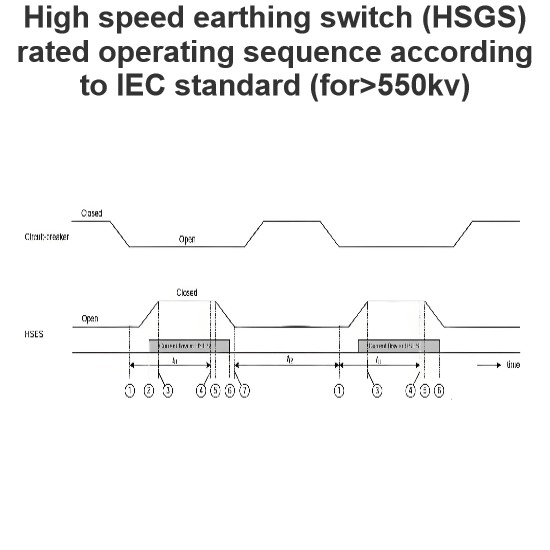
High speed earthing switch (HSGS) rated operating sequence according to IEC standard (for>550kv)
High - Speed Earth Switches (HSES) have two rated operating sequences: C–ti1–O C–ti1–O–ti2–C–ti1–Owhere: ti1 represents a time period that is longer than the time needed for secondary arc extinction and for the dielectric recovery of air insulation at the fault location. ti1 is determined by users while taking system stability into account. The recommended value of ti1 is 0.15 s. ti2 is the intermediate time specifie
04/12/2025
Consult
Tip
Consult
Tip
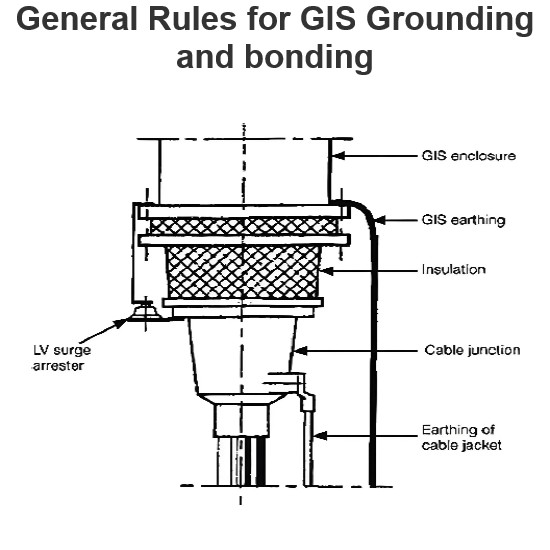
General Rules for GIS Grounding and bonding
General Rules for GIS Grounding and bondingIn most Gas - Insulated Switchgears (GIS), there are two grounding grids: The station grounding grid, which is analogous to that in a typical Air - Insulated Switchgear (AIS) installation. The GIS grounding mesh, a closely - spaced grounding grid embedded in the concrete slab where the GIS is installed.Typical rules for GIS grounding and bonding are as follows: All grounding conductors should be kept as short as feasible. The grounding mesh and its inte
04/12/2025
Consult
Tip
Consult
Tip
 Very Fast Transient Over voltage(VFTO) wave common characteristics in HV& EHV GIS
Very Fast Transient Over voltage(VFTO) wave common characteristics in HV& EHV GISSteep wavefront, with a rise time typically ranging from 2 to 20 nanoseconds: When restriking occurs in the contact clearance of a disconnector, the arc - reignition process is extremely rapid. As a result, the voltage waveform injected into the power grid exhibits a very high ascending or descending steepness.Theoretically, the amplitude of Very Fast Transient Overvoltage (VFTO) can reach up to 3.0 per - unit.
04/12/2025
Consult
Tip
Consult
Tip
Ground switches in GIS
Ground switches feature a moving contact that creates or closes a gap between the high - voltage conductor and the enclosure. At the enclosure and the conductor, sliding contacts equipped with suitable electric - field shields are incorporated.A “maintenance” ground switch can be operated either manually or via a motor drive. It takes several seconds to open or close, and when fully closed, it can carry the rated short - circuit current for the specified time period (either 1 or 3 seconds) witho
04/11/2025
Consult
Tip
Consult
Tip
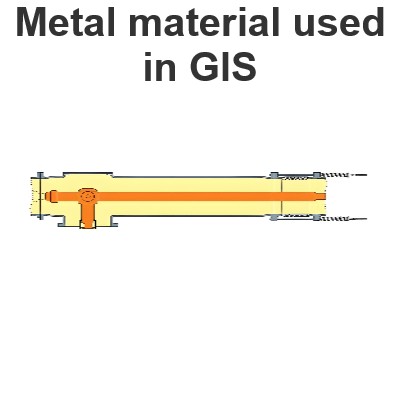
Metal material used in GIS
SteelThe enclosure has two fundamental functions: maintaining internal gas pressure and ensuring gas - tightness to prevent the release of SF6 into the atmosphere. Sheet steel materials are well - suited for fulfilling these functions. In contrast, cast steel has porosity issues and cannot guarantee the high - level gas - tightness required for Gas - Insulated Switchgear (GIS).Steel is relatively easy to weld and shape. Steel enclosures are typically fabricated by mechanically forming steel shee
04/10/2025
Consult
Tip
Consult
Tip
HV vacuum circuit breaker in GIS
Requirements for Larger Tank Enclosure in VCB Vacuum breakers permit the use of insulation media other than SF6. When insulating gases such as dry air, nitrogen, or CO2 are chosen, their insulation performance will be inferior compared to that of SF6 at the same pressure. Stray capacitances to the tank negatively impact voltage division within the vacuum interrupter (VI). This may necessitate a larger, higher - rated - voltage VI.Considerations When Applying VCB in GIS Stray capacitances from th
04/09/2025
Consult
Tip
Consult
Tip
Important points in engineering studies in high voltage gas insulated switchgear (GIS)
Important points in engineering studies in high voltage gas insulated switchgear (GIS)Engineering Studies in Gas - insulated Switchgear (GIS)Once the electrical engineer has defined the preliminary configuration of the GIS and determined and specified the primary equipment data, additional studies related to the engineering aspects, as well as the logistics of delivery and installation, must be carried out.The most crucial engineering studies are summarized as follows:1. Transient Recovery Volta
04/06/2025
Consult
Tip
Consult
Tip
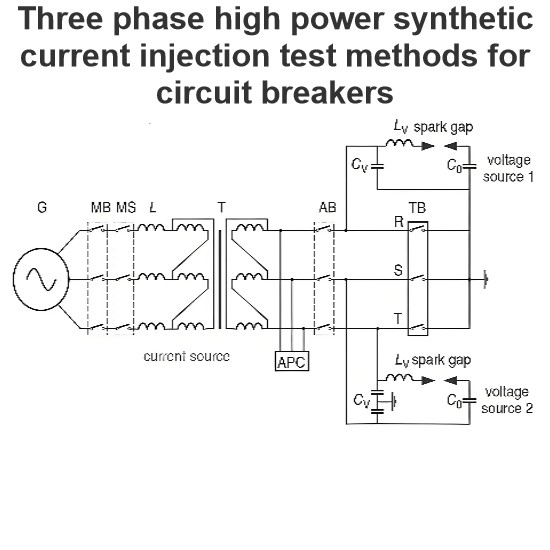
Three phase high power synthetic current injection test methods for circuit breakers
This test just apply to 3 pole operation circuit breakers.As Fig these circuits use a three-phase current source and, generally, two voltage sources. one voltage source provides the TRV for the first pole-to-clear and the other gives the recovery voltage for the second- and third poles-to-clear, in the case where these poles clear simultaneously as in non-effectively earthed systems.This system have following components: A three phase current source (G) Voltage source 1 with current injection pa
03/26/2025
Consult
Tip
Consult
Tip
SF6 decomposition products from electrical arc in gas switchgear
During the switching of normal load or short-circuit current, SF₆ molecules are ionized and fragmented by the arc. The figure illustrates the main reaction processes and the locations where each process is likely to occur. SF₄, as the primary decomposition product resulting from the electric discharge, first reacts with H₂O on the inner wall surface, giving rise to SOF₂. The metal fluorides remain in the form of powder or dust on the surface. H₂O is released in this reaction and thus becomes ava
03/19/2025
Consult
Tip
Consult
Tip
Send inquiry
+86
Click to upload file
Download
Get the IEE Business Application
Use the IEE-Business app to find equipment, obtain solutions, connect with experts, and participate in industry collaboration anytime, anywhere—fully supporting the development of your power projects and business.