1 Introduction
Common insulation methods for 10kV medium-voltage ring main units (RMUs) include gas insulation, solid insulation, and air insulation.
• Gas insulation typically uses SF₆ as the insulating medium. However, a single SF₆ molecule has a greenhouse effect 25,000 times greater than a CO₂ molecule, and SF₆ persists in the atmosphere for 3,400 years, posing significant environmental risks. Medium-voltage RMUs are widely distributed, making SF₆ recovery difficult and costly if handled responsibly.
• Air insulation requires larger insulation clearances, preventing significant size reduction of switchgear.
With the rapid development of urban power distribution networks, applications such as high-rise buildings and rail transit demand enhanced RMU performance—requiring smaller footprints, high safety/reliability, minimal maintenance, and environmental suitability. Medium-voltage solid-insulated RMUs represent a growing trend.
10kV solid-insulated RMUs utilize solid insulation technology instead of SF₆ gas. Their volume is only 30% of comparable air-insulated equipment, offering more reliable insulation performance and receiving consistent recognition from experts and users.
2 Insulation Materials and Design
Cost analysis shows that the insulation structure accounts for over 40% of the total price of solid-insulated RMUs. Selecting suitable insulation materials, designing rational insulation structures, and determining appropriate insulation methods are crucial for RMU value.
Since its first synthesis in 1930, epoxy resin has been continuously improved with additives. It is renowned for its high dielectric strength, high mechanical strength, low volumetric shrinkage during curing, and ease of machining. Thus, we use it as the primary insulation material for medium-voltage RMUs, enhanced with hardeners, toughening agents, plasticizers, fillers, and pigments to form high-performance epoxy resin. Improvements in heat resistance, thermal expansion, and thermal conductivity provide flame retardancy and excellent insulation properties under both long-term operating voltage and short-term overvoltages.
Conventional RMU insulation structures create non-uniform electric fields. Merely increasing clearances is insufficient to enhance insulation strength in such fields. We optimize the field structure to improve uniformity. Epoxy resin’s electrical strength ranges from 22–28 kV/mm, meaning only a few millimeters of clearance are needed between phases in optimized structures, drastically reducing product size.
3 Structural Design of Medium-Voltage Solid-Insulated RMUs
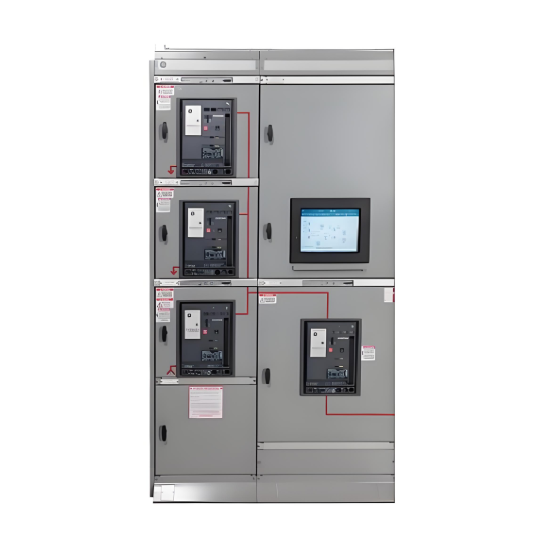
Vacuum interrupters, disconnectors, grounding switches, and all conductive components are placed into molds. High-performance epoxy resin is then integrally cast using automated pressure gelation technology. The arc-extinguishing medium is vacuum, with insulation provided by the epoxy resin.
The cabinet structure adopts modular design for easy standardized mass production. Each RMU bay is separated by metal partitions to contain fault arcs within individual modules. Integrated busbar connectors and integrated contact connectors are utilized. The main busbar consists of segmented, enclosed insulated busbars connected by telescopic integrated connectors for convenient on-site installation and commissioning. The cabinet door features an internal arc-proof design and allows breaker closing, opening, and grounding (three-position operation) with the door closed. Switch status is visible through observation windows, ensuring safe and reliable operation.
4 Advantages and Type Testing Analysis of Medium-Voltage Solid-Insulated RMUs
4.1 Key Advantages:
(1) Uses high-performance epoxy resin for reliable insulation and low partial discharge.
(2) Fully insulated and sealed structure with no exposed live parts. Unaffected by dust or contaminants. Suitable for diverse environments (high/low temperatures, high altitudes, explosion/contamination-prone areas). Eliminates issues like SF₆ gas pressure fluctuations during high-temperature operation or liquefaction in extreme cold. Offers distinct advantages in high-salt-fog coastal areas.
(3) SF₆-free and contains no hazardous gases—an eco-friendly product. Leak-proof design eliminates regular maintenance. Enhanced explosion resistance suits hazardous locations. The fully insulated three-phase structure prevents phase-to-phase faults, ensuring safety and reliability.
(4) Occupies only 30% of the space required by air-insulated RMUs—an ultra-compact solution.
4.2 Type Testing Analysis
Based on these advantages, comprehensive type testing was conducted, including:
Additional national standard tests were performed:
5 Key Construction Points
① When pouring concrete, pour beams and columns first, followed by slabs. Pour layer-by-layer along the direction of the formwork tubes, distributing concrete onto the CBM self-stabilizing formwork before vibrating downward. Deposit the first layer of concrete to half the height of the formwork, vibrate symmetrically on both sides. Use vibrators ≤35mm diameter (typically 30mm) for uniform penetration and vibration. Avoid gaps, under-vibration, or contact with the formwork. Spacing ≤25cm, duration ≤3s per point. After confirming compaction, vibrate the surface layer again with a screed vibrator before initial setting, followed by leveling and compaction with a wood float.
② Water/electricity conduits should run within the ribs between CBM self-stabilizing formwork units. If passing through a unit, use a smaller formwork size. During formwork installation and concrete pouring, construct working platforms. Position concrete pump pipe supports on these platforms. Personnel must not walk directly on the formwork, and materials must not be stacked directly on it.
6 Engineering Performance of CBM Self-Stabilizing Formwork
① Increased Clear Height
Compared to conventional beam-slab systems, the two projects using hollow-core slabs reduced structural thickness per floor by 30–50cm, increasing clear height. CBM self-stabilizing formwork is ideal for large-span, heavy-load industrial/public structures. It ensures uniform force distribution and allows flexible placement of partition walls.
② Reduced Costs
The CBM hollow-core slab system features a grid-like orthogonal "I"-shaped lattice and hidden closely-spaced ribs, enabling balanced force transfer. Based on the two projects, it reduced reinforcement steel by 27%, concrete volume by 29%, and formwork area by 46% compared to conventional RC frame structures. Overall construction costs decreased by 26.3%.
③ Simplified Construction
CBM formwork offers high strength, light weight, impact resistance, and integrated support frames for easy installation. With hidden beams, the slab bottom remains flat, simplifying formwork/shoring operations.
④ Lighter Weight, Optimized Performance
CBM hollow-core slabs reduce structural self-weight by 27.6% based on calculations, optimizing the design of beams, slabs, columns, and foundations.
7 Discussion on CBM Formwork Construction Issues
① Ensuring lower flange concrete compaction is challenging. Leakage in CBM hollow-core slabs is difficult to remedy.
Unlike conventional slabs where concrete is placed directly on a single surface, CBM slabs have upper and lower flanges. Achieving compaction in the lower flange requires meticulous vibration using small-diameter vibrators and external vibrators. After this, the hidden beams and top slab are poured, demanding great care and dedicated QC oversight.
Crack frequency in CBM slabs is comparable to or slightly lower than conventional slabs. However, leaks occurred in the basement roofs and roof slabs of both projects. Identifying the cause is difficult—potential sources include cracks in the upper flange, water seepage through adjacent formwork, or conduits within the ribs. Per leak, repair effort/cost is 5–8 times higher than for conventional slabs.
② Construction Joints & Expansion Strips Require Detailed Design
Structural expansion joint locations are typically specified by design codes. However, the dual-flange nature of CBM slabs complicates pouring if a joint abuts a formwork unit: ensuring bond between new/old concrete in the lower flange and containing grout is difficult. On-site, joint locations should be adjusted based on formwork layout to ensure joints fall within ribs between formwork units. Resizing adjacent units may be necessary.
With CBM slabs typically covering large areas, designers often overlook construction joint placement. To ensure proper bonding within the initial setting time, the site team must determine joint locations considering pour width limits and resource capabilities. Joints must meet code requirements and be placed within ribs.
③ Difficult Mitigation of Formwork Buoyancy
If formwork buoyancy occurs during pouring, the existing countermeasures (removing top reinforcement, clearing concrete, re-fixing formwork) are impractical and often ineffective. Currently, the only solution is breaking/removing the floated unit, placing additional reinforcement, and pouring solid concrete there. Rigorous onsite monitoring of formwork securing and anti-buoyancy measures is essential during construction.