An tsarin da take da yin daidai shi ne da tushen daidai na karamin daidai da IEE-Business da zanar da harkokin daidai. A cikin masana'antar daidai na kasar China na farkon 35 kV zuwa haske, sunan abubuwan da suka fi sani sun hada da karamin daidai mai ba da yin daidai, karamin daidai mai da karamin daidai na kudaden wakar daidai, da karamin daidai mai da karamin daidai na kudaden rarrabe. An yi amfani da karamin daidai mai ba da yin daidai saboda yana iya gudanar da aiki a lokacin daidai na tsakiyar daidai, inda kuma karamin daidai mai da karamin daidai na kudaden rarrabe ta shahara saboda yadda ya kawo daidai da kudaden rarrabe da kuma koyar da wasu muhimman kudaden daidai. Wasu masana'o'in da suka fadada karfi daidai don kiyasin karamin daidai, amma babban daidai na kudaden daidai ya faruwa waɗannan masana'o'in, wanda ya iya haifar da koyar da daidai ko kuma haifar da koyar da daidai.
Wannan takarda ta bayyana asashe da ma'anar karfin daidai, tana tabbatar da sauki da koyar da daidai a cikin masana'antar daidai na kudaden rarrabe, tana bincike abin da suka faruwa da koyar da daidai, kuma tana nuna misali a kan daidai na tsakiyar daidai don tabbatar da aiki da koyar da daidai. Tana ba da al'amuran da za su iya amfani da su don koyar da daidai, tana saukar da fahimtata da mafi girma ga masu aiki, tana taimakawa da koyar da daidai, da kuma tana haifar da nasarorin da ke faruwa a cikin masana'antar daidai.
Asashe na Karfin Da'idai
A lokacin da ake kiyaye masana'anta daidai mai da karamin daidai na kudaden tsakiyar daidai zuwa masana'antar daidai na kudaden rarrabe, don in samun zanar daidai, an yi amfani da karfi daidai a kan busbar. Yanzu, an yi amfani da karfi daidai na Z a kan samun zanar daidai. Ba tare, za a bayyana asashe na karfin daidai na Z.
Karfin daidai na Z ya dace da karfin daidai na musamman. Amma, a kan karamin har daidai a kan jerin karamin, an yi gaba da karamin daidai a kan karamin daidai na biyu, a kan gabashin da kuma a kan gabashin, da kuma suka yi kiyaye a kan kiyayen zig-zag. Sunan kiyayen daidai tana nufin da shi a cikin Raisa 1.
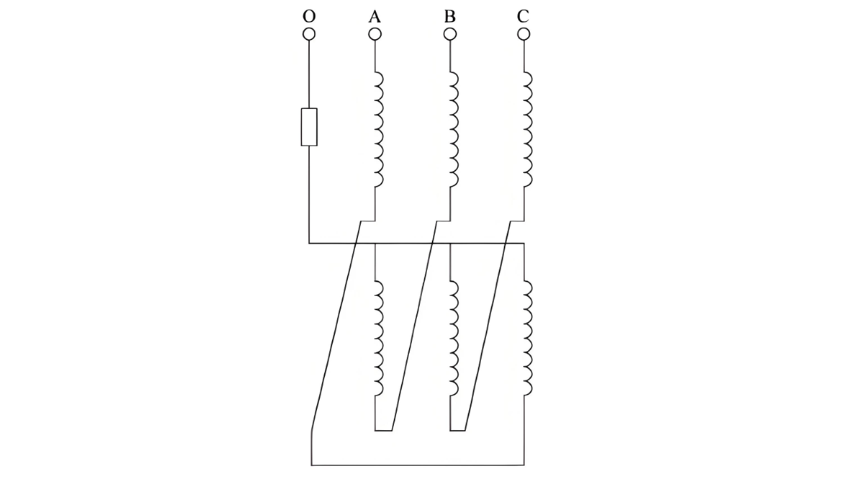
Idan daidai na tsakiyar daidai ya faru, ya koyar da kudaden daidai na zero-sequence a kan zanar daidai. Kiyayen zig-zag na karfin daidai na Z ya haifar da kudaden daidai na zero-sequence a kan gabashin da kuma a kan gabashin, ta haifar da flux daidai da kuma taimakawa da kudaden daidai na zero-sequence da suka haifar da overvoltage mai daidai. Don kudaden daidai na positive/negative-sequence, ma'anar daidai na karfin daidai na musamman ya haifar da kudaden daidai.
A lokacin da aiki, karfin daidai ya ci gaba (ba suka da aiki a kan karamin daidai na biyu). Idan daidai na tsakiyar daidai ya faru, kudaden daidai na positive, negative, da kuma zero-sequence za su koyar da shi. Saboda "high positive/negative-sequence, low zero-sequence impedance", tana iya amfani da kudaden daidai na zero-sequence a kan koyar da daidai.
2 Sauki da Bincike Ta Hanyar Koyar Da Da'idai Na Karfin Da'idai
Ta hanyar koyar da daidai na karfin daidai na musamman ana amfani da phase-to-phase da kuma zero-sequence current protection. Haka tana bayyana:
2.1 Sauki Na Phase-to-Phase Current Protection
2.1.1 Asashe Na Sauki
Tana amfani da hanyar koyar da daidai na instantaneous trip da kuma over-current protection:
2.1.2 Tripping Modes
Don koyar da connection na karfin daidai na power supply transformer:
2.2 Sauki Na Zero-Sequence Current Protection For Earthing Transformers
2.2.1 Asashe Na Sauki
Since the zero-sequence current protection of the earthing transformer does not serve as the main protection, there are three time limits, which are shown as follows:

In the formula: t01, t02, t03 are the 1st, 2nd, and 3rd time limits of the zero-sequence current protection of the earthing transformer respectively; t0I' is the time setting value of Section I of the zero-sequence current of the outgoing line; t0II' is the longest time setting value of Section II of the zero-sequence current protection of all equipment on the busbar except the earthing transformer; Δt is set as 0.2 - 0.5 s.
2.2.2 Tripping Modes
2.3 Analysis of Current Protection Operation for Earthing Transformers
Analysis of the earthing transformer protection configuration shows significant differences in tripping modes between phase-to-phase and zero-sequence current protections: zero-sequence protection blocks auto-standby input during operation, while phase-to-phase protection does not.
If the zero-sequence current measured by the protection device reaches the operation value and a ground fault occurs (with the earthing transformer as the only zero-sequence current path in a small-resistance grounding system), the device detects the fault but cannot locate it. If the fault is on the outgoing line, after the protection trips the earthing transformer, the auto-standby input switches to the standby busbar. If the standby busbar recloses onto the faulty line, the earthing transformer on it still detects zero-sequence current, triggering another trip. Since the auto-standby input hasn’t finished charging, the outage range may expand. Thus, zero-sequence protection must block auto-standby input.
When phase-to-phase protection acts (but zero-sequence protection doesn’t), the device judges a phase-to-phase short-circuit in the earthing transformer itself. It trips the earthing transformer, parallel-trips the power supply transformer’s same-side circuit breaker, and the auto-standby input switches to the standby busbar. As the fault is on the tripped earthing transformer, the standby busbar reconnects to the normal line, restoring power.
In summary, phase-to-phase and zero-sequence current protections of earthing transformers differ greatly in fault cause and location judgment, requiring distinct settings and configurations. However, during a ground short-circuit, phase-to-phase protection may misoperate due to measured zero-sequence components. Given their different auto-standby input logics, misoperation may expand the fault range or even cause a full-substation blackout.
3 Case Analysis
3.1 Fault Process
The primary wiring diagram of a 110 kV substation is shown in Figure 2. Before the fault, the low-voltage side 018 circuit breaker of Transformer 1 was closed, the low-voltage side 032 circuit breaker of Transformer 2 was closed, and the 034 circuit breaker was in the test position.
At 06:14 on July 30, 2023, the over-current I section protection of the No. 2 earthing transformer activated, tripping the No. 2 earthing transformer 022 circuit breaker. Meanwhile, it interlocked to cut off the low-voltage side 032 circuit breaker of Transformer 2, causing the 10 kV Section II and III busbars to lose power. The automatic standby power supply (auto-standby) device operated to close the 10 kV Section I/II bus tie 020 circuit breaker.
At 06:36, the over-current I section protection of the No. 1 earthing transformer activated, tripping the No. 1 earthing transformer 015 circuit breaker and interlocking to cut off the low-voltage side 018 circuit breaker of Transformer 1, leading to power loss in all 10 kV Section I, II, and III busbars. The auto-standby device then closed the low-voltage side 032 circuit breaker of Transformer 2 and the No. 2 earthing transformer 022 circuit breaker. However, the fault persisted, triggering the over-current I section protection of the No. 2 earthing transformer again. The 022 circuit breaker tripped and interlocked to cut off the 032 circuit breaker, eventually causing a complete power outage in the substation's 10 kV system.

3.2 On-site Equipment Inspection Results
Primary equipment inspection findings:
Rainwater leakage from the steel support above the 10 kV Section III bus PT chamber infiltrated the switchgear, degrading insulation and causing a C-phase discharge that evolved into a metallic ground fault. In the low-resistance grounding system, the No. 2 earthing transformer detected zero-sequence currents of ~4.3 A/phase (exceeding the 2.5 A overcurrent I-section setting), triggering tripping. The overcurrent protection does not block the 10 kV auto-standby, leading to repeated operations. The final trip left the auto-standby uncharged, causing a complete 10 kV outage.
Key contributing factor: The "phase current zero-sequence cancellation" control word was disabled (set to "0"), preventing software filtering of zero-sequence components in phase currents. With a 13 A zero-sequence current, the overcurrent protection misoperated. Properly enabled, this control would have prevented the fault. Instead, the zero-sequence overcurrent protection I-section (set at 1.4 A) operated: 1st time-limit tripped the bus tie and blocked auto-standby; 2nd time-limit tripped the earthing and main transformer breakers, isolating Sections II/III while Section I remained powered.
Root cause: Disabled zero-sequence cancellation control word allowed phase current misinterpretation.
4 Conclusion
This paper outlines earthing transformer protection settings, analyzes misoperation risks under high zero-sequence currents, and presents a case study. To prevent recurrence:
Key takeaway: Proactive configuration of protection software is critical for preventing misoperations during ground faults.