Ang modo sa pag-ground sa neutral nga punto nagrefer sa koneksyon tali sa neutral nga punto sa sistema sa kuryente ug ang lupa. Sa mga sistema sa China nga 35 kV o mas lawas, ang mga komon nga mga metodo mao ang ungrounded neutral, arc-suppression coil grounding, ug small-resistance grounding. Ang ungrounded mode adunay maluwas nga paggamit tungod kay mahimo niya ang maong operasyon sa dili matag luwas bahin sa panahon sa single-phase grounding faults, samtang ang small-resistance grounding naging mainstream tungod sa ilang paagi sa pag-eliminate sa fault ug pag-limit sa overvoltage. Daghan kaayo nga mga substation ang nag-install og grounding transformers aron mopasabot sa neutral grounding, apan ang gihusay nga karakteristikas sa fault nakakaapekto sa relay protection, nagpailis o nagdala og panganak.
Ang makina nga paper naa'y nagpakilala sa mga prinsipyo ug katangian sa grounding transformer, nagexpound sa kasamtangan nga konfigurasyon/setting sa current protection sa small-resistance systems, nag-analyze sa mga dahon sa maloperation, ug nagamit ang usa ka case sa single-phase grounding aron mapaghatudan sa mga proteksyon actions ug failure roots. Ito naghatag og references alang sa pag-handle/prevention sa fault, nagdeepen sa pag-unawa sa maintenance staff, nag-enhance sa efficiency sa troubleshooting, ug nag-eliminate sa potential hazards.
Prinsipyo sa Trabaho sa Earthing Transformer
Sa panahon sa transformation sa usa ka substation nga may delta - connected, neutral - ungrounded system ngadto sa small - resistance grounding system, aron mag-introduce og neutral point, ang pinaka komon nga praktika mao ang pagdagdag og earthing transformer sa busbar. Karon, ang Z - type earthing transformer ang kasagaran gigamit aron mag-introduce og grounding point. Sunod, ang prinsipyo sa trabaho sa Z - type earthing transformer ang i-aanalyze.
Ang Z - type earthing transformer structurally similar sa ordinary power transformer. Apan, ang winding sa bawng phase core gihatag og duha ka bahin nga may equal turns, upper ug lower, nga giconnect sa zig - zag shape. Ang iyang wiring method gitray sa Figure 1.
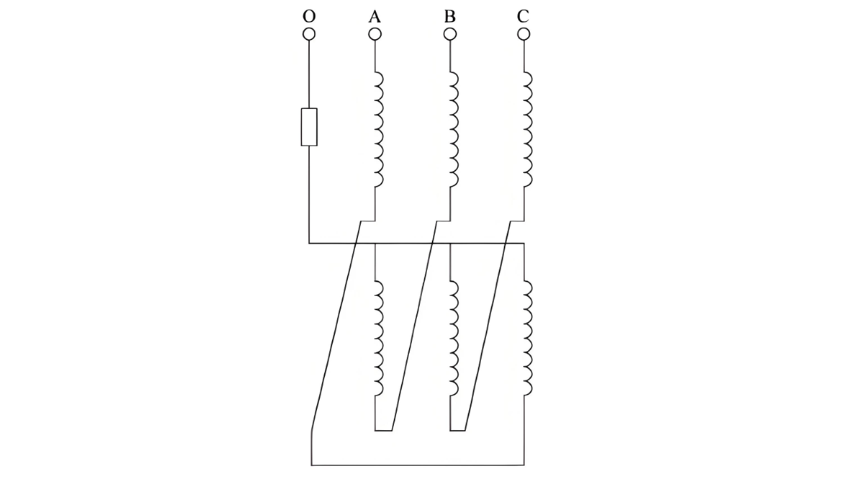
Kon may ground short - circuit, ang zero - sequence current mogulid sa rute sa neutral point. Ang Z - type earthing transformer's zig - zag connection mogawas sa upper ug lower winding zero - sequence currents nga mag-oppose sa usa ka sama, canceling magnetic fluxes ug minimize zero - sequence impedance aron malikayan ang excessive arc - grounding overvoltage. Para sa positive/negative - sequence currents, ang iyang conventional transformer - like electromagnetic properties mo-create og high impedance, restricting their flow.
Sa normal nga operasyon, ang earthing transformer mogawas sa near no - load (no secondary load). Sa panahon sa ground fault, ang positive, negative, ug zero - sequence fault currents mogulid sa rute sa iya. Tungod sa "high positive/negative - sequence, low zero - sequence impedance", ang protection device mosugyot sa grid's zero - sequence current.
2 Konfigurasyon ug Analisis sa Current Protection para sa Earthing Transformers
Ang earthing transformer current protection kasagaran gamiton ang phase - to - phase ug zero - sequence current protection. Ania ang breakdown:
2.1 Setting sa Phase - to - Phase Current Protection
2.1.1 Mga Prinsipyo sa Setting
Kini nga proteksyon kasama ang instantaneous trip ug over - current protection:
2.1.2 Tripping Modes
Batasan sa koneksyon sa earthing transformer sa power supply transformer:
2.2 Setting of Zero - Sequence Current Protection for Earthing Transformers
2.2.1 Setting Principles
Since the zero - sequence current protection of the earthing transformer does not serve as the main protection, there are three time limits, which are shown as follows:

In the formula: t01, t02, t03 are the 1st, 2nd, and 3rd time limits of the zero - sequence current protection of the earthing transformer respectively; t0I' is the time setting value of Section I of the zero - sequence current of the outgoing line; t0II' is the longest time setting value of Section II of the zero - sequence current protection of all equipment on the busbar except the earthing transformer; Δt is set as 0.2 - 0.5 s.
2.2.2 Tripping Modes
2.3 Analysis of Current Protection Operation for Earthing Transformers
Analysis of the earthing transformer protection configuration shows significant differences in tripping modes between phase - to - phase and zero - sequence current protections: zero - sequence protection blocks auto - standby input during operation, while phase - to - phase protection does not.
If the zero - sequence current measured by the protection device reaches the operation value and a ground fault occurs (with the earthing transformer as the only zero - sequence current path in a small - resistance grounding system), the device detects the fault but cannot locate it. If the fault is on the outgoing line, after the protection trips the earthing transformer, the auto - standby input switches to the standby busbar. If the standby busbar recloses onto the faulty line, the earthing transformer on it still detects zero - sequence current, triggering another trip. Since the auto - standby input hasn’t finished charging, the outage range may expand. Thus, zero - sequence protection must block auto - standby input.
When phase - to - phase protection acts (but zero - sequence protection doesn’t), the device judges a phase - to - phase short - circuit in the earthing transformer itself. It trips the earthing transformer, parallel - trips the power supply transformer’s same - side circuit breaker, and the auto - standby input switches to the standby busbar. As the fault is on the tripped earthing transformer, the standby busbar reconnects to the normal line, restoring power.
In summary, phase - to - phase and zero - sequence current protections of earthing transformers differ greatly in fault cause and location judgment, requiring distinct settings and configurations. However, during a ground short - circuit, phase - to - phase protection may misoperate due to measured zero - sequence components. Given their different auto - standby input logics, misoperation may expand the fault range or even cause a full - substation blackout.
3 Case Analysis
3.1 Fault Process
The primary wiring diagram of a 110 kV substation is shown in Figure 2. Before the fault, the low-voltage side 018 circuit breaker of Transformer 1 was closed, the low-voltage side 032 circuit breaker of Transformer 2 was closed, and the 034 circuit breaker was in the test position.
At 06:14 on July 30, 2023, the over-current I section protection of the No. 2 earthing transformer activated, tripping the No. 2 earthing transformer 022 circuit breaker. Meanwhile, it interlocked to cut off the low-voltage side 032 circuit breaker of Transformer 2, causing the 10 kV Section II and III busbars to lose power. The automatic standby power supply (auto-standby) device operated to close the 10 kV Section I/II bus tie 020 circuit breaker.
At 06:36, the over-current I section protection of the No. 1 earthing transformer activated, tripping the No. 1 earthing transformer 015 circuit breaker and interlocking to cut off the low-voltage side 018 circuit breaker of Transformer 1, leading to power loss in all 10 kV Section I, II, and III busbars. The auto-standby device then closed the low-voltage side 032 circuit breaker of Transformer 2 and the No. 2 earthing transformer 022 circuit breaker. However, the fault persisted, triggering the over-current I section protection of the No. 2 earthing transformer again. The 022 circuit breaker tripped and interlocked to cut off the 032 circuit breaker, eventually causing a complete power outage in the substation's 10 kV system.

3.2 On-site Equipment Inspection Results
Primary equipment inspection findings:
Rainwater leakage from the steel support above the 10 kV Section III bus PT chamber infiltrated the switchgear, degrading insulation and causing a C-phase discharge that evolved into a metallic ground fault. In the low-resistance grounding system, the No. 2 earthing transformer detected zero-sequence currents of ~4.3 A/phase (exceeding the 2.5 A overcurrent I-section setting), triggering tripping. The overcurrent protection does not block the 10 kV auto-standby, leading to repeated operations. The final trip left the auto-standby uncharged, causing a complete 10 kV outage.
Key contributing factor: The "phase current zero-sequence cancellation" control word was disabled (set to "0"), preventing software filtering of zero-sequence components in phase currents. With a 13 A zero-sequence current, the overcurrent protection misoperated. Properly enabled, this control would have prevented the fault. Instead, the zero-sequence overcurrent protection I-section (set at 1.4 A) operated: 1st time-limit tripped the bus tie and blocked auto-standby; 2nd time-limit tripped the earthing and main transformer breakers, isolating Sections II/III while Section I remained powered.
Root cause: Disabled zero-sequence cancellation control word allowed phase current misinterpretation.
4 Conclusion
This paper outlines earthing transformer protection settings, analyzes misoperation risks under high zero-sequence currents, and presents a case study. To prevent recurrence:
Key takeaway: Proactive configuration of protection software is critical for preventing misoperations during ground faults.