Search


Rockwill MV/HV Circuit Breaker Operating Mechanism Technology — In-Depth Analysis

Rockwill MV/HV circuit breaker operating mechanism technology – in-depth analysis of spring, magnetic, and motor-driven actuation systems.

Rockwill
Field: Manufacturing
10Year<
China
Add us on Google
In the circuit breaker family, the operating mechanism is regarded as the "heart" — its speed, force, and precision directly determine whether the breaker can reliably open or close a circuit within milliseconds. The reliability level of the operating mechanism directly determines the overall service life of the circuit breaker.

Rockwill (Wenzhou Rockwill Electric Co., Ltd.), as a professional manufacturer in the MV/HV switchgear field, has adopted a clear tiered strategy for operating mechanism technology: oil-free and gas-free pure spring operating mechanisms across the entire MV-to-HV range, leveraging mature, reliable, and structurally simple designs to handle various demanding conditions; for high-capacity, heavy-load HV circuit breaker scenarios, hydraulic operating mechanisms are selected to provide additional power redundancy; while actively developing magnetic drive mechanisms to address future intelligent and frequent operation requirements. This multi-layered approach — "spring as foundation, hydraulic as supplement, magnetic as forward-looking" — reflects not only rigorous technical evaluation but also deep insight into market and engineering applications.

Hydraulic Operating Mechanism — Dedicated Power for HV Large-Capacity, Heavy-Load Scenarios

1.1 Positioning of Hydraulic Mechanisms in HV Large-Capacity Circuit Breakers

In the MV/HV field, hydraulic operating mechanisms are not a universal configuration but are specifically targeted at large-capacity, heavy-load HV circuit breakers. When a circuit breaker must carry extremely high rated currents and short-circuit breaking currents, the contact system mass becomes substantial and the operating energy demand rises sharply. In such cases, the hydraulic mechanism becomes an indispensable choice due to its ultra-high power density. Specific advantages include:

  • Extremely High Output Power: The hydraulic system can instantaneously release enormous energy under a high-pressure reserve of 30–50 MPa, sufficient to drive the heavy contact systems of EHV large-capacity breakers for rapid opening and closing.
  • Smooth and Reliable Operation: Liquid transmission has no mechanical clearance, providing smooth motion that effectively reduces mechanical impact during high-current interruption, protecting the arc chamber and transmission components.
  • Quiet and Noise-Free Operation: Compared with pneumatic and spring mechanisms, hydraulic mechanisms operate more quietly and smoothly, offering better environmental compatibility.

Industry statistics indicate that among major failures of HV circuit breakers, approximately 44% are attributed to the operating mechanism; among minor failures, mechanical mechanism issues account for about 40%. Therefore, in large-capacity HV circuit breakers where operating energy requirements are extremely high and reliability cannot be compromised, hydraulic mechanisms continue to play an important supplementary role.

iee-business

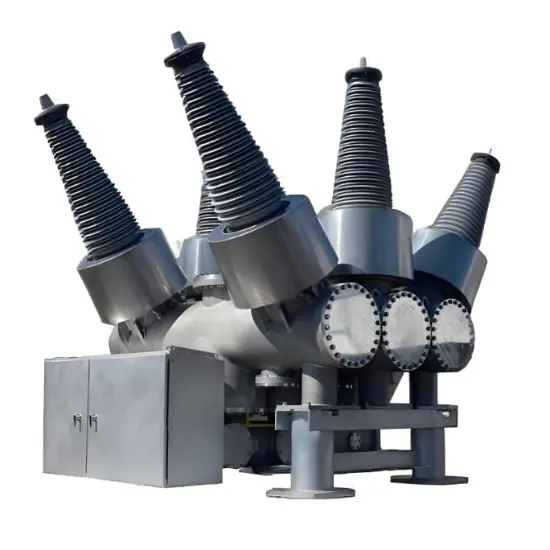
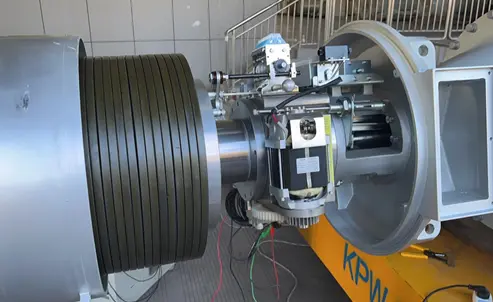
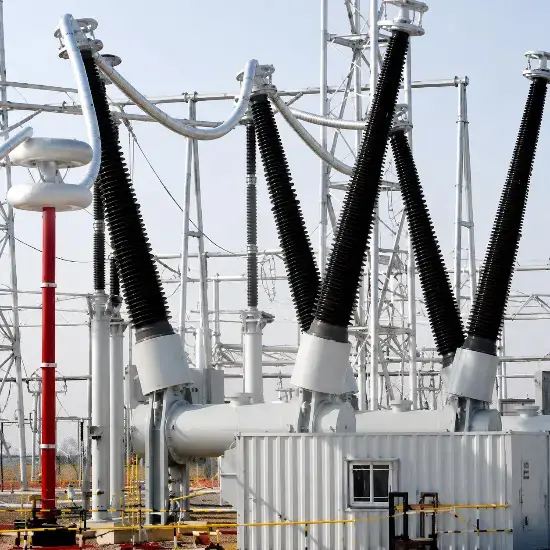
Integrated Hydraulic Operating Mechanism Equipped for ROCKWILL 362kV Tank-type SF₆ Circuit Breaker

1.2 Core Components and Working Principle of Hydraulic Operating Mechanisms

A hydraulic operating mechanism mainly consists of four modules: the energy storage element (motor, oil pump, accumulator), control element (electromagnet, valve system), actuating element (working cylinder), and auxiliary elements (oil tank, pressure switch, piping). Its operation is divided into three stages:

  • Energy Storage Stage: The motor drives the oil pump, drawing low-pressure oil from the tank into the accumulator to compress nitrogen gas for energy storage, generating a high oil pressure of over 30 MPa.
  • Closing Operation: The closing electromagnet is energized, actuating the pilot valve, which drives the amplification valve to change the pressure in the rodless chamber of the working cylinder to high pressure, causing the working cylinder to perform the closing action.
  • Opening Operation: The opening electromagnet is energized, driving the opening valve system to switch the rodless chamber pressure of the working cylinder to low pressure, completing the opening action.

In certain special markets (such as the Americas), circuit breaker operating mechanisms are also required to meet demanding conditions such as "with closing resistor" and "at least 4 close-open (CO) operating cycles," imposing higher design standards on accumulator volume and cyclic operating capability.

1.3 Rockwill Hydraulic Operating Mechanism Technical Features

Rockwill has implemented several targeted innovations for hydraulic operating mechanisms on large-capacity HV products such as the 362 kV dead-tank SF₆ circuit breaker:

  • Near-Zero External Piping Design: Traditional hydraulic mechanisms have numerous external pipes and connectors, which are the main risk points for oil leakage. Rockwill adopts a highly integrated design with largely internalized piping, fundamentally reducing the oil leakage probability for dead-tank circuit breakers.
  • Automatic Hydraulic Oil Pressure Control, Unaffected by Ambient Temperature: Built-in automatic oil pressure regulation maintains stable operating characteristics even under extreme climatic conditions, ensuring reliable operation in harsh environments such as high altitude and heavy pollution.
  • Meeting HV Large-Capacity Parameter Requirements: This hydraulic mechanism can be used with EHV class products, with rated current up to 3,150–5,000 A, rated short-time withstand current 40–63 kA, and peak withstand current up to 100–158 kA, precisely covering the demanding requirements of large-capacity interruption.

Spring Operating Mechanism — The Mainstay of Oil-Free and Gas-Free Transmission in MV/HV

2.1 Oil-Free, Gas-Free Spring Mechanisms Widely Adopted in the MV Field

In the MV circuit breaker field, the widespread adoption of oil-free, gas-free spring operating mechanisms has become industry consensus. These mechanisms rely entirely on mechanical spring energy storage, requiring no hydraulic oil, compressed air, or other fluid media, fundamentally eliminating the maintenance burden of oil leakage, gas leakage, and auxiliary support systems. Rockwill not only follows this technical mainstream but has substantially expanded its application boundary — extending from MV 40.5 kV all the way up to HV 550 kV, making the pure spring mechanism the mainstay configuration covering the entire voltage range.

iee-business

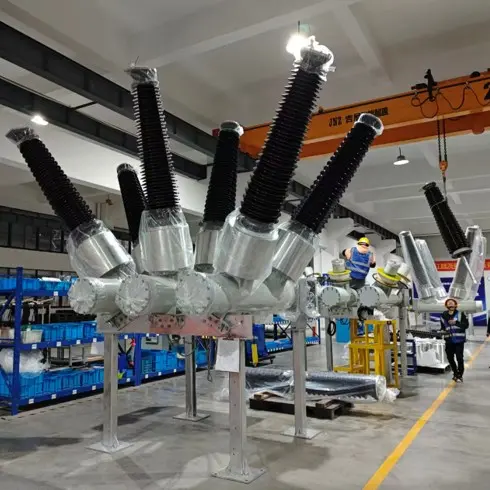
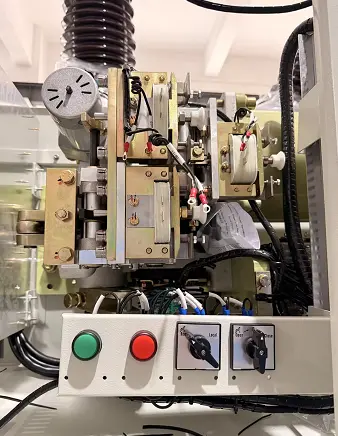
Spring Operating Mechanism for RHD245 Dead-tank Circuit Breaker

2.2 Basic Principle and Product Matrix of Spring Operating Mechanisms

Spring operating mechanisms use spring elastic potential energy to drive contact opening and closing. The core process is: energy storage → latched holding → release. A motor or manual operation extends (or compresses) the spring to store energy; once in position, a latch holds the spring. When the closing coil is energized, the latch releases, and the spring potential energy is released within milliseconds, driving the transmission mechanism to close the contacts. Opening is accomplished by an independent opening spring or the remaining energy of the closing spring.

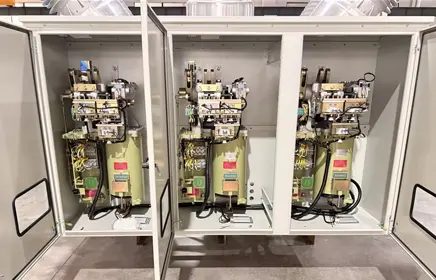
Rockwill's MV/HV circuit breakers are fully equipped with pure spring operating mechanisms, mainly divided into two series: the RHB live-tank SF6 circuit breaker and the RHD dead-tank SF6circuit breaker. The RHB series covers voltage classes from 40.5 kV to 363 kV, equipped with CT-type spring operating mechanisms. The RHD series covers voltage classes from 40.5 kV to 550 kV, using oil-free and gas-free pure spring operating mechanisms. Both series have a mechanical life of no less than 10,000 operations, fully comply with IEC, CEI, GB, JB, DL, and other domestic and international standards, and support customized manufacturing. Notably, RHD models at 362 kV and above have fully adopted pure spring operating mechanisms, marking the technical maturity of spring mechanisms in HV and EHV large-capacity circuit breakers.

iee-business

Pure Spring Operating Mechanism for RHD 72.5kV Dead-tank Circuit Breaker

2.3 Core Advantages of Spring Operating Mechanisms

  • Oil-Free, Gas-Free, Maintenance-Free: No hydraulic oil or compressed air systems, fewer sealing components, extremely low full-lifecycle O&M costs, particularly suitable for remote unattended substations.
  • Low Power Supply Requirements, Compatible with AC and DC: Low closing and opening current; supports both electric and manual local energy storage operation.
  • Operable Even After Power Loss: When the DC panel fails or batteries are depleted, manual energy storage and manual opening/closing functions provide a last line of defense for system restoration.
  • Fast Automatic Reclosing: Springs can pre-store energy for multiple operations, completing "open-close-open" cycles at very short intervals.
  • Strong Environmental Adaptability: All moving parts are enclosed in the mechanism housing with high protection ratings, suitable for outdoor, dusty, high-humidity, and other harsh environments.

Magnetic Drive Mechanism — The Innovator Reshaping the Future Market

Notably, with the improvement of permanent magnet material performance and the maturity of intelligent control technology, magnetic drive mechanisms are gradually forming a new market landscape. Magnetic mechanisms use permanent magnets for holding and electromagnetic coils for control, directly driving contact movement with electromagnetic force, eliminating complex mechanical latches and transmission links. The structure is simpler and response is faster, making them naturally suitable for scenarios requiring frequent operation, condition sensing, and intelligent control.

Currently, magnetic mechanisms have mature applications in MV vacuum circuit breakers and automatic reclosers. Rockwill has adopted a self-developed monostable permanent magnet operating mechanism in the RCW series automatic recloser, using dual-coil control for fast opening and closing, integrated with control, protection, measurement, communication, and online monitoring functions. This has accumulated valuable experience for future extension of magnetic drive to higher voltage classes and larger capacities in MV/HV circuit breakers. As mechanism output continues to increase, magnetic drive is expected to complement spring mechanisms in certain MV/HV applications, reshaping the operating mechanism market landscape.

In-Depth Analysis of the Technical Path — A Scientific and Forward-Looking Tiered Strategy

Rockwill's choice of operating mechanisms is not a simple "one-size-fits-all" approach but a comprehensive optimization based on actual scenario requirements, technical maturity, and full-lifecycle cost:

  • Efficiency: In the MV field, firmly adopts oil-free and gas-free spring operating mechanisms, fully leveraging their high reliability and maintenance-free advantages. At HV and even EHV levels, continues to extend spring mechanism application, having achieved pure spring configuration for RHD-550 kV dead-tank breakers, making spring mechanisms the most widely covered and highest-proportion technical route.
  • Capability: For a few extreme large-capacity interruption scenarios or specific market requirements, uses hydraulic mechanisms to provide additional power redundancy, precisely targeting the dedicated niche of heavy-load HV circuit breakers, ensuring reliable operation under the most demanding conditions.
  • Forward-Looking: Actively develops magnetic drive mechanisms to address the higher requirements of future smart grids for frequent operation, online condition sensing, and predictive maintenance, cultivating new technology growth areas.

From an industry trend perspective, operating mechanisms are evolving from purely mechanical/hydraulic execution units toward "sensing-capable, diagnosable, predictable" intelligent nodes. Rockwill's technical route of "spring as foundation for comprehensive coverage, hydraulic for dedicated large-capacity HV, magnetic for forward-looking positioning" ensures both the reliability and economic advantages of current products while reserving ample space for future intelligent upgrades. This layered, precisely adaptive strategy is the crystallization of its long-term deep expertise in the HV switchgear field.

Conclusion

The operating mechanism is the "hidden champion" in the circuit breaker technical system — every precisely timed release results from the precise coordination of energy storage, control, and transmission. Rockwill's positioning in MV/HV operating mechanism technology — letting oil-free, gas-free spring mechanisms handle the broad demand from 40.5 kV to 550 kV, focusing hydraulic mechanisms on the special conditions of HV large-capacity heavy loads, and pioneering the exploration of magnetic drive — demonstrates clear technical breakthroughs and rigorous engineering logic. As intelligent monitoring, adaptive control, and other technologies continue to advance, this layered strategy will undoubtedly inject stronger technical vitality into MV/HV circuit breakers, continuously providing customers with high-reliability, low-maintenance, and highly adaptable operational assurance.

Edited From:Garca

Give a tip and encourage the author!

Comments

Share your question or perspective
WhatsApp
Send inquiry
+86
Click to upload file
Download
Get the IEE Business Application
Use the IEE-Business app to find equipment, obtain solutions, connect with experts, and participate in industry collaboration anytime, anywhere—fully supporting the development of your power projects and business.
Login
or continue with
New here?
Register