Core distinction
“Single-motion” and “double-motion” describe how the arcing-contact systems move during opening and closing. They do not refer to the number of main and arcing contacts.
- Single-motion contact structure: one contact side moves—normally the moving contact, nozzle, and associated compression components—while the opposing contact remains fixed.
- Double-motion contact structure: the upper and lower contact systems move in opposite directions during the critical portion of the opening/closing stroke, increasing their relative separation speed.
Single-motion: Fixed contact ←→ Moving contact
Only one side moves
Double-motion: Upper contact ← → Lower contact
Both sides move in opposite directions
Comparison
| Aspect |
Single-Motion Structure |
Double-Motion Structure |
| Mechanical arrangement |
One contact system is fixed; the other is driven by the operating mechanism |
Both contact systems participate in motion through levers, linkages, guides, or similar transmission components |
| Relative contact speed |
Approximately equal to the speed of the moving contact |
Sum of the opposing contact speeds; higher relative speed can be achieved under similar drive conditions |
| Initial opening performance |
Requires the moving contact to provide the required opening speed |
Higher initial separation speed is achievable during the critical arcing interval |
| Operating energy |
Typically higher because one side must produce the full required relative speed |
May reduce the required operating energy of the mechanism |
| Operating mechanism |
Often demands higher output force, speed, and stiffness |
Can be more compatible with lower-energy mechanisms, but requires more sophisticated transmission design |
| High-current interruption |
Depends strongly on nozzle, gas flow, and single-side contact speed |
Higher relative speed can improve the interruption margin for high short-circuit currents |
| Small-current interruption |
Requires careful self-blast or auxiliary-blast design to avoid restrikes |
Higher relative speed during the arcing period can help reduce restrike risk |
| Mechanical complexity |
Lower; fewer moving parts and a shorter motion chain |
Higher; additional levers, pins, rollers, guides, and synchronization requirements |
| Manufacturing and maintenance |
Generally easier to manufacture, adjust, inspect, and maintain |
Requires tighter tolerances and closer control of wear, clearance, lubrication, and timing |
| Typical reliability concerns |
Moving-contact drive, guiding components, compression components, and mechanism output |
All single-motion concerns plus linkage wear, looseness, jamming, and timing deviation |
Why double-motion can improve interruption performance
The relevant parameter is the rate at which the gap between the arcing contacts is established:
Vrelative=vupper contact+vlower contact
Because the two contacts travel in opposite directions, a double-motion structure can increase vrelativevrelative without requiring one contact system to carry the entire speed demand.
This can provide two key benefits:
- High-current interruption: Faster gap formation during the initial opening and arcing period supports arc cooling, dielectric recovery, and interruption margin.
- Reduced operating-mechanism burden: The required relative speed can be shared by two moving systems, potentially reducing the speed, force, and operating energy demanded from a single driven contact.
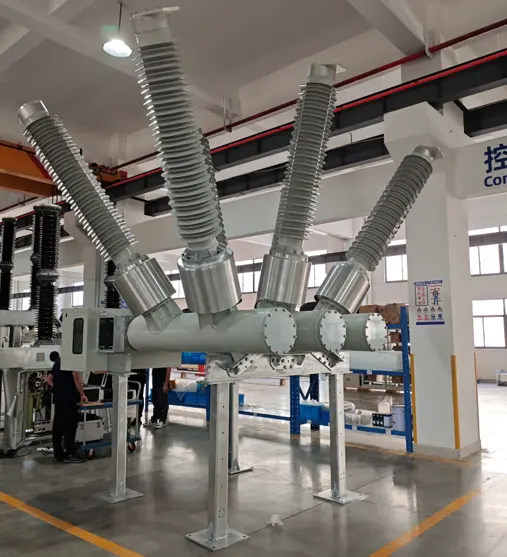
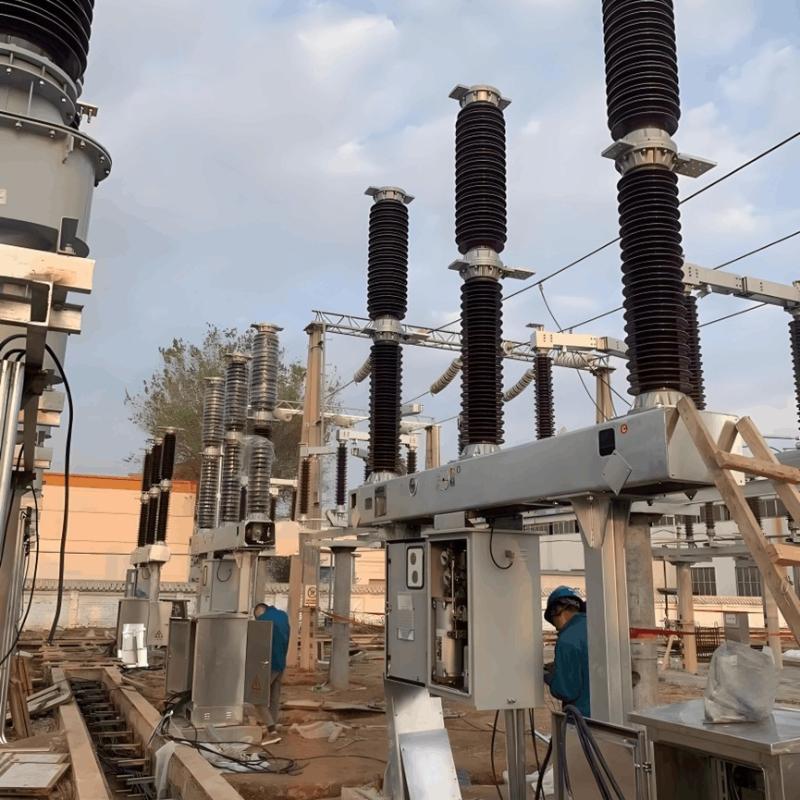
Rockwill RHD‑170 Dead‑Tank SF₆ Circuit Breaker with Silicone Rubber Insulators
Engineering trade-offs
Single-motion contact structure
Advantages
- Simpler mechanical layout and shorter motion chain.
- Easier manufacturing, assembly, commissioning, and fault diagnosis.
- Fewer moving interfaces and coordination requirements.
- Suitable for mature, proven breaker platforms.
Limitations
- The moving contact and operating mechanism must provide nearly all required separation speed.
- High interruption ratings may require a larger, faster, or higher-energy mechanism.
- In puffer-type interrupters, mechanical gas compression further increases operating-energy demand.
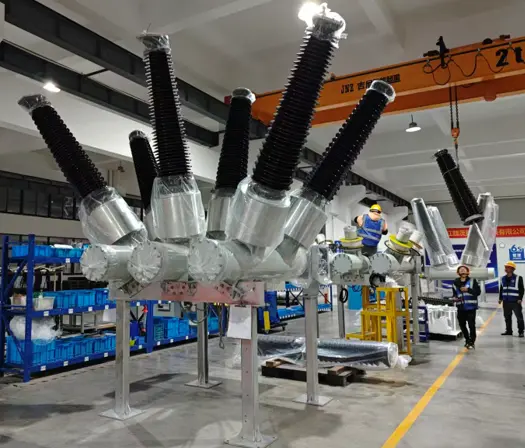
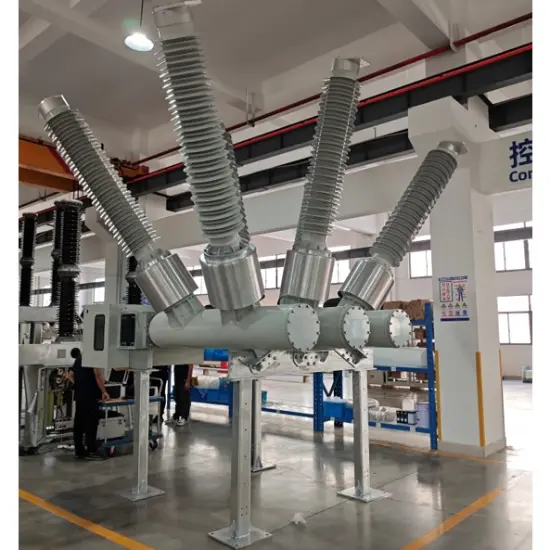
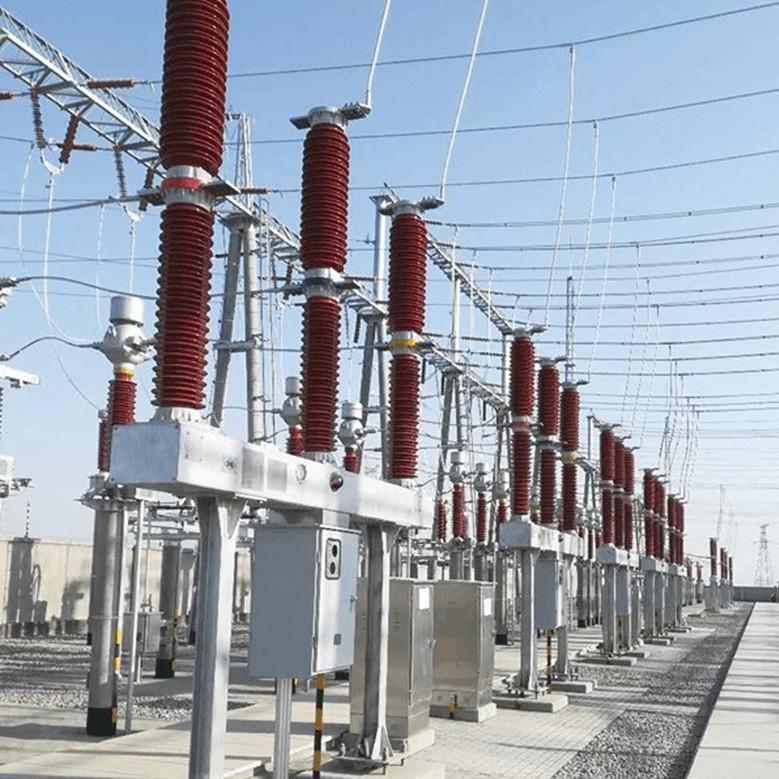
Rockwill RHD‑170 Dead‑Tank SF₆ Circuit Breaker with Porcelain Insulators
Double-motion contact structure
Advantages
- Higher relative contact speed within a limited stroke.
- Potentially better interruption margin for high short-circuit currents.
- Can support lower-energy operating mechanisms, especially when combined with self-blast or thermal-expansion interruption principles.
- Useful for high-performance, compact, or lightweight breaker designs.
Limitations
- More complicated mechanical transmission and motion coordination.
- Greater sensitivity to manufacturing tolerances, mechanical wear, lubrication condition, and accumulated clearance.
- Timing must be optimized: the opposing motion must occur during the relevant prestrike and arcing intervals rather than simply throughout the entire stroke.
- Usually increases design complexity and may increase manufacturing and maintenance requirements.
Selection guidance
| Primary requirement |
Preferred direction |
Rationale |
| Simplicity, mature design, and maintenance convenience |
Single-motion |
Fewer moving parts and lower mechanical complexity |
| High voltage, high short-circuit interruption capability, or compact design |
Double-motion |
Higher relative separation speed can improve interruption performance |
| Lower operating energy or spring-operated mechanism compatibility |
Double-motion with a self-blast interrupter |
Helps reduce dependence on one high-energy moving system |
| Limited maintenance resources |
Single-motion, or a double-motion design with proven field history |
Long-term mechanism reliability and service support are decisive |
| Retrofitting an existing single-motion breaker |
Requires a full engineering assessment |
Converting to double-motion affects the interrupter, drive train, operating mechanism, and type-test performance; it is not a simple contact replacement |
Conclusion
A double-motion contact structure exchanges mechanical simplicity for higher relative contact speed and the potential for lower operating energy.
- Choose single-motion when mechanical simplicity, maintainability, and a mature proven design are the main priorities.
- Choose double-motion when interruption performance, reduced operating-mechanism energy, compactness, or high-rating capability are the main priorities.
- Double-motion is not automatically more reliable; its reliability depends heavily on linkage design, motion timing, manufacturing consistency, and lifetime mechanical-condition control.
The Rockwill 170 kV tank-type circuit breaker RHD series adopts a proven single-motion contact structure combined with a self-blast puffer interruption system. Without relying on complex double-motion linkages, it utilizes the arc’s own energy to reduce operating-mechanism energy requirements, delivering strong interrupting performance with a simplified transmission chain.
Combined with an oil-free, maintenance-free spring operating mechanism, a seismic design rated at Level 9, and a low gas leakage rate, the RHD series achieves 63 kA high short-circuit interrupting capability while avoiding the timing risks associated with multi-linkage transmission systems. This provides high reliability, reduced maintenance workload, and a well-balanced solution for equipment performance and long-term field maintainability.
Edited From:Garca

 Login
Login