
• Product
  • Suppliers
  • Manufacturers
  • Solutions
  • Free tools
  • Knowledges
  • Experts
  • Communities
Search


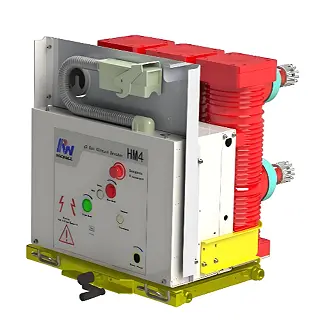
Rockwill HM4 G3 Gas Circuit Breaker — Gas Medium Configuration & Functional Analysis

Rockwill
Field: Manufacturing
10Year<
China

Core Configuration Logic: Why Two Media Are Needed

Medium-voltage systems (12–40.5 kV) operate under high electric field stress and complex duty cycles, requiring circuit breakers to simultaneously solve two technical challenges: long-term electrical isolation and instantaneous fault interruption. This makes the configuration of an insulating medium and an arc-quenching medium a hard requirement for safe equipment operation.

Normal Insulation Requirement: The equipment must withstand the system's rated voltage and various overvoltage stresses over its entire service life. A high-insulation medium is needed to isolate live parts and prevent breakdown or short circuits.

Transient Arc-Quenching Requirement: When the circuit is interrupted, contact separation generates a high-temperature plasma arc reaching tens of thousands of degrees. An arc-quenching medium must instantly cut off the conductive path to prevent equipment burn-down or even explosion.

The HM4 circuit breaker uses a single G3 eco-friendly gas to perform both functions simultaneously, meeting these stringent electrical requirements while enabling compact equipment size and lifetime maintenance-free operation.

iee-business

Core Role of the Insulating Medium (G3 Gas)

The insulation strength of G3 gas far exceeds that of air at normal pressure. For more than 99% of its normal service life, the gas serves as a critical safety barrier:

  • Phase-to-Phase and Phase-to-Ground Isolation: Effectively blocks potential differences between three-phase conductors and between live parts and the grounded metal enclosure, preventing phase-to-phase breakdown or enclosure energization.
  • Reliable Contact Gap Isolation: After the breaker opens, G3 gas fills the contact gap, stably withstanding power-frequency withstand voltage and lightning impulse voltage, preventing contact gap breakdown or insulation failure, and providing absolutely reliable isolation for line maintenance.
  • Environmental Protection: Combined with the permanently sealed pole design, G3 gas effectively prevents ingress of external moisture and dust, ensuring long-term stability of internal insulation performance.

Core Role of the Arc-Quenching Medium (G3 Gas)

Within milliseconds of contact separation, G3 gas achieves efficient fault interruption through self-blast arc-quenching technology:

  • Cooling and Deionization: During opening, the moving contact compresses the gas chamber to form a high-speed gas flow that rapidly carries away arc heat. At the same time, G3 gas's strong electronegativity captures a large number of free electrons, working with rapid cooling to promote charged particle recombination and completely sever the conductive path.
  • No Current Chopping: Achieves smooth current zero-crossing extinction, avoiding switching overvoltages caused by abrupt current interruption in inductive loads (such as motors and transformers), protecting downstream equipment insulation.
  • Rapid Insulation Recovery: After arc extinction, G3 gas restores its dielectric strength extremely quickly, preventing arc re-ignition and fully meeting the demanding requirements of overhead line auto-reclosing cycles.
  • Redundant Fault Tolerance: Even under extreme conditions where gas pressure drops to the minimum safety threshold, the equipment still retains 30% of its rated breaking capacity as an emergency redundancy to ensure safe equipment withdrawal from service.

iee-business

Synergistic Advantages of Integrated Design

  • Complementary Duty Timing: Under normal conditions, the medium provides insulation isolation; under transient conditions, it provides arc-quenching interruption. The two functions operate at different times, perfectly covering the equipment's full operating spectrum.
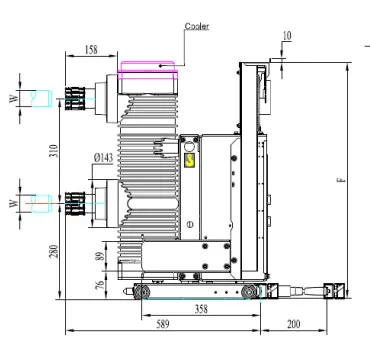
  • Compact and Streamlined Structure: Because both insulation and arc quenching share the same medium, the equipment does not need separate insulation and arc-quenching zones, significantly reducing overall volume and weight (114–190 kg), making it highly suitable for compact indoor switchgear layouts.
  • Green and Maintenance-Free: The permanently sealed process completely eliminates the need for subsequent gas refilling and inspection work. At the same time, G3 gas has an extremely low greenhouse effect, aligning with the green and low-carbon development trend in the power industry.

Competitor Benchmarking (ABB & Schneider): HM4 G3 Differentiated Core Competitiveness

The current mainstream medium-voltage circuit breaker market is still dominated by SF6 products, which offer excellent electrical performance but suffer from three major drawbacks: high greenhouse effect, toxic gas generation during arcing, and increasingly strict global policy controls. The following comparisons against two leading imported SF₆ circuit breakers highlight the HM4's core advantages.

1 Benchmarking Against ABB HD4 Series SF₆ Circuit Breaker

Competitor Overview: Industry benchmark SF6 circuit breaker, using a single SF6 medium for both insulation and arc quenching, with stable performance covering 12–40.5 kV distribution networks and widespread market adoption.

HM4 Differentiated Advantage: Both products deliver identical electrical breaking and insulation withstand performance. However, SF6 gas has a GWP of 23,500, is subject to EU F-Gas regulation restrictions, faces progressive phase-out risk, and produces toxic substances during arc decomposition, leading to high disposal costs at end of life. The HM4 uses G3 gas with a GWP of only 1/40 that of SF6, is non-toxic, and creates no hazardous waste disposal pressure, completely resolving policy compliance and environmental concerns.

2 Benchmarking Against Schneider SF1/SF2 Series SF₆ Circuit Breaker

Competitor Overview: A general-purpose SF6 circuit breaker on the market, with good mechanical reliability commonly used in municipal and industrial-commercial distribution networks, but unable to eliminate the inherent defects of SF6

HM4 Differentiated Advantage: Beyond the environmental advantage, Schneider SF6 circuit breakers require periodic gas pressure inspections, moisture content testing, and on-site gas refilling — cumbersome maintenance. The HM4 uses a permanently sealed pole design, eliminating gas refilling and gas detection entirely, resulting in lower full-lifecycle maintenance costs. Additionally, the HM4's lightweight body enables direct in-situ replacement of old switchgear, making retrofit projects more convenient with shorter construction timelines.

Conclusion

The HM4 circuit breaker perfectly unifies the functions of "normal insulation barrier" and "transient arc-quenching core" through the integrated application of G3 gas. This design not only meets the high-reliability breaking and insulation requirements of medium-voltage distribution networks but also delivers comprehensive advantages in structural compactness, full-lifecycle maintenance-free operation, and environmental compliance. When competing against international first-tier SF6 circuit breakers such as the ABB HD4 and Schneider SF1/SF2, the HM4 leverages the unique advantages of G3 gas — low carbon footprint, non-toxicity, maintenance-free operation, and easy retrofit — to avoid the policy and maintenance pain points of traditional SF6 equipment, providing an ideal solution that combines high safety with green, low-carbon performance for modern power distribution systems.

Edited From:Garca 


Give a tip and encourage the author!

Comments

Share your question or perspective
WhatsApp
Send inquiry
+86
Click to upload file
Download
Get the IEE Business Application
Use the IEE-Business app to find equipment, obtain solutions, connect with experts, and participate in industry collaboration anytime, anywhere—fully supporting the development of your power projects and business.
Login
or continue with
New here?
Register