
• Product
  • Suppliers
  • Manufacturers
  • Solutions
  • Free tools
  • Knowledges
  • Experts
  • Communities
Search


Risks and Root-Cause Analysis of Earthing Switch Incomplete Closing and Poor Contact

Rockwill
Field: Manufacturing
10Year<
China
 
Incomplete closing or poor contact of earthing switches is a common hidden hazard in power systems, posing serious safety risks. The causes mainly involve mechanical transmission, contact interfaces, and electrical control.
iee-business
 

I. Principal Risks

1. Personnel Electrocution Risk

The core function of an earthing switch is to provide reliable earthing during equipment maintenance. If it fails to close fully, the equipment cannot be reliably earthed. Should inadvertent energisation or induced voltage occur on the line, maintenance personnel face a direct electrocution hazard.

2. Equipment Overheating and Burn-Out Risk

Poor contact abnormally increases contact resistance between moving and stationary contacts. Under constant current, the increased resistance sharply raises power dissipation (P = I²R), causing severe local temperature rise. Prolonged overheating accelerates contact oxidation and insulation ageing; in severe cases it leads to contact welding, erosion, and deformation.

Welded contacts cannot open; eroded contacts further increase resistance, creating a vicious "heating → oxidation → aggravated heating" cycle that ultimately triggers internal short-circuits in the switchgear.

3. Catastrophic Maloperation Risk

Earthing switch status is tied to the "five-prevention" interlock logic with circuit breakers and disconnectors: only when fully closed with correct position feedback can interlocks (e.g., "prevent energisation with earthing connected") be enforced.

If the switch fails to close fully, auxiliary contacts may not signal correctly, causing interlock logic to fail. The system may then misjudge the equipment as either reliably earthed or not, precipitating dangerous maloperations such as "energising with earthing connected" or "operating a disconnector under load."

iee-business

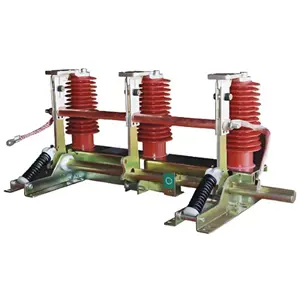
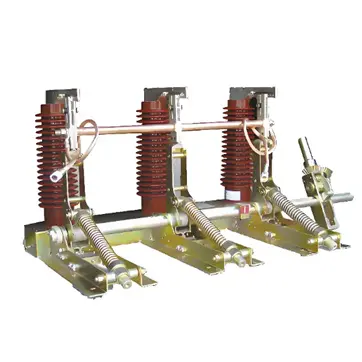
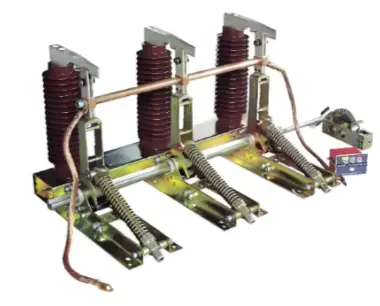
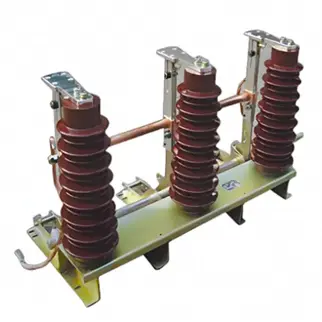
HV Grounding Switch


II. Principal Causes

The three cause categories often overlap and interact (e.g., contact oxidation increases closing resistance, further aggravating mechanism binding). When acting together they must be investigated and rectified holistically.

1. Mechanical Transmission Failures

  • Link deformation or fracture: The drive link twists or fractures under long-term load or impact, reducing mechanism output torque so contacts cannot reach the design position.
  • Fastener loosening: Repeated switching shocks and vibration cause bolts without effective locking to back off, altering transmission dimensions or reducing contact pressure.
  • Mechanism binding: Lubricant ageing, dust ingress, or shaft corrosion increases mechanical resistance, causing difficult or incomplete closing.

2. Contact and Interface Issues

  • Contact oxidation and erosion: Moving/stationary contacts exposed to moisture and chemical gases form oxide films; prior poor-contact arcing erodes surfaces, reducing effective contact area and feeding the vicious cycle.
  • Insufficient contact pressure: Contact finger springs fatigue and relax over long service, dropping contact pressure below design requirements.
  • Installation and alignment deviation: For split-type earthing switches, lack of proper installation guidance or gauging leads to poor alignment and insufficient bite depth; forced installation distorts stationary contacts.

3. Electrical Control and Interlock Failures

  • Electrical interlock failure: Wiring errors in the interlock circuit, de-energised or burnt lock coils, or poor contact on the live-indicator NO node prevent correct execution of the close command.
  • Position detection anomaly: Hall-effect sensor faults or misadjusted limit switches on intelligent earthing switches cause the control system to misjudge the closing state, prematurely stopping the action or issuing false signals.

III. Summary

Although earthing switches lack the arc-quenching duties of circuit breakers, their mechanical reliability is inseparable from power system safety. Incomplete closing and poor contact are not mere mechanical blemishes — they are fatal hazards capable of triggering electrocution, equipment burn-out, and catastrophic maloperation.

The roots lie in mechanical fatigue/loosening, contact oxidation/erosion, and interlock logic failure, with the three categories intertwining and mutually amplifying.

Therefore, in routine O&M and overhaul, the earthing switch's mechanical travel, contact pressure, and interlock function must be core inspection indicators — corresponding to mechanical transmission, contact interface, and electrical interlock respectively — forming a closed-loop management of "accurate indicators, targeted measures": verifying travel and position via mechanical characteristic tests; judging contact quality via circuit resistance measurement; verifying interlock logic via interlock transmission and live operating tests; and cross-checking abnormal heating via infrared thermography.

Rigorous preventive testing and hidden-hazard screening build a solid safety defence line, ensuring the dual safety of equipment and personnel.

Edited From: Garca

Give a tip and encourage the author!
Topics:

Comments

Share your question or perspective
WhatsApp
Send inquiry
+86
Click to upload file
Download
Get the IEE Business Application
Use the IEE-Business app to find equipment, obtain solutions, connect with experts, and participate in industry collaboration anytime, anywhere—fully supporting the development of your power projects and business.
Login
or continue with
New here?
Register