Rockwill VD4 Vacuum Circuit Breaker: Differences and Selection Guide Between Withdrawable and Fixed Types

Rockwill VD4 circuit breaker: fixed vs withdrawable type differences, selection guide, and application advice for switchgear.

Rockwill
Field: Manufacturing
10Year<
China
Add us on Google

I. Core Overview

Rockwill VD4 withdrawable (draw-out) and fixed circuit breakers are identical in core components — both are equipped with genuine vacuum interrupters, embedded poles, and EL spring operating mechanisms. There is no difference in basic electrical parameters (rated voltage, rated current, short-circuit breaking capacity, etc.). The essential differences are reflected in five dimensions: chassis structural design, primary/secondary connection method, operational safety, investment cost, and installation space.
II. In-Depth Comparison of Structure and Electrical Performance

Base and Structural Design:

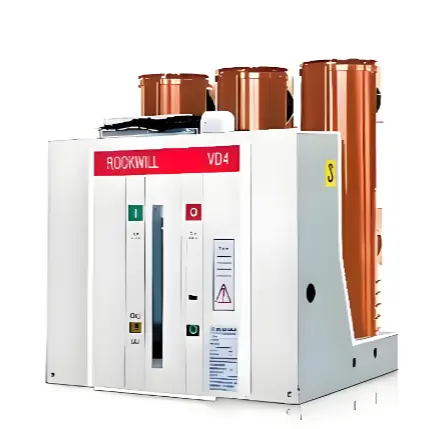
  • The fixed VD4 (model VD4/F) uses an integrated fixed frame mounted directly to the cabinet bracket, with no casters or levering mechanism. Its overall depth is reduced by 10%-15% compared to the withdrawable type at the same rating.

iee-business

Rockwill VD4 Fixed Type Vacuum Circuit Breaker
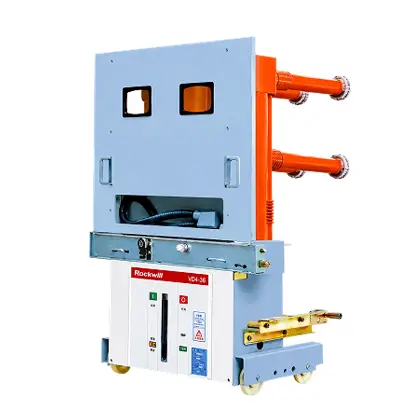
  • The withdrawable VD4 (model VD4/P) comes standard with a dedicated truck chassis, load-bearing casters, and a screw-levering mechanism, supporting switching between connected, test, and isolated positions. However, the cabinet must reserve space for the withdrawable truck to be pulled out.

Indoor high voltage vacuum circuit breaker 40.5kV

Rockwill Withdrawable Type Vacuum Circuit Breaker

Primary Circuit and Dynamic/Thermal Stability:

  • The fixed type uses bolted copper terminals with rigid copper bar or cable connections, providing stable contact resistance with no contact wear risk — ideal for long-term high-current operation. The withdrawable type has silver-plated moving isolating contacts at the pole ends, which automatically engage with fixed contacts when levered into the cabinet. Since frequent racking in and out wears the silver-plating, periodic contact pressure and temperature rise checks are required under high-current conditions.
  • Additionally, before the withdrawable truck is pushed into the connected position, the fixed contact housing (insulating sleeve) interior must be regularly cleaned to prevent dust from affecting insulation performance. The truck's lead screw, guide rails, and other transmission components also require periodic lubrication to prevent mechanical jamming.

Secondary Circuit and Wiring Method:

The fixed type uses cabinet hardwiring, with secondary control wires connected directly to the circuit breaker terminal block. The withdrawable type comes pre-wired from the factory with standard aviation connectors (commonly 58-pin, depending on control requirements).

When positioned in the test position, the secondary circuit automatically engages or disengages without manual wiring intervention, greatly improving on-site commissioning efficiency. It should be noted that fixed-type hardwiring offers natural physical stability against vibration and long-term aging.

While aviation connectors on the withdrawable type are convenient, their protection rating and locking mechanism must be verified reliable under extreme harsh environments (e.g., strong vibration, high salt fog).

Safety Isolation and Interlocking:

The fixed type only has open/close mechanical interlocking on the breaker itself, without built-in isolation capability — it requires a separate disconnect switch (e.g., GN series) to create a visible physical break.

The withdrawable type features a complete five-prevention mechanical interlocking logic (e.g., close-prevented during racking, close-prevented in intermediate position, racking only permitted with door closed). When levered to the isolated position, it creates a visible physical isolation gap, meeting high-voltage equipment safety codes without requiring an additional disconnect switch.

Fault Repair Time:

A withdrawable breaker can be replaced entirely with a spare unit of the same rating, requiring only 10-30 minutes of outage. When a fixed breaker fails, the entire circuit must be de-energized, connecting copper bars must be removed, and the equipment lifted out for repair, typically requiring 4-8 hours of outage.
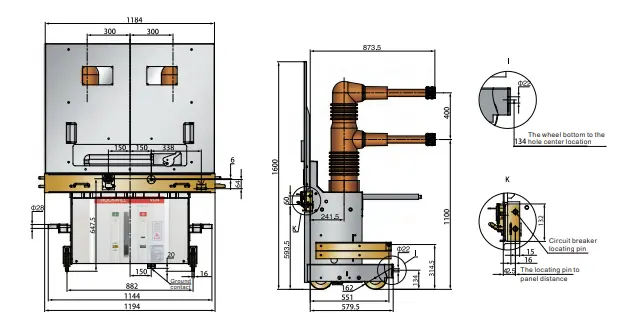
Indoor high voltage vacuum circuit breaker 40.5kV

Overall Dimensions and Mounting Drawing of Withdrawable Vacuum Circuit Breaker

III. Comprehensive Assessment of Installation, O&M, and Cost

  • Procurement and Space Cost: The fixed type pairs with XGN fixed cabinets, reducing total package cost by 20%-30%, and requires less cabinet depth — ideal for space-constrained projects. The withdrawable type pairs with KYN withdrawable cabinets, has higher initial investment due to the truck chassis and isolating contacts, and requires additional space for truck withdrawal.
  • Installation and Commissioning Efficiency: The fixed type requires on-site copper bar connections and individual secondary wiring, leading to longer installation time. The withdrawable type, with its aviation connectors and factory pre-wired secondary circuits, offers extremely high on-site commissioning efficiency.
  • Maintenance and Spare Parts Investment: The fixed type requires no truck or isolating contact maintenance. Only spare breaker units need to be stocked, keeping spare parts costs low. The withdrawable type requires annual lead screw maintenance, contact pressure checks, and complete spare truck units, resulting in higher spare parts investment.
  • Ease of Future Expansion/Retrofit: Changing the current rating of a fixed breaker requires removing copper bars — a large modification effort. The withdrawable type allows direct replacement of the truck unit with one of the required current rating, making retrofits extremely convenient.

IV. Application Scenarios and Selection Logic

  • Load Level and Power Continuity: If the project involves ordinary terminal loads that can tolerate extended outage time, the fixed VD4 is recommended. If it involves critical priority loads (e.g., hospitals, data centers, chemical plants) requiring rapid power restoration, the withdrawable VD4 is mandatory.
  • Matching Switchgear Type: XGN fixed cabinets, HXGN ring main units, and outdoor compact substations only accommodate fixed VD4. KYN28, UniGear ZS1, and similar withdrawable cabinets only accommodate withdrawable VD4.
  • Space and Budget: If the substation room is small and costs are tightly controlled, the fixed type is more economical. If space is ample and the user is willing to accept higher initial investment for O&M convenience, choose the withdrawable type.
  • Inspection Frequency and Code Requirements: If the equipment undergoes simple inspection only once every 3-5 years and no visible break is required, the fixed type is sufficient. If periodic preventive testing is required, or project codes explicitly require a visible isolation gap and simplified interlocking, the withdrawable type is mandatory.
  • Industry Status: In the current medium-voltage distribution market (especially at 12kV), withdrawable breakers have become dominant in mainstream switchgear such as KYN28, because they automatically form an electrical isolation gap when withdrawn, making operation safer and more convenient. Traditional fixed breakers have gradually been replaced by withdrawable types in applications requiring frequent maintenance. However, in ring main units, compact substations, and severely budget-constrained terminal distribution projects, fixed breakers still offer irreplaceable economic advantages.

V. Core Selection Summary

In summary, if the project is budget-sensitive, space-constrained, involves ordinary loads with low inspection frequency, the fixed VD4 should be chosen decisively. Conversely, if the project demands high power continuity, rapid fault restoration, frequent preventive testing, or strict safety isolation codes, the withdrawable VD4 takes priority.

Edited From:Garca

Give a tip and encourage the author!

Comments

Share your question or perspective
WhatsApp
Send inquiry
+86
Click to upload file
Download
Get the IEE Business Application
Use the IEE-Business app to find equipment, obtain solutions, connect with experts, and participate in industry collaboration anytime, anywhere—fully supporting the development of your power projects and business.
Login
or continue with
New here?
Register








