
• Product
  • Suppliers
  • Manufacturers
  • Solutions
  • Free tools
  • Knowledges
  • Experts
  • Communities
Search


HV Circuit Breaker Voltage Classes: What's the Difference Between 275kV, 330kV, 345kV and 362kV?

Rockwill
Field: Manufacturing
10Year<
China

Two Key Concepts First

Un (Nominal Voltage) — The nameplate of the grid, e.g., "330 kV system."
Um (Rated Maximum Voltage) — The highest voltage the equipment can continuously withstand; the real basis for selection.

A 275 kV system corresponds to Um = 300 kV. 330 kV, 345 kV and 362 kV systems all correspond to Um = 362 kV.
These four nominal voltages represent only two insulation classes.

Difference 1: External Insulation — Visible at a Glance

  • Air Clearance (live-part-to-ground distance): When Um rises from 300 kV to 362 kV, clearance increases by approximately 10–15%. 362 kV class breakers are visibly larger.
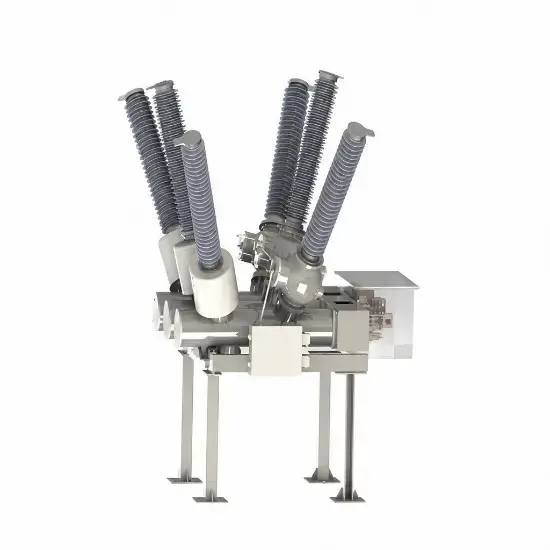
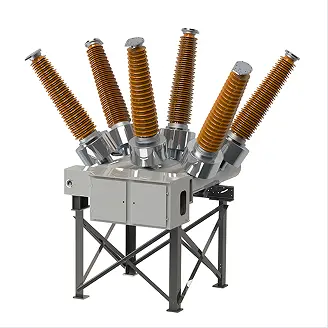
  • Creepage Distance (insulator surface path length): At the same pollution level, 362 kV bushings are about 20% longer than 275 kV bushings. Bushing length alone gives a rough indication of the insulation class.

Difference 2: Internal Insulation — Structural Design

  • SF₆ Gas Gap: With a 100 kV increase in Um, the gas gap between the conductor and the tank wall must be enlarged to avoid breakdown. Designers can either increase the gap or raise gas pressure — but SF₆ liquefies at approximately −36°C at 0.6–0.7 MPa, limiting how much pressure can be increased.
  • Solid Insulation (insulating rods, nozzles, supports): Creepage distances and internal withstand margins must be redesigned for the higher insulation level. Larger insulation parts directly increase interrupter length and overall weight.
  • Contact Stroke (distance between open contacts): 362 kV class requires 40–50% more stroke than 275 kV, significantly increasing the demand on the operating mechanism.
 

Difference 3: Interruption Performance — Arc Chamber Design

  • Recovery Voltage: Higher system voltage means higher recovery voltage across the contacts during interruption. 362 kV class is approximately 20% higher than the 275 kV class, requiring stronger arc-quenching capability.
  • Dielectric Recovery Rate: After current zero, the dielectric strength across the contacts must recover fast enough to withstand the recovery voltage. The 362 kV class has approximately 110 kV higher peak recovery voltage than the 275 kV class, demanding faster dielectric strength build-up, more optimized nozzle flow, and higher contact separation speed.
  • Number of Interrupters: 275 kV class typically uses 2 interrupters; 362 kV requires 2–3. More interrupters mean a longer arc chamber and greater mechanical complexity.

Difference 4: Grading Capacitors — Essential for Multi-Break Designs

In multi-break designs, stray capacitance to ground causes uneven voltage distribution across breaks. Grading capacitors equalize the voltage. 275 kV class uses 2 capacitor sets; 362 kV requires 2–3 sets with higher capacitance values.

Difference 5: Operating Mechanism — Type and Output

  • Mechanism Type: 275 kV class requires relatively low operating energy (~3–4 kJ) and can use simple spring mechanisms. 362 kV class requires significantly more energy (~5–7 kJ), necessitating hydraulic or spring-hydraulic mechanisms — more complex and more expensive.
  • Output Energy: Increased stroke, more interrupters, and heavier arc chamber push operating energy 50–75% higher for 362 kV class. The two classes share no common mechanism design.

Difference 6: Altitude Performance

Above 1000 m, air density decreases and insulation strength drops. At 3000 m altitude, the insulation margin must increase by 20%. The 362 kV class, starting from a higher voltage base, is more severely affected.

Difference 7: Seismic Performance

Equipment height and center of gravity directly determine seismic performance. The 362kV unit features longer bushings and a higher overall structure, with its center of gravity approximately 15–20% higher than that of the 275kV model. In areas with high seismic fortification intensity, 362kV equipment generally requires reinforced flanges, composite bushings or integral frame strengthening, while the 275kV equipment has relatively lenient requirements in these aspects.

Difference 8: Weight and SF₆ Volume

Parameter 275 kV Class 362 kV Class
SF₆ charge ~100–150 kg ~180–300 kg
Bushing height ~3.5–4 m ~4.5–5 m
Overall height ~5–6 m ~7–8.5 m
Single-phase shipping weight ~4–6 t ~7–10 t
275 kV class can often be shipped fully assembled; 362 kV class usually requires disassembly for transport and on-site reassembly.

Difference 9: Type Testing — Certification Cost

More Test Duties: 362 kV class falls underBeyond the standard T10, T30, T60, T100 tests, it also requires T100s (short-line fault) and T100a (asymmetrical breaking) tests.

Higher Test Cost: Each short-circuit test requires shipping the test object to a high-power lab. Test circuit costs rise significantly with voltage. A full type test program for a 362 kV breaker costs 2–3 times that of a 275 kV breaker.

More Severe Dielectric Tests: The 362 kV class requires LI across-open contacts of 1175 kV — far more challenging for both the test facility and the breaker itself than 950 kV.

Summary

Upgrading from 275kV to 362kV is more than a nameplate change. It requires systematic redesign of core components including bushings, interrupters, solid insulators, grading capacitors and operating mechanisms. This raises material costs, manufacturing complexity and type test expenses, leading to a price difference of 1.5 to 2 times.
Three on-site identification criteria without checking nameplates: air clearance, bushing length and number of grading capacitors.
Edited From:Garca
Give a tip and encourage the author!

Comments

Share your question or perspective
WhatsApp
Send inquiry
+86
Click to upload file
Download
Get the IEE Business Application
Use the IEE-Business app to find equipment, obtain solutions, connect with experts, and participate in industry collaboration anytime, anywhere—fully supporting the development of your power projects and business.
Login
or continue with
New here?
Register