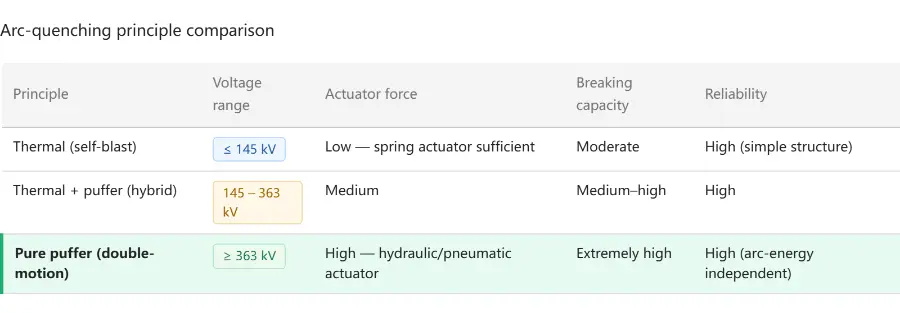
1.Comparison of Three Arc-Quenching Principles
2. Root Causes — Layer by Layer
2.1 Fault current and arc energy far exceed the self-blast ceiling
At 363 kV and above, the rated short-circuit breaking current typically reaches 40–63 kA. Self-blast (thermal) quenching relies on the arc itself to heat SF₆ and build blowing pressure — a useful feature at lower voltages, but a liability at UHV:
- Excessive arc energy → accelerated SF₆ decomposition (SO₂, SOF₂) → dielectric recovery blocked
- The transient recovery voltage (TRV) rises steeply, and the dielectric recovery rate of an over-heated gas column cannot keep up
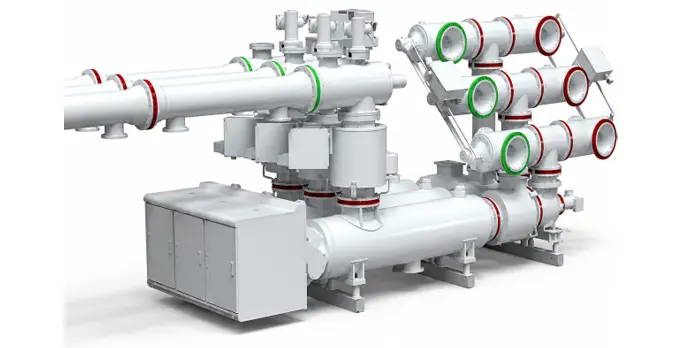
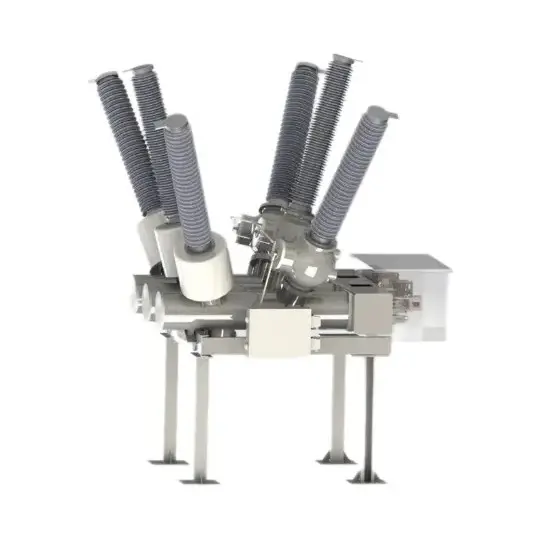
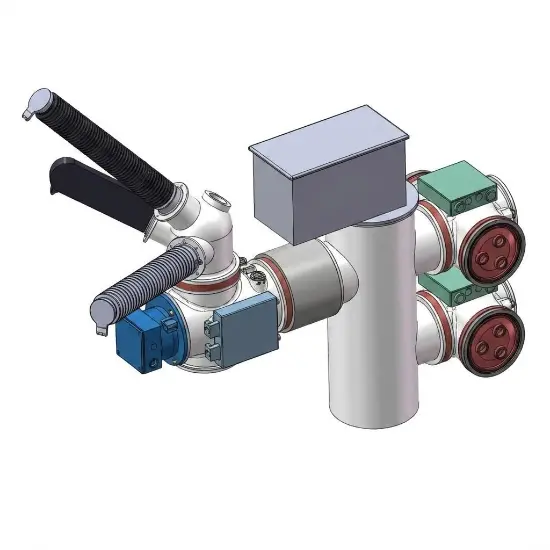
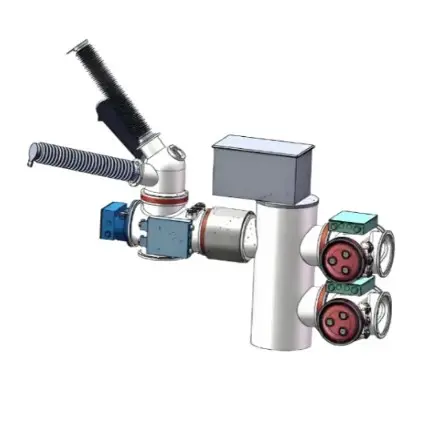
Rockwill RHP Series Hybrid Gas Insulated Switchgear
2.2 The decisive advantage of pure puffer: active, deterministic gas blast
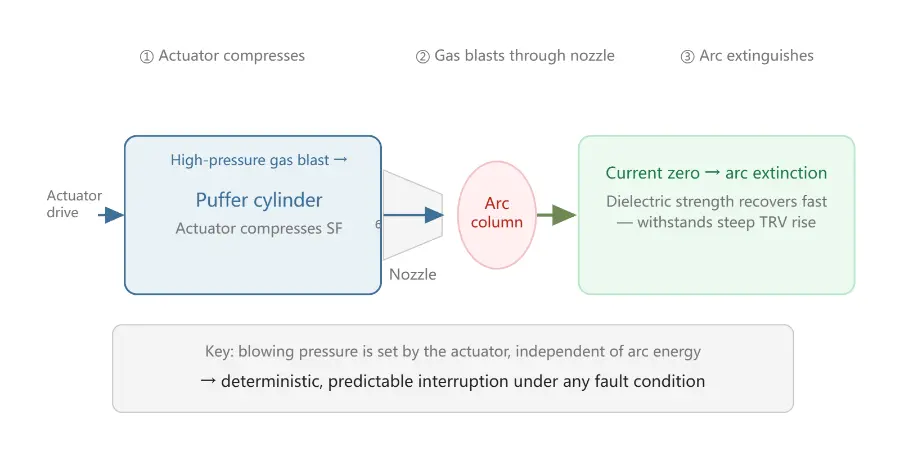
In a puffer interrupter, the blowing pressure is generated entirely by mechanical compression of the gas cylinder — completely decoupled from arc energy:
3.TRV requirements are extremely demanding
UHV systems impose high TRV peak values and steep rates of rise of recovery voltage (RRRV). The pure puffer design builds sufficient pressure before current zero, and maintains high-velocity gas flow immediately after, driving the arc column temperature below the critical dielectric threshold faster than the TRV can rise.
4. Self-blast failure modes at UHV
| Scenario |
Self-blast risk |
| Close-in fault (high current, steep TRV) |
Overheating → SF₆ decomposition → dielectric recovery failure |
| Small inductive current interruption |
Insufficient arc energy → cannot build blowing pressure |
| Long-line capacitive current interruption |
Current chopping → reignition risk |
The pure puffer design carries ample pre-built pressure reserves for all three scenarios, independent of arc conditions.
5. Actuator sizing is mature and cost-justified
Pure puffer interrupters require high-output actuators (hydraulic-spring or pneumatic) to overcome the compression reaction force. At 363 kV+, this is a well-established standard configuration in GIS engineering — the cost premium is accepted and proportional to the reliability gain.
6.Summary
The core rationale for adopting pure puffer-type arc quenching at 363 kV and above is that the interrupting energy and TRV requirements have exceeded the reliable operating limits of self-blast (thermal expansion) technology. A deterministic, mechanically driven blast pressure must be provided by the operating mechanism, decoupling the arc-quenching behavior from the arc state. This ensures reliable interruption under all operating conditions—including high-current, low-current, and short-line faults—and enables successful dielectric recovery under extremely steep transient recovery voltages (TRVs).
The Rockwill GIS circuit breaker is built upon this core rationale. Leveraging a highly reliable spring-operated mechanism and an optimized puffer-type interrupter matching design, it ensures stable output of active blast pressure while keeping operating energy within a reasonable range. With minimal mechanical characteristic deviation throughout its entire service life, it fulfills the stringent interrupting reliability requirements of ultra-high-voltage power grids.
Edited From:Garca

 Login