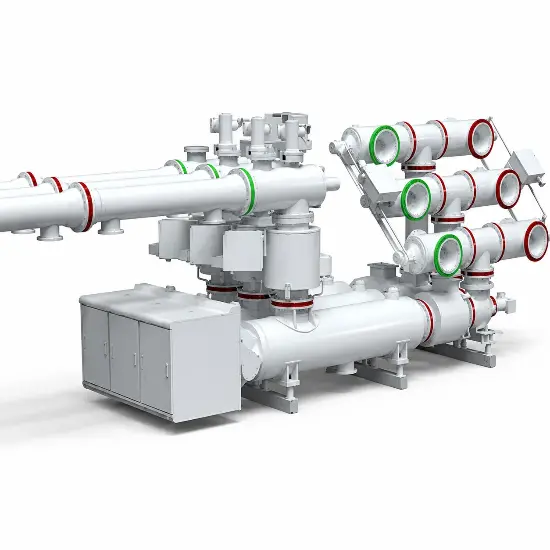
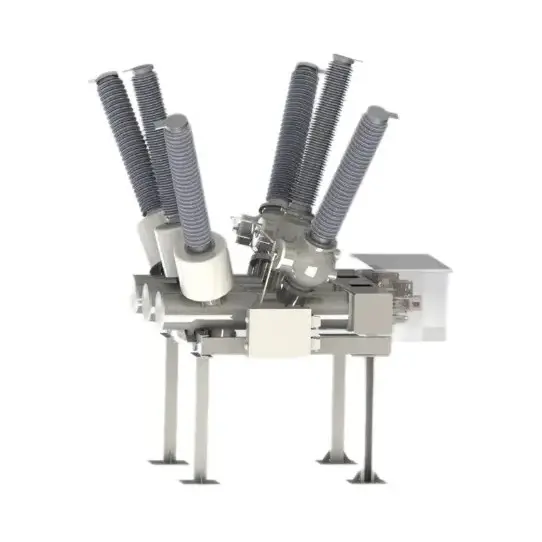
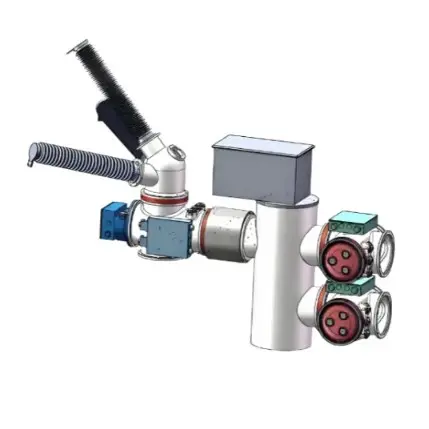
Gas-insulated metal-enclosed switchgear (GIS) must adopt a fully enclosed structure, primarily determined by its core operating principles and design objectives. Taking the Rockwill GIS RHG-145 series—compliant with both GB and IEC standards—as a reference, the necessity and advantages of this fully enclosed design can be summarized in the following five key aspects:
1. Maintaining the Core Insulation and Efficient Arc-Quenching Environment
GIS internally utilizes high-performance pressurized gas (such as SF₆) as the insulating medium between phases and to ground. The fully enclosed metal enclosure serves as the essential physical barrier to maintain a sealed gas environment and prevent leakage.
This high level of sealing not only ensures ultra-low partial discharge and leakage rates but also provides the foundation for more efficient arc-quenching technologies. For example, the Rockwill GIS RHG-145 is equipped with a self-blast arc-quenching CT26 spring operating mechanism, enabling reliable interruption of short-circuit currents up to 40kA.
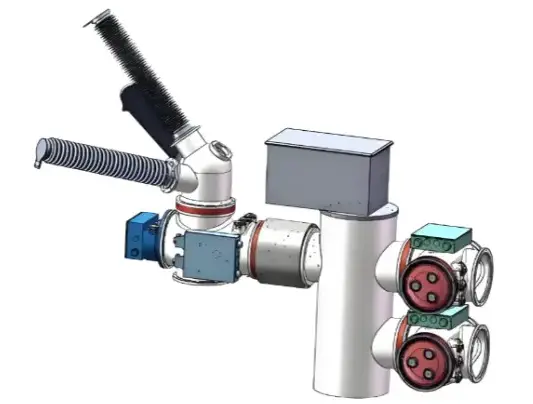
Rockwill RHG-145 Gas-Insulated Metal-Enclosed Switchgear
2. Achieving Extreme Compactness and High Integration
Since the dielectric strength of SF₆ gas is 2 to 3 times that of air at atmospheric pressure, the insulation distances between live parts are significantly reduced. The fully enclosed structure allows primary components such as circuit breakers, disconnectors, and instrument transformers to be highly integrated within a compact enclosure. Take the Rockwill GIS RHG-145 as an example—its three-phase common enclosure design compresses the bay width to just 0.8 meters, reducing the footprint to only 30%–50% of a traditional air-insulated substation (AIS), while greatly simplifying on-site assembly of modular components.
3. Complete Isolation from External Environmental Interference (High Reliability & Maintenance-Free Operation)
In conventional open-type equipment, high-voltage parts are exposed to the air and highly susceptible to environmental influences. The fully enclosed structure of GIS completely isolates all live parts from the outside world, endowing it with exceptional adaptability to various operating conditions.
Thanks to this design and the corrosion-resistant aluminum alloy enclosure, GIS is immune to high altitudes, strong winds, ice accretion, heavy pollution, or animal intrusion. It is suitable for both indoor and outdoor installation, serving as the fundamental guarantee for "long-term maintenance-free" operation.
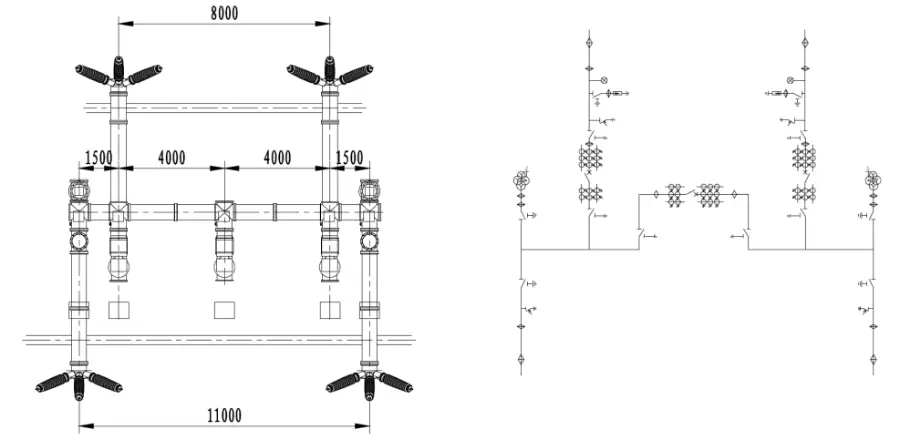
RHG-145 Plan of Bridge Connection Interval and Primary Principle Diagram
4. Enhanced Personnel Protection and Operational Safety
The metal enclosure of GIS is reliably grounded, with no exposed high-voltage live parts externally, completely eliminating the risk of electric shock to operating and maintenance personnel. In the event of an internal fault, it effectively contains the arc and prevents the release of high-pressure gas. Furthermore, the enclosed architecture provides an excellent platform for complex interlocking mechanisms. For instance, the Rockwill GIS RHG-145 integrates a three-position switch combining make, isolate, and earth functions within the sealed enclosure. Together with full-circuit electrical and mechanical interlocks, it fundamentally eliminates the possibility of live-line maloperation.
5. Superior Electromagnetic Shielding and Reduced Losses
The grounded metal enclosure effectively shields the electromagnetic fields generated by internal high-voltage, high-current conductors, preventing interference with external secondary control systems—such as local monitoring and "four-remote" (remote control, remote indication, remote measurement, remote regulation) functions in intelligent GIS. Particularly in GIS designs with three-phase common enclosures, under symmetrical operating conditions, the magnetic fields generated by the three-phase currents largely cancel each other out through vector superposition within the enclosure. Combined with the non-magnetic aluminum alloy material, this significantly reduces external leakage flux as well as eddy current losses and enclosure heating.
Conclusion
The fully enclosed metal enclosure is not merely a "container" for SF₆ gas—it is the fundamental physical foundation that enables modern GIS to achieve miniaturization, withstand harsh environments, ensure absolute safety, and optimize electromagnetic performance.
Edited From:Garca

 Login
Login