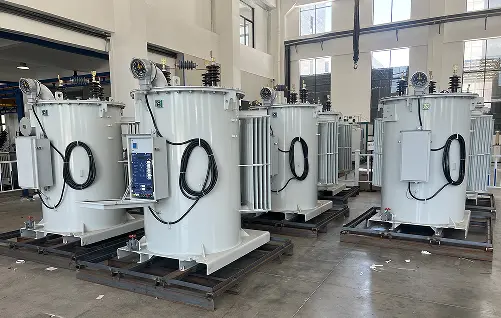
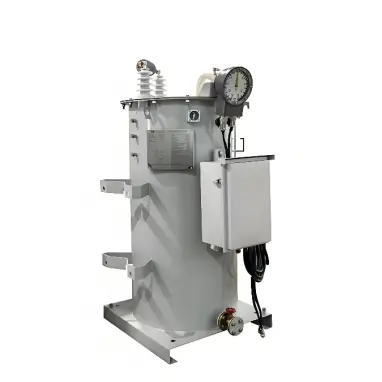
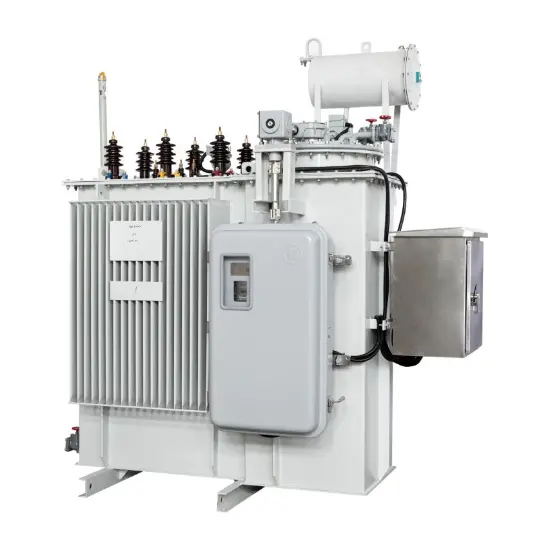
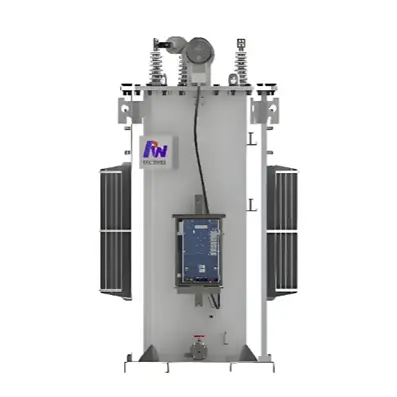
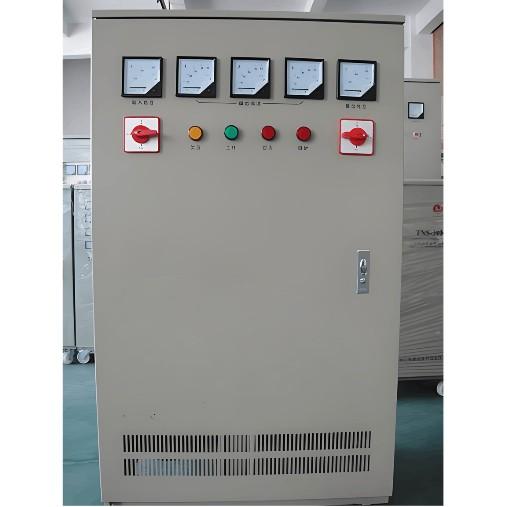
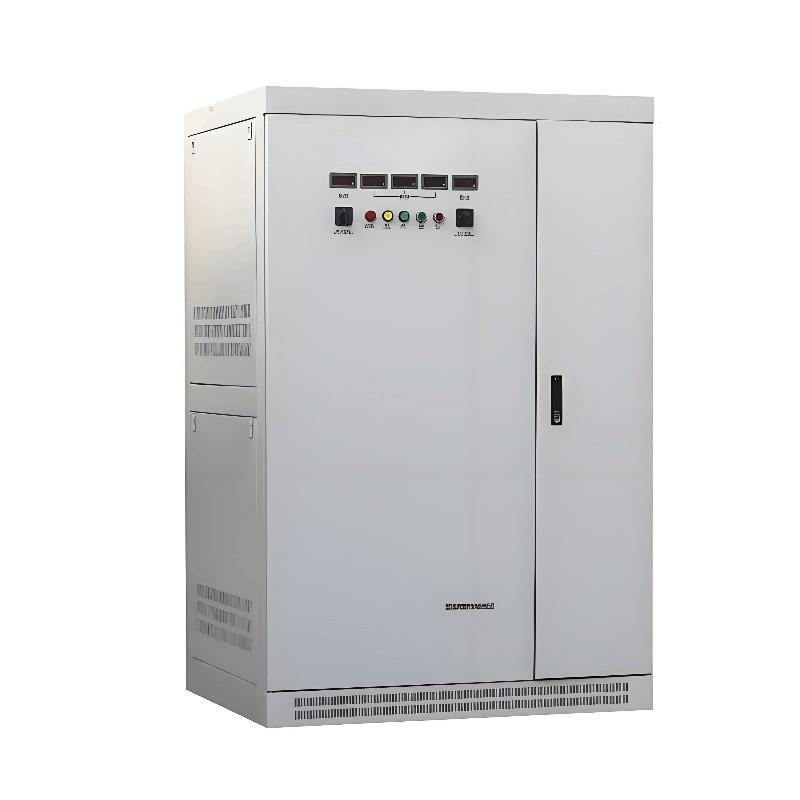
The RVR-1 is a single-phase oil-immersed autotransformer on-load regulator, suited to pole-mounted single-phase feeders and single-phase laterals, or to three-unit open-delta banks on three-phase three-wire systems. The RVR-3 is a complete three-phase oil-immersed unit, suited to three-phase distribution networks and to substation, pad-mounted, or pole-mounted installation.
| Series |
Phases |
Rated voltage |
Taps and range |
Current and capacity |
Mounting and standards |
| RVR-1 |
Single-phase |
2.4 to 34.5 kV (some pages 6 to 33 kV at 50 Hz; 7.62 to 34.5 kV in the catalogue) |
32 steps at approximately 0.625%, ±10% |
50 to 546 A or 50 to 600 A; catalogue capacity approximately 38 to 660 kVA, and 30 to 990 kVA depending on the voltage class |
Pole-mounted, pad-mounted, or substation; ANSI C57.15, IEC 60076-21, and related standards |
| RVR-3 |
Three-phase |
13.8 / 14.4 / 19.92 / 34.5 kV |
16 steps at 2.5%, ±20% |
38 to 1000 kVA |
Oil-immersed ONAN, motor-driven OLTC; optional GPRS, GSM, or Bluetooth; IEC and related standards |
Key takeaway: use the RVR-1 for fine-grain correction at the end of single-phase laterals (0.625 percent per step), and use the RVR-3 when a three-phase application calls for a wide range (2.5 percent per step, ±20 percent).
On Rockwill's official three-phase pages, the SVR-3 and the RVR-3 are both presented as three-phase automatic step voltage regulators. Their core architecture is the same: an oil-immersed autotransformer, a motor-driven OLTC, current and voltage transformers, and a smart controller. Both offer a regulation range of up to 16 steps × 2.5 percent, ±20 percent. The differences are mainly the series name used on the page and the orderable voltage matrix.
-
RVR-3 official listing: 13.8 / 14.4 / 19.92 / 34.5 kV, 38 to 1000 kVA, with IEC 60076-21, IEC 60214, IEEE C57.15, and similar standards applicable.
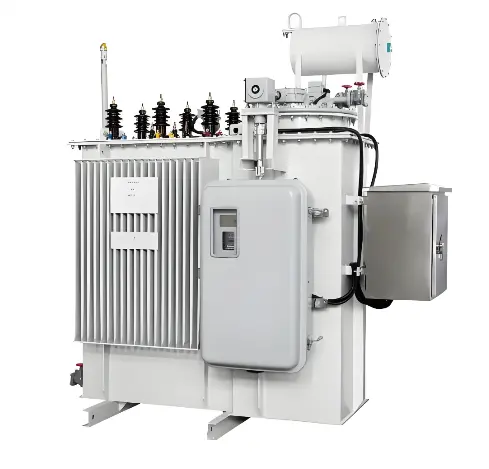
Three-Phase Automatic Step Voltage Regulator
-
SVR-3 catalogue: separately lists 50 Hz voltages of 6 / 6.35 / 11 / 15 / 22 / 33 kV and 60 Hz voltages of 7.62 / 13.8 / 14.4 / 19.92 / 34.5 kV. One technical table lists rated currents of 50 to 1665 A, capacities of 38.1 to 1000 kVA, and a basic impulse level (BIL) of 60 to 200 kV, depending on model and voltage class. Its controller is designated the SVR smart controller and supports GPRS, GSM, and Bluetooth, together with overcurrent, overload, undervoltage, and fault blocking functions.
-
Recommended tender wording: do not write only "SVR". Write instead "three-phase medium voltage on-load step voltage regulator, autotransformer plus OLTC, 16 × 2.5 percent or taps selected to suit the load, oil-immersed ONAN, controller with line drop compensation, bandwidth, time delay and limits, and communication protocol".
Match the choice directly to the feeder conditions.
The RVR, AVR step, and SVR medium voltage on-load solutions change taps by driving a tap changer with a motor. They are step-type on-load regulators that operate tap by tap on a second-level timescale and rely on bandwidth plus time delay to prevent oscillation.
They do not provide millisecond-level dynamic voltage support. Where the requirement is voltage sag or flicker mitigation, or transient reactive power support for renewable generation, static reactive compensation, a dynamic voltage restorer (DVR), or a STATCOM should be specified separately. An on-load regulator should not be used as a dynamic compensator.
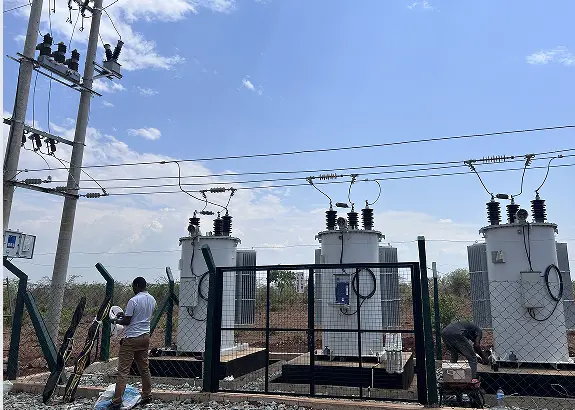
Overseas distribution network site: Three-phase RVR‑3/SVR‑3 MV line voltage regulators on foundation, commissioned for end-of-long-feeder voltage management.
Q: Are the Rockwill RVR and AVR the same thing?
A: In medium voltage line applications the hardware often overlaps. AVR is the functional umbrella term for an automatic voltage regulator; RVR is the Rockwill series name, with the RVR-1 single-phase and the RVR-3 three-phase. In tender documents, using AVR to describe the function and RVR or SVR to identify the specific model avoids ambiguity.
Q: What are the highest voltage class and capacity of the RVR-1?
A: The official single-phase page lists 2.4 to 34.5 kV (some 50 Hz catalogues list 6 to 33 kV), 32 steps at approximately 0.625 percent, and ±10 percent. The 7.62 to 34.5 kV catalogue lists capacities of 38 to 660 kVA, while the 6 to 33 kV at 50 Hz catalogue lists 30 to 990 kVA. The actual rating is determined by the specific combination of voltage, current, and BIL.
Q: Which has the larger capacity, the SVR-3 or the RVR-3?
A: In Rockwill's three-phase range, both are listed up to approximately 1000 kVA three-phase. The SVR-3 catalogue covers a wider voltage spread, including the 50 Hz steps of 6 / 11 / 15 / 22 / 33 kV, whereas the RVR-3 catalogue is mainly listed at 13.8 / 14.4 / 19.92 / 34.5 kV. Capacities above 1000 kVA, or ratings for unusual feeders, need to be confirmed through a Rockwill custom design.
Q: How fast does a medium voltage line automatic voltage regulator respond?
A: On-load tap changing is stepwise rather than continuous thyristor regulation. The time per tap depends on the OLTC motor, the controller delay, and the anti-hunting bandwidth setting, and is normally assessed in engineering terms as seconds per tap. It is not intended for voltage sag mitigation.
Edited From:Garca

 Login
Login