

Search


Rockwill Load Switch: Core Differences Between Standard (Two-Position) and Three-Position Designs

Rockwill load switch core design differences: standard 2-position vs 3-position for RMU applications in MV distribution.

Rockwill
Field: Manufacturing
10Year<
China
Add us on Google

In Rockwill's product system, the most fundamental difference between a standard load switch and a three-position load switch lies in functional integration and safety level. A standard load switch addresses only the "make and break" function, while Rockwill's three-position load switch integrates "make/break," "isolation," and "earthing" in a single unit — making it the standard configuration for core products such as ring main units.

The specific differences are summarized below:

Comparison Dimension Rockwill Standard (Two-Position) Load Switch Rockwill Three-Position Load Switch
Operating positions 2: Closed position, Open position 3: Closed position, Open (isolating) position, Earth position
Core functions Can only make and break normal load current Highly integrated: load switching, circuit isolation, and equipment earthing in one
Safety features Single function; after opening, does not guarantee a visible isolating gap; typically requires an external disconnector Open position inherently provides a visible isolating gap; internal positive mechanical interlock eliminates the risk of maloperation such as closing the earthing switch onto an energized circuit
Rockwill representative products Selected basic SF6 load switches, vacuum load switches (non-three-position design) Rysec series (eco-friendly gas), VFX series (side-mounted vacuum), classic SF6 C-module / F-module
Typical applications Simple, cost-sensitive LV or end-of-line distribution circuits Rockwill ring main units (RMU), compact substations, cable distribution cabinets — applications requiring high integration and safety
 

I. Core Safety Logic: Disconnection vs. Isolation (Rockwill Design Philosophy)

This is the most fundamental difference between the two designs and the focal point of Rockwill's safety value proposition to customers:

  • "Disconnection" simply means the circuit is opened and the load is disconnected.
  • "Isolation" requires not only disconnection but also a sufficiently large and visible open gap, ensuring physical separation between the supply side and the load side — a mandatory condition for maintenance personnel safety.

Rockwill's three-position load switch inherently meets the national standard for an isolating position in its open position. Furthermore, it uses a single set of contact blades to switch between the three positions, physically preventing simultaneous "Closed" and "Earth" states and fundamentally eliminating maloperation risks. In contrast, a standard load switch after opening typically satisfies "disconnection" but not "isolation," necessitating an external disconnector in series — adding cost and space.

II. Three Core Technical Routes for Rockwill Three-Position Products

Rockwill offers three mature three-position solutions based on different insulating media and arc-extinguishing methods, all supporting "Closed – Open – Earth" three-position switching:

1. Eco-Friendly Gas Insulated (Rysec Series)

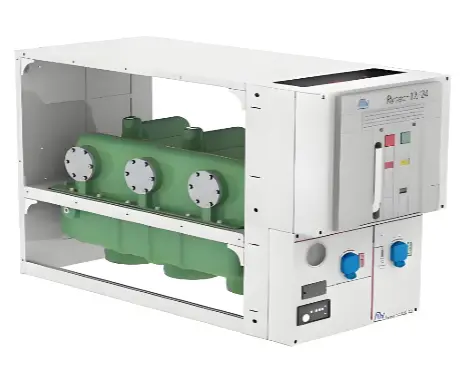
Uses pure air or nitrogen as the insulating medium, completely SF6-free, achieving zero greenhouse gas emissions (GWP = 0). Its compact three-position integrated design significantly reduces cubicle space, with a mechanical life of up to 10,000 maintenance-free operations, fully meeting the green requirements of modern power systems.

iee-business

Compact three position SF6 free/Pure air load break switch 12kV 24kV

2. Vacuum Interrupter Type (VFX Series)

Combines the efficient arc-extinguishing capability of a vacuum interrupter with a three-position disconnector. Operation follows a strict sequence: the vacuum interrupter opens first to extinguish the arc, then the disconnector opens to create a visible gap. This division of labor ensures the interrupter handles only current interruption while the isolating gap bears only voltage, significantly extending electrical life. Ideal for 500 mm wide compact RMUs and applications requiring frequent operation.

Reliable 12kV Indoor Compressed Load Break Switch

3. Classic SF6 Gas Insulated Type

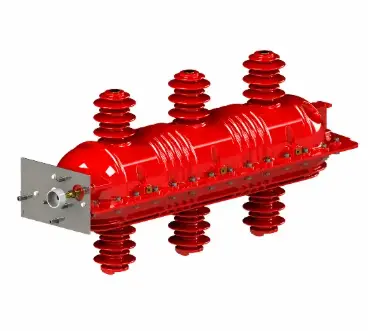
This is the most widely applied and mature solution in Rockwill ring main units. Whether in the C-module (load switch unit) or the F-module (switch-fuse combination), the internal switching element is a standard SF6 three-position load switch, offering excellent insulation and arc-extinguishing performance suitable for various harsh environments.

iee-business

Reliable Indoor SF6 Load Break Switch 36kV

III. Summary and Selection Guide (Rockwill Internal Guidance)

In sales and technical selection, the following principles can be used for customer recommendations:

  • Recommend three-position load switches: For any application involving ring main units, compact substations, or distribution main lines with high supply reliability requirements, priority should be given to Rockwill's Rysec, VFX, or SF6 three-position products. Through high integration, a single device addresses all three requirements — switching, isolation, and earthing — while providing the highest level of safety interlocking. The overall cost-effectiveness and safety far exceed the "standard load switch + external disconnector" combination.
  • Consider standard load switches only when: The customer project is a minimal LV end-of-line branch, a purely emergency bypass, with extreme cost sensitivity and no maintenance isolation requirements. In such cases, Rockwill's basic two-position load switch may be offered as an economy option.

Edited From:Garca

Give a tip and encourage the author!

Comments

Share your question or perspective
WhatsApp
Send inquiry
+86
Click to upload file
Download
Get the IEE Business Application
Use the IEE-Business app to find equipment, obtain solutions, connect with experts, and participate in industry collaboration anytime, anywhere—fully supporting the development of your power projects and business.
Login
or continue with
New here?
Register








