General Rules for GIS Grounding and bonding
In most Gas - Insulated Switchgears (GIS), there are two grounding grids:
The station grounding grid, which is analogous to that in a typical Air - Insulated Switchgear (AIS) installation.
The GIS grounding mesh, a closely - spaced grounding grid embedded in the concrete slab where the GIS is installed.
Typical rules for GIS grounding and bonding are as follows:
All grounding conductors should be kept as short as feasible.
The grounding mesh and its interconnections must be able to carry the system's fault currents.
All exposed grounding conductors should be safeguarded against mechanical damage.
At all discontinuities within the GIS, appropriate grounding and bonding techniques, such as using multiple conductors or voltage limiters, must be employed.
Ensure that all metallic building components, GIS support structures, and GIS maintenance platforms are properly grounded.
Reinforcement steel in the building floor should be linked to the GIS grounding mesh to further balance ground potentials.
All secondary cables should be shielded, with both ends of each cable shield grounded to reduce potential electromagnetic interference.
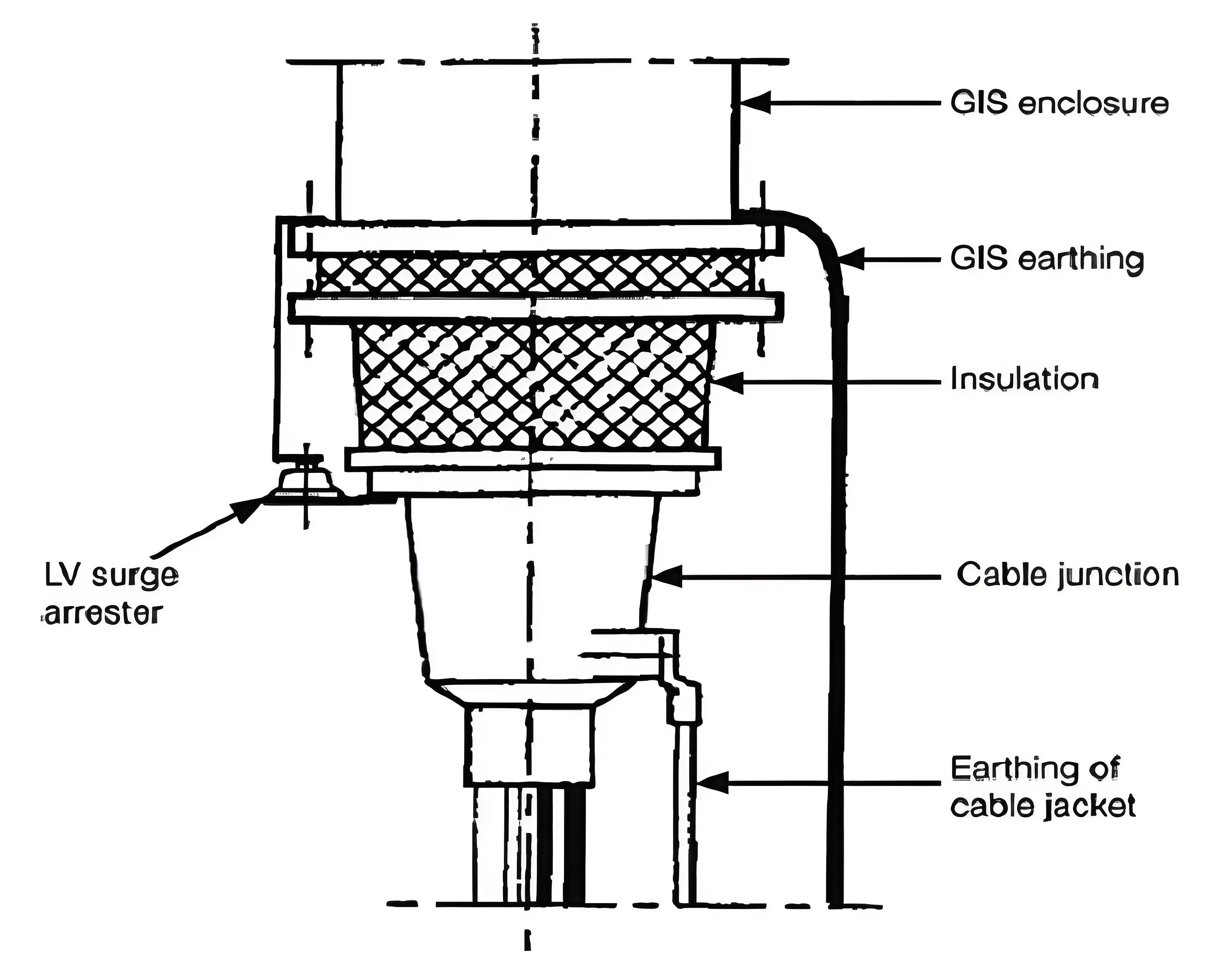
The picture depicts the insulation connection between the metal enclosure of a GIS and the metal part of the cable via nonlinear resistors.

 Login