• Product
  • Suppliers
  • Manufacturers
  • Solutions
  • Free tools
  • Knowledges
  • Experts
  • Communities
Search


What Are Combined Transformer Standards? Key Specs & Tests

Edwiin
Edwiin
Field: Power switch
China

Combined Instrument Transformers: Technical Requirements and Testing Standards Explained with Data

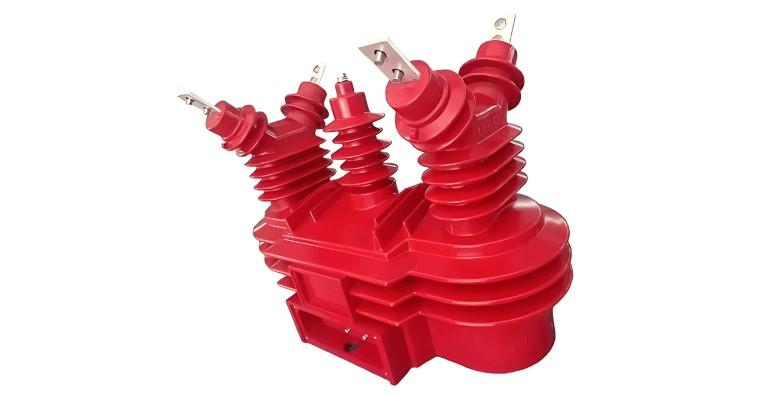
A combined instrument transformer integrates a voltage transformer (VT) and a current transformer (CT) into a single unit. Its design and performance are governed by comprehensive standards covering technical specifications, testing procedures, and operational reliability.

1. Technical Requirements

Rated Voltage:
The primary rated voltages include 3kV, 6kV, 10kV, and 35kV, among others. The secondary voltage is typically standardized at 100V or 100/√3 V. For example, in a 10kV system, the primary rated voltage of the combined transformer is 10kV, while the secondary output is 100V—meeting both measurement and protection requirements.

Rated Current Ratio:
The CT section offers various rated current ratios such as 50/5, 100/5, and 200/5. These ratios can be selected based on actual system current levels to accurately transform primary current to the secondary side (typically 5A), ensuring precise monitoring and relay protection operation.

2. Testing Standards

Insulation Tests:
These verify the dielectric strength of the transformer under normal and transient overvoltage conditions.

  • Power Frequency Withstand Test:
    For a 10kV combined transformer, the test voltage is typically 42kV RMS, applied for 1 minute. This ensures the insulation can withstand sustained power-frequency overvoltages during service.

  • Impulse Withstand Test:
    The peak impulse voltage is generally 75kV, simulating lightning surge conditions. This test evaluates the transformer’s ability to endure transient overvoltages without breakdown.

Accuracy (Error) Tests:
Strict error limits are defined based on accuracy classes.
CT VT.jpg

  • Voltage Transformer (0.2 Class):
    At rated voltage, the ratio error must not exceed ±0.2%, and the phase angle error must be within ±10 minutes (′).

  • Current Transformer (0.2S Class):
    Over a wide range from 1% to 120% of rated current, the ratio error remains within approximately ±0.2%, with tightly controlled phase angle error. This high accuracy is essential for metering applications, especially under low-load conditions.

Temperature Rise Test:
This test ensures safe long-term operation under full load.

  • Conducted at rated load and specified ambient temperature (usually 40°C), the average winding temperature rise must not exceed 65K. This limit prevents insulation degradation and ensures reliable performance over the transformer’s service life.

Summary

Combined instrument transformers are engineered to meet rigorous international standards (such as IEC 61869 series and GB/T 20840). Their technical parameters—like 10kV primary voltage, 100V secondary output, and 100/5 current ratio—are selected based on system requirements. Compliance with tests including 42kV power frequency, 75kV impulse withstand, ±0.2% accuracy, and 65K temperature rise guarantees safety, precision, and durability in power systems.
Give a tip and encourage the author!
Recommended
How Voltage Harmonics Affect H59 Distribution Transformer Heating?
The Impact of Voltage Harmonics on Temperature Rise in H59 Distribution TransformersH59 distribution transformers are among the most critical equipment in power systems, primarily functioning to convert high-voltage electricity from the power grid into low-voltage electricity required by end users. However, power systems contain numerous nonlinear loads and sources, which introduce voltage harmonics that adversely affect the operation of H59 distribution transformers. This article will discuss i
Echo
12/08/2025
What Is an H61 Distribution Transformer? Uses & Setup
H61 distribution transformers refer to transformers used in power distribution systems. In a distribution system, high-voltage electricity must be converted into low-voltage electricity via transformers to supply electrical equipment in residential, commercial, and industrial facilities. The H61 distribution transformer is a type of infrastructure equipment primarily used in the following scenarios: Supplying power from high-voltage grids to low-voltage grids: During power delivery, high-voltage
James
12/08/2025
How to Diagnose Faults in H59 Distribution Transformers by Listening to Their Sounds
In recent years, the accident rate of H59 distribution transformers has shown an upward trend. This article analyzes the causes of failures in H59 distribution transformers and proposes a series of preventive measures to ensure their normal operation and provide effective assurance for power supply.H59 distribution transformers play a vital role in power systems. With the continuous expansion of power system scale and the increasing single-unit capacity of transformers, any transformer failure n
Noah
12/08/2025
What lightning protection measures are used for H61 distribution transformers?
What lightning protection measures are used for H61 distribution transformers?A surge arrester should be installed on the high-voltage side of the H61 distribution transformer. According to SDJ7–79 "Technical Code for Design of Overvoltage Protection of Electric Power Equipment," the high-voltage side of an H61 distribution transformer should generally be protected by a surge arrester. The grounding conductor of the arrester, the neutral point on the low-voltage side of the transformer, and the
Felix Spark
12/08/2025
Send inquiry
Download
Get the IEE Business Application
Use the IEE-Business app to find equipment, obtain solutions, connect with experts, and participate in industry collaboration anytime, anywhere—fully supporting the development of your power projects and business.