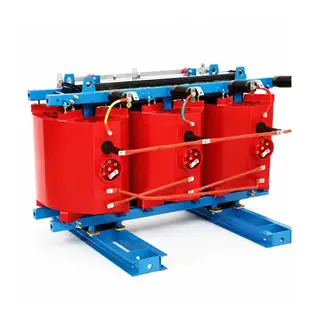
Taking the Vziman 33kV resin-cast dry-type distribution transformer SC(B)10 series as an example — a product that strictly complies with international and national dry-type transformer standards, employs advanced vacuum casting technology, and offers customizable insulation thickness — this series serves as a typical benchmark for understanding the necessity of this process.
1. Bubble Elimination and Partial Discharge Control
Epoxy resin has high viscosity, and under atmospheric pressure casting, it readily entraps air, forming micro-bubbles. Under an electric field, these bubbles become initiation sites for partial discharge (PD), which over time leads to insulation degradation and even breakdown.
The Vacuum Pressure Casting (VPC) process performs resin degassing and casting under a vacuum environment, fundamentally suppressing bubble formation. By virtue of this process, the Vziman SC(B)10 series achieves an exceptionally low partial discharge level of <5 pC, ensuring high dielectric strength of the windings — a foundational prerequisite for its capability to cover medium-to-high voltage levels up to 33kV.
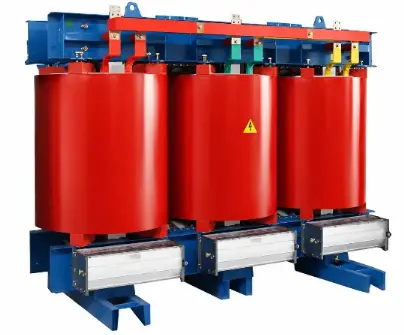
Vziman SC (B) 10 Series Dry-Type Distribution Transformer
2. Ensuring Insulation Integrity
Dry-type transformers lack the liquid insulation medium found in oil-immersed types; the epoxy resin itself serves as the primary insulation. Any internal defects within the casting — such as voids, micro-cracks, or impurity paths — directly compromise the electrical strength.
The VPC process allows the resin to thoroughly impregnate the complex winding structures — including inter-turn, inter-layer, and lead-out sections — under vacuum, followed by pressure compaction to ensure complete filling of all gaps. The SC(B)10 series employs Class F insulation (with an average winding temperature rise ≤100K), and its insulation reliability is fundamentally built upon this defect-free casting body.
3. Enhanced Mechanical Strength and Short-Circuit Withstand Capability
A defect-free cast body exhibits higher mechanical cohesion. On this basis, the SC(B)10 series further reinforces the outer layer of the windings with glass-fiber prepreg, forming a robust composite insulation structure. Under sudden short-circuit conditions, the windings withstand enormous electromagnetic dynamic forces without deformation — a capability stemming both from the highly dense casting achieved via VPC and the strong constraint provided by the glass-fiber reinforcement.
4. Extreme Environmental Adaptability
The dense vacuum-cast structure not only delivers excellent electrical performance but also endows the transformer with outstanding environmental resilience. The SC(B)10 series achieves C2 class climatic tolerance and E2 class environmental tolerance, offering moisture-proof, dust-proof, and corrosion-resistant characteristics. It operates reliably in humid or heavily polluted environments with minimal maintenance requirements — a property fundamentally dependent on the void-free and crack-free dense casting structure.
5. Low Losses and Acoustic Optimization
By eliminating internal voids, the VPC process ensures a continuous thermal conduction path and more uniform heat dissipation within the windings, effectively mitigating local hot spots. This underpins the SC(B)10 series' excellent performance in both no-load and load losses. Additionally, the dense cast body, combined with an optimized winding fastening structure, effectively reduces electromagnetic vibration noise during operation, meeting the acoustic environmental requirements of modern buildings.
6. Process Sequence
7. Comparison: Vacuum Pressure Casting vs. Atmospheric Casting
| Parameter |
Atmospheric Casting |
Vacuum Pressure Casting (SC(B)10 Series) |
| Void Content |
High, difficult to avoid |
Extremely low |
| Partial Discharge Level |
>10 pC |
<5 pC |
| Insulation Class Reliability |
High variability |
Class F, temp. rise ≤100K |
| Applicable Voltage Level |
Low voltage (≤1 kV) |
Medium-high voltage up to 33 kV |
| Climate/Environmental Tolerance |
General |
C2 / E2 class |
| Mechanical Strength |
General |
Glass-fiber reinforced, short-circuit proof |
Conclusion
Vacuum pressure casting is the critical process guarantee for achieving high insulation reliability, low partial discharge, and an extended service life in dry-type transformers. The Vziman 33kV dry-type transformer SC(B)10 series, as a typical application of this process, features a three-phase 50Hz design, Class F insulation, extremely low PD below 5 pC, and C2/E2 class environmental tolerance. It is ideally suited for high-reliability applications such as direct power supply at load centers and optimized distribution network architectures.
Edited From:Echo

 Login