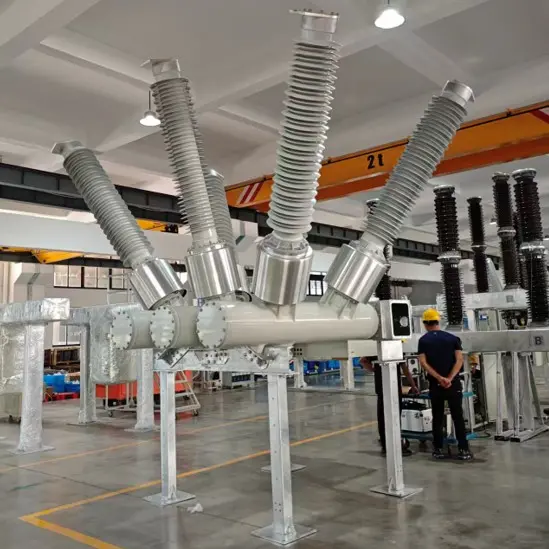
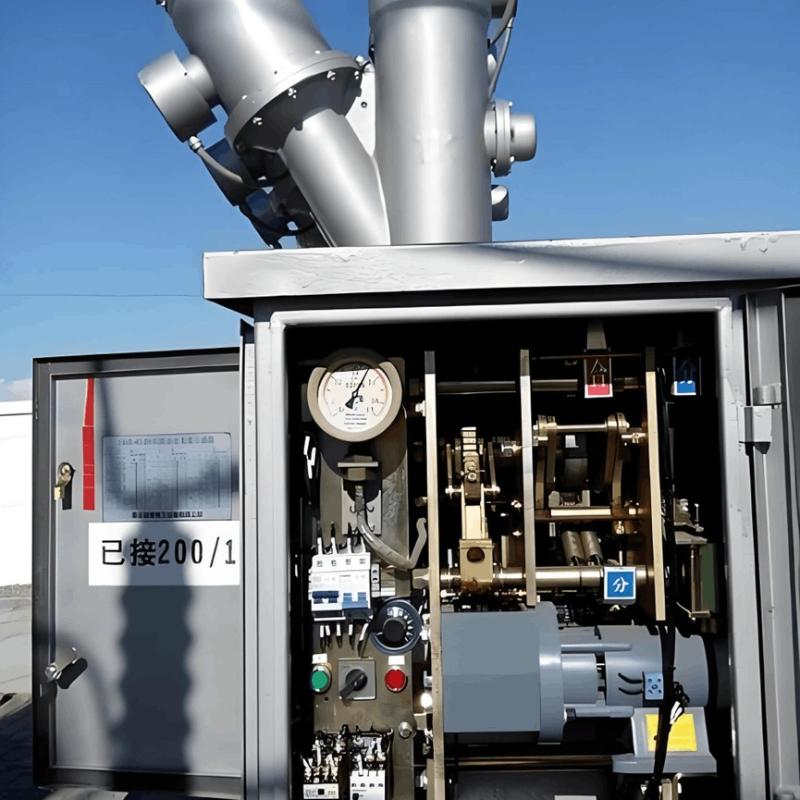
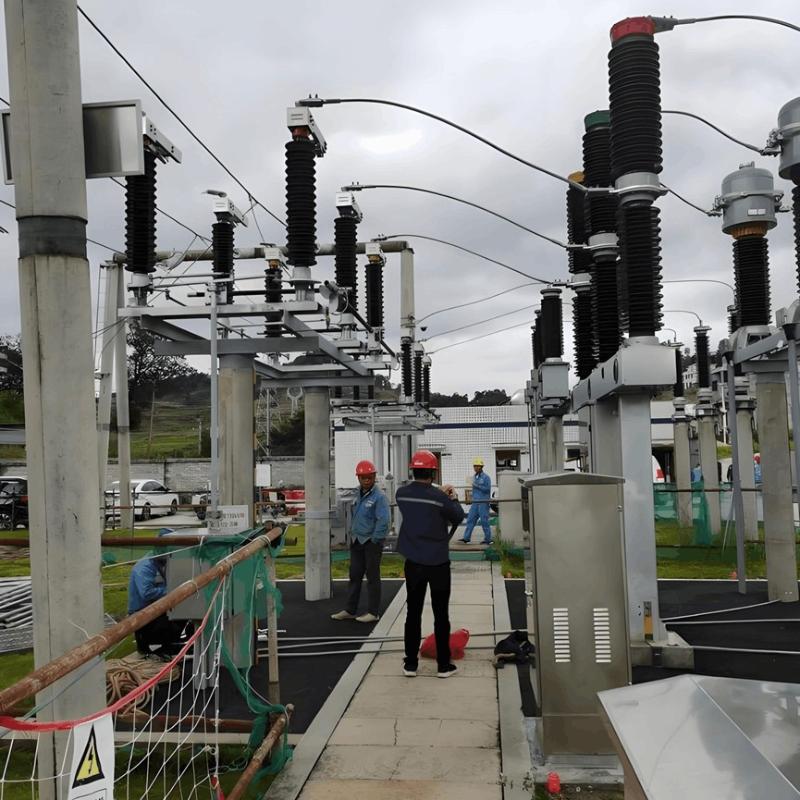
The 72.5kV dead tank vacuum circuit breaker houses the vacuum interrupter within a grounded metal enclosure. Its built-in instrument transformers—typically of the bushing-type—offer significant comprehensive advantages over conventional porcelain-clad circuit breakers.
The core advantages of the built-in transformer design are analyzed below:
1. Compact Structure and Space Optimization
-
No independent foundation required: The built-in transformers are directly mounted on the circuit breaker's outgoing bushing sleeves, eliminating the need for separate concrete foundations, support structures, and additional installation space typically required for porcelain-clad breakers.
-
Reduced footprint: By integrating the circuit breaker and instrument transformers into a single unit, the bay width of the substation can be substantially reduced—particularly advantageous for urban substations with limited land availability or containerized mobile substations.
-
Lower project costs: Savings are achieved through reduced foundation work, minimized primary conductor connections, and shortened secondary cabling runs, thereby lowering overall construction expenditures.
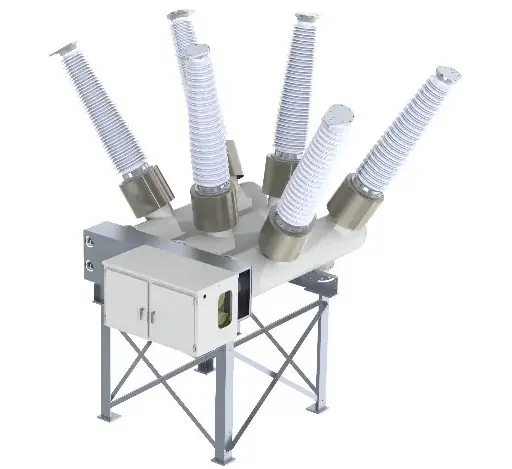
Rockwill RVD Series Dead Tank Vacuum Circuit Breakers
2. Superior Power Protection Performance
-
Elimination of protection dead zones: The dead tank configuration typically arranges built-in transformers on both sides of the vacuum interrupter, ensuring that the protection zone covers the circuit breaker itself with no blind spots. In the event of a flashover within the bushing or internal components, the protection system responds instantly and initiates tripping.
-
High immunity to electromagnetic interference: The transformers are positioned near or within the grounded metal tank, providing excellent shielding effects. Secondary signals are therefore less susceptible to external high-voltage electric field disturbances.
3. High Reliability and Environmental Adaptability
-
Outstanding seismic performance: The dead tank circuit breaker features a low center of gravity, and the built-in transformers are rigidly connected to the main structure, ensuring exceptional overall stability capable of withstanding high-intensity seismic loads.
-
Enhanced resistance to pollution and climatic conditions: The transformers are protected by the metal enclosure or the lower portion of the bushings, shielding them from direct exposure to sunlight, rain, snow, or salt spray. This significantly slows insulation aging and extends maintenance intervals.
-
Simplified transport and installation: The circuit breaker and transformers are fully assembled and tested at the factory, then shipped as an integrated unit. On-site installation requires only minor bushing repositioning and connection work.
4. Safety and Environmental Sustainability
-
Enhanced safety with a low-center-of-gravity design: The grounded tank structure ensures that operation and maintenance personnel are not required to come into contact with the live outer casing of the transformers during inspections.
-
Eco-friendly trend: At the 72.5kV level, the combination of vacuum interruption and built-in transformers is typically paired with clean dry air or nitrogen insulation, entirely eliminating the greenhouse gas emission risks associated with SF₆ and avoiding the need for pressure monitoring related to transformer gas leakage.
Visual Illustration: Layout of built-in instrument transformers in tank-type circuit breakers.
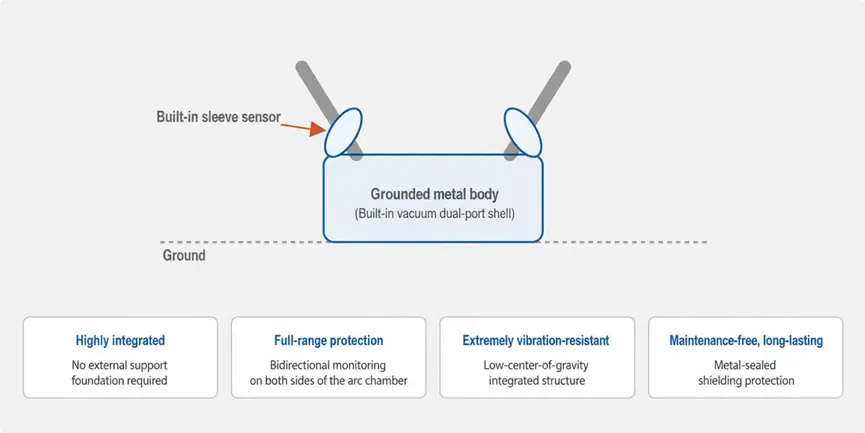
Conclusion: The foremost advantage of built-in instrument transformers in 72.5kV tank-type vacuum circuit breakers lies in the optimal balance between cost efficiency and safety and reliability. Not only does this design reduce land usage and civil works for significant cost savings, but it also achieves dead-angle-free power protection through dual-side transformer placement, making it an ideal solution for compact, intelligent substation development.
Rockwill Dead Tank Vacuum Circuit Breakers (RVD Series) are built upon advanced core technologies and mature mass-production experience. Featuring vacuum interrupter switching and dry-air insulation, the interruption process produces no gas decomposition, ensuring high reliability. The product adheres to green design principles (3R criteria and LS standards) while optimizing total life-cycle costs. With excellent arc-quenching performance and robust impulse withstand capability, it adapts well to complex grid conditions. Moreover, the vacuum interrupter unit requires no routine maintenance, significantly reducing operational expenditures.
Edited From:Garca

 Login
Login