• Product
  • Suppliers
  • Manufacturers
  • Solutions
  • Free tools
  • Knowledges
  • Experts
  • Communities
Search


Free Expert Guides on Power Systems, Circuit Design & Electrical Troubleshooting

Access free engineering resources from IEE Business—covering power design, circuit layout, equipment selection, and troubleshooting. Expert-developed guides help engineers, procurement, and project teams make better decisions. Stay ahead on smart grids, renewables, efficiency, and AI tools. Improve reliability, reduce downtime, and enhance outcomes with real-world solutions. Explore our knowledge hub today.
Out of phase current switching in High Voltage Circuit Breakers
When two parts of an electrical network with the same operating voltage are coupled, a phase displacement switching phenomenon occurs if their equivalent sources have different phase angles, with some or all phases being 180° out of phase. During the switching operation, the circuit breaker encounters source voltages with differing phase angles, leading to the presence of phase-displaced currents in the connection. These currents must be reliably interrupted by the circuit breakers on bo
12/07/2024
Consult
Tip
Consult
Tip
Contact Nozzle Ablation in high voltage sf6 circuit breaker
Inspection and Maintenance of High-Voltage SF6 Circuit Breaker Nozzles1.Background and Traditional Inspection MethodsHigh-voltage SF6 circuit breakers are widely used in power systems to protect circuits from short circuits and overloads. To ensure their reliability and safety, manufacturers typically require periodic disassembly and visual inspection of the main contacts, arc contacts, and gas nozzles. These inspections aim to assess the wear condition of these components and determine whether
12/06/2024
Consult
Tip
Consult
Tip
Brief History of the Past and Present of High voltage Vacuum Circuit Breakers
High Voltage Vacuum Circuit Breakers: An OverviewIntroductionHigh voltage vacuum circuit breakers (HV VCBs) have emerged as a viable alternative to traditional SF6 gas-insulated circuit breakers, particularly in applications where frequent switching and lower maintenance costs are critical. Since 2014, HV VCBs have been increasingly adopted as an alternative to high-voltage gas circuit breakers, offering a greener and more sustainable solution by eliminating the use of SF6, a potent greenhouse g
12/05/2024
Consult
Tip
Consult
Tip
Phenomena created during switching of no-load transformers by AIS high voltage disconnect switch
Introduction to High-Voltage Isolators Difference Between High-Voltage Circuit Breakers and Earthing SwitchesHigh-Voltage Circuit Breaker (Circuit Breaker) and Earthing Switch are two different mechanical switching devices, each playing a crucial role in power systems. High-Voltage Circuit Breaker: It is primarily used to indicate whether a circuit is open or closed. The circuit breaker has the capability to interrupt current, allowing it to cut off large currents under live conditions and maint
12/04/2024
Consult
Tip
Consult
Tip
What makes an MCB unsuitable for a load with a high inrush current?
The MCB (Miniature Circuit Breaker) is not suitable for loads with high surge currents, mainly due to its design characteristics and protection mechanisms. Here's a detailed explanation:The protective characteristics of MCBMCB is mainly used to provide overload and short circuit protection, and its protection characteristics are usually divided into four types: A, B, C and D, each corresponding to a different peak current bearing capacity. Feature A: Suitable for lower peak currents (typically 2
12/03/2024
Consult
Tip
Consult
Tip
Important points for SF6 gas leakage on-site test for high voltage switchgear
SF6 Gas Leakage Testing on SitePurposeSF6 gas leakage testing is conducted to ensure that there are no gas leaks at the field-assembled joints of Gas-Insulated Switchgear (GIS). Leaks can occur during field assembly due to various factors such as damaged sealing surfaces, improper placement, incorrect application of seals, seal damage or omission, improper application of lubricants and sealants, misalignment or inadequate tightening of mating surfaces, and contamination.Scope Exclusions: There i
12/03/2024
Consult
Tip
Consult
Tip
Description of the basic phenomena during circuit breaker switching in grids
Circuit breaker switching terminology can be understood by considering an actual event.Figures 1 to 3 show the trace of a close-open (CO) three-phase unearthed fault current test on a vacuum circuit breaker (trace courtesy of KEMA).Taking each figure in turn, the terminology is as follows:Circuit Breaker Tripping Sequence and Related QuantitiesFrom Figure 1, we can observe the following sequence of events in detail:1.Initial State: The circuit breaker starts in the open position. A closing signa
12/03/2024
Consult
Tip
Consult
Tip
What is the difference between an electromagnetic release and a thermal release in a circuit breaker?
Differences Between Magnetic Trip Units and Thermomagnetic Trip Units in Circuit BreakersIn circuit breakers, magnetic trip units (Magnetic Trip Unit) and thermomagnetic trip units (Thermomagnetic Trip Unit) are two different protection mechanisms that detect and respond to overcurrent conditions in distinct ways. Below are the main differences between them:1. Working PrincipleMagnetic Trip UnitWorking Principle: A magnetic trip unit detects short circuits or instantaneous high currents through
11/30/2024
Consult
Tip
Consult
Tip
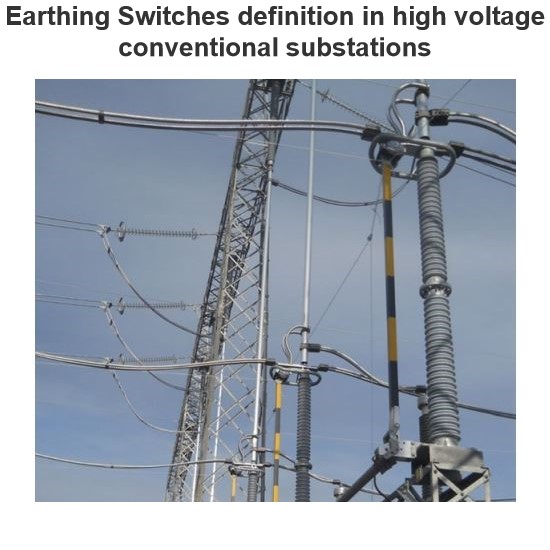
Earthing Switches definition in high voltage conventional substations
Overview of Grounding SwitchesA grounding switch is a mechanical device specifically designed to safely connect a circuit to earth (ground). It is capable of withstanding fault currents for a certain period during short circuits or other abnormal conditions, while not carrying load current during normal operation. Therefore, grounding switches play a crucial role in power systems by ensuring the safety of personnel and equipment.Key FunctionsGrounding switches should be able to perform the follo
11/30/2024
Consult
Tip
Consult
Tip
What is the difference between traditional and digital switchgear?
Traditional switchgear and digital switchgear differ significantly in terms of design, functionality, and application. Understanding these differences can help determine which type of switchgear is better suited for specific industrial needs. Below are the main distinctions between traditional and digital switchgear, along with their respective advantages and applicable scenarios:Traditional SwitchgearCharacteristics: Mechanical Structure: Primarily relies on physical components such as mechanic
11/29/2024
Consult
Tip
Consult
Tip
Send inquiry
+86
Click to upload file
Download
Get the IEE Business Application
Use the IEE-Business app to find equipment, obtain solutions, connect with experts, and participate in industry collaboration anytime, anywhere—fully supporting the development of your power projects and business.